

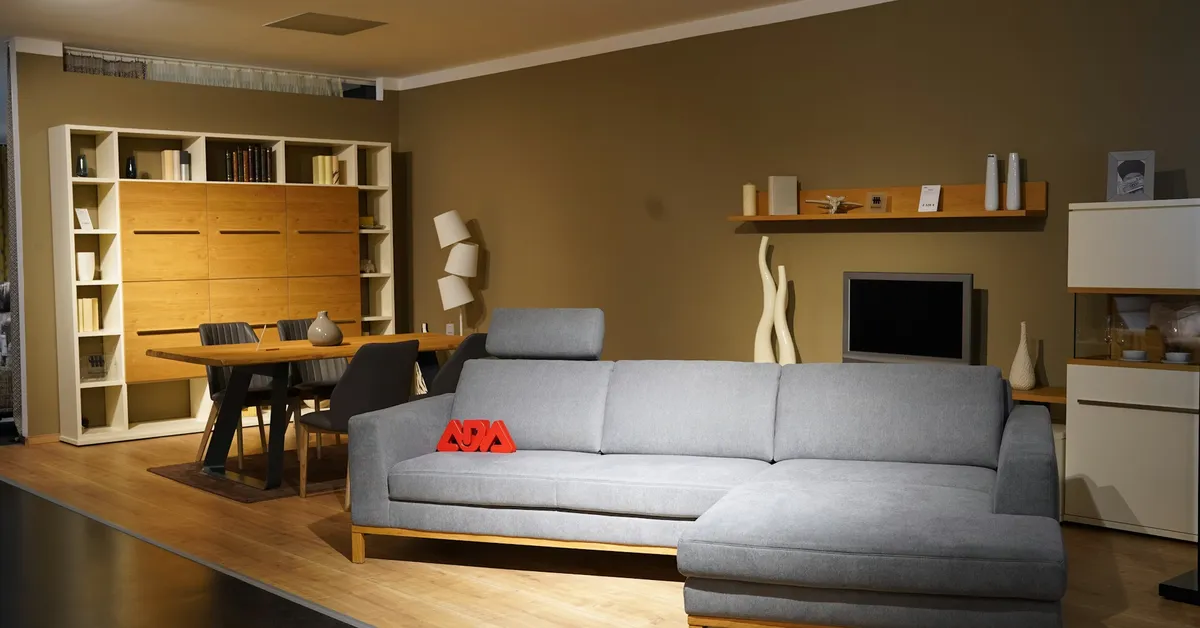
There’s a particular kind of buyer’s remorse that furniture shopping specializes in. You stand in the showroom, the lighting is warm and flattering, the sectional looks enormous and perfect, and you think: yes, that’s the one. Six weeks later it arrives, and you realize your living room is not a showroom. The proportions are wrong. The color reads differently under your ceiling fixture. The thing you imagined anchoring your space is instead eating it alive.
This has been the furniture industry’s dirty little secret for decades that the purchase happens in one environment and the consequences land in another. Augmented reality is the first technology that has seriously tried to close that gap.
What AR Actually Does (and Doesn’t Do)
The basic mechanic sounds almost too simple: you open an app, point your phone camera at your floor, and a rendered version of a sofa appears in your room. You can walk around it. You can swap the upholstery. You can check whether it clears the coffee table. IKEA Place, Wayfair’s View in Room 3D, and similar tools from West Elm and Pottery Barn have made this experience genuinely accessible no headset required, no technical expertise assumed.
But calling it “seeing your new chair in your old room” is still a partial truth. What you’re seeing is a 3D model, rendered in real time, overlaid on a live camera feed. The model’s quality varies enormously between retailers. Some are built from photogrammetry actual scans of the physical object and they’re remarkably accurate in texture, shadow behavior, and dimensional fidelity. Others are generic approximations that look convincing in screenshots and slightly off in motion. The difference matters more than most shoppers realize.
The technology is also dependent on your phone’s LiDAR capability and the ambient lighting in your room. An iPhone 12 Pro or later has a depth-sensing chip that allows the AR layer to understand the actual geometry of your floor, walls, and existing furniture. Without it, the virtual object floats rather than sits it doesn’t cast shadows that match your light source, and it doesn’t properly occlude when you move behind it. That floating quality is subtle but persistent, and it’s what makes some people dismiss the experience as a gimmick before they’ve given it a real chance.
The Measurement Problem Nobody Talks About Enough
Here’s where the practical value becomes undeniable: scale. The single most common furniture mistake isn’t about color or style it’s about size. People consistently misjudge how large or small a piece will feel in their actual space. Showrooms use scale tricks. Online dimensions are just numbers until you imagine them wrong.
AR solves this with something close to brute clarity. When you place a virtual dining table in your dining room and realize you can’t open the china cabinet without moving it, that’s not a styling insight that’s a functional revelation. When the loveseat you thought was modest takes up the entire reading corner, the app has just saved you from a mistake that would have cost you real money and real frustration.
The smarter apps now integrate room-measurement tools directly. You can map your room’s dimensions before you start browsing, and the system will flag pieces that exceed your spatial parameters. Wayfair’s platform has pushed this further, building a feature that lets you save your room layout and return to it across sessions so you’re not starting from scratch every time you want to try a different piece.
The Psychology of Seeing It There
There’s something worth examining in why AR works as persuasion, not just as utility. Retailers know it. The conversion rates from AR-assisted browsing are measurably higher than standard product page views in some cases, return rates drop by thirty percent or more when customers have used AR before purchasing.
The reason isn’t purely practical. It’s psychological. The moment a piece of furniture appears in your actual room, your brain begins to own it. You start making space for it emotionally. You imagine sitting in it. You notice how the light hits the fabric at 4pm, because you’re literally seeing it hit the fabric at 4pm. The cognitive leap from “product I’m considering” to “thing that belongs in my home” collapses in a way that no amount of high-resolution photography can replicate.
This is also where a certain critical awareness is worth maintaining. The experience is designed to lower resistance, and it does so effectively. A well-lit, beautifully modeled chair placed in your room by an AR app is still a rendered object. It doesn’t carry weight, age, or smell. The texture you’re reading on screen is a material approximation. The color, while significantly more accurate than a product photo, is still filtered through your phone’s camera calibration and your room’s specific light conditions. AR narrows the gap between imagination and reality it doesn’t eliminate it.
How to Actually Use These Tools Well
The people who get the most out of furniture AR are the ones who use it as a filtering tool rather than a final answer. The workflow that makes sense: browse normally, narrow your options to two or three candidates, then use AR to eliminate rather than to confirm.
Elimination is the key word. If a sofa looks wrong in AR too bulky, wrong undertone in your light, awkward against your existing rug trust that. The technology is good enough to surface genuine incompatibilities. What it’s less reliable for is surfacing genuine rightness. “This looks fine in AR” is a weaker signal than “this looks clearly wrong.”
It also helps to try pieces at different times of day. A fabric that looks warm and inviting in morning light might feel heavy and dark by evening. Since you’re pointing your phone at your actual room, the lighting in the AR view changes with your room’s actual lighting. Use that. A few minutes in the morning, a few minutes after sunset with your lamps on you’ll learn more about whether a piece fits your life than you would from an hour on a showroom floor.
For rooms with complex existing palettes lots of pattern, mixed wood tones, competing textures AR is especially valuable because it forces you to see the new piece in honest relationship with what’s already there. Showrooms stage furniture against neutral backdrops by design. Your home is not neutral. It has personality and history and the particular chaos of being actually lived in.
Where the Technology Is Heading
The current generation of AR furniture tools is impressive but still first-generation in important ways. The 3D models, even the good ones, don’t yet capture the way fabric compresses under weight, or how a wooden surface develops a patina over years, or how a chair’s cushion actually feels when you’ve been sitting in it for two hours.
What’s coming and already visible in early implementations from companies like Houzz and in Apple’s broader Vision Pro ambitions is spatial computing that treats your home as a persistent, mapped environment rather than a fresh camera feed each session. Imagine an AR layer that knows your room the way a floor plan knows it: permanently, accurately, with every outlet and window and radiator accounted for. You browse furniture the way you browse a menu at a restaurant knowing exactly what you’re ordering into, with no ambiguity about fit.
There are also early experiments with AI-assisted styling layered on top of AR placement systems that don’t just show you where a piece goes, but suggest what else might work alongside it, based on what’s already in your room. Whether that becomes genuinely useful or merely another recommendation engine dressed in spatial clothing remains to be seen.
For now, though, the tool that exists is already meaningfully better than the imagination it replaces. The chair you’re considering is not a photograph on a white background. It’s not a number on a spec sheet. Point your phone at the corner where it might live, and at least some version of the truth will appear.