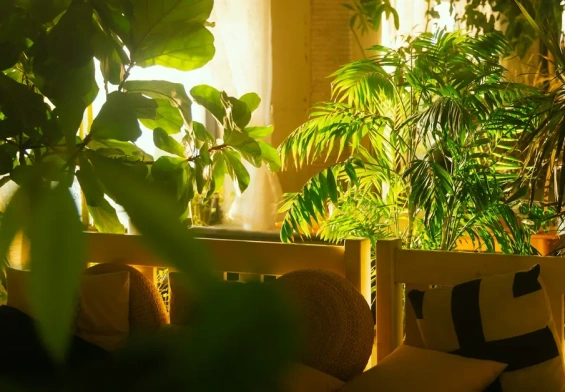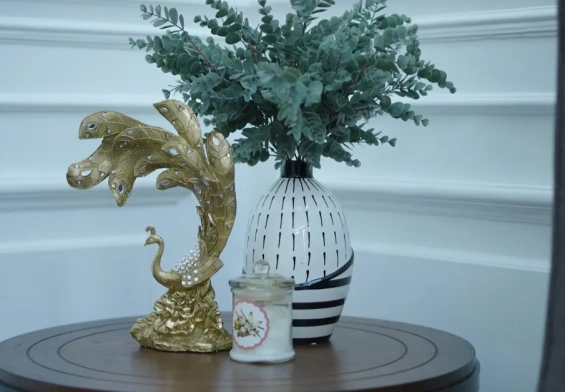


There’s a moment most people recognize but rarely name. You walk into a room flooded with natural light, maybe there’s a potted fig tree in the corner, the air carries a faint green scent, and something in your chest quietly loosens. It’s not dramatic. It doesn’t announce itself. But something shifts a low hum of tension you didn’t even know you were carrying simply dissolves. That moment is biophilic design doing exactly what it was always meant to do.
The word “biophilia” was popularized by the biologist E.O. Wilson in 1984, though the instinct it describes is far older than any scientific vocabulary. Wilson argued that humans carry an innate, genetically encoded affinity for living systems and natural processes that our nervous systems evolved over hundreds of thousands of years in intimate relationship with the natural world, and that severing that relationship doesn’t just make us uncomfortable. It makes us unwell.
The Science Underneath the Aesthetic
Biophilic design isn’t a decorating trend dressed up in academic language. The research behind it is surprisingly robust. Studies conducted across hospitals, schools, offices, and residential spaces consistently show that exposure to natural elements whether genuine or carefully simulated produces measurable physiological responses. Blood pressure drops. Cortisol levels fall. Attention restores itself after periods of cognitive fatigue in ways that staring at a blank wall simply cannot replicate.
One of the most cited studies in this field came from environmental psychologist Roger Ulrich in 1984, the same year Wilson published his biophilia hypothesis. Ulrich examined hospital patients recovering from gallbladder surgery. One group had a window view of a brick wall. The other looked out at a small stand of trees. The tree-view patients required fewer pain medications, had shorter hospital stays, and received fewer negative notes from nurses. The variable was a window. The outcome was clinical.
This is the part that tends to surprise people who encounter biophilic design for the first time as an interior design concept. They expect it to be about aesthetics and it is, partly. But underneath the beauty lies a genuine biological mechanism. The human visual system is calibrated to find fractal patterns soothing. Natural fractals the branching of a fern, the veining of a leaf, the ripple pattern of water appear at what mathematicians call a mid-range fractal dimension, roughly between 1.3 and 1.5 on the fractal dimension scale. Research by physicist Richard Taylor found that viewing these patterns reduces physiological stress by up to 60 percent. Our eyes weren’t built for drywall and right angles. They were built for the edge of a forest.
What Biophilic Design Actually Looks Like in Practice
Here is where the concept gets interesting and where a lot of well-intentioned implementations go wrong. Biophilic design is not simply adding a succulent to your desk or hanging a landscape photograph in the hallway. Those gestures aren’t meaningless, but they represent the shallowest layer of a much more layered discipline.
Practitioners typically organize biophilic design into three broad categories of experience: direct nature connection, indirect nature connection, and the experience of space and place.
Direct connection is the most intuitive. It means actual living elements plants, water features, natural light, views of the outdoors, even the presence of animals. A living wall covered in ferns and moss isn’t just visually striking; it actively improves air quality, regulates humidity, and introduces a subtle biological dynamism into a space. The plants grow. They change with the seasons. They respond to light. That aliveness matters in ways that are difficult to quantify but easy to feel.
Indirect connection works through materials, textures, patterns, and imagery that reference nature without being nature itself. Wood grain, stone surfaces, linen textiles, the sound of a water feature, natural color palettes drawn from earth and sky these elements work on the nervous system through association and sensory memory. A reclaimed oak floor doesn’t photosynthesize, but it carries the visual and tactile language of living systems. The brain reads it accordingly.
The third category space and place is perhaps the most sophisticated and the least discussed. It refers to the way spatial configuration itself can mirror experiences we find instinctively comforting or stimulating in natural environments. The concept of prospect and refuge, for example, describes our evolved preference for spaces that offer both a wide view and a sheltered enclosure think of a chair positioned with its back to a wall, facing an open room or a window. We seek these arrangements unconsciously. Good biophilic design builds them deliberately.
The Urban Apartment Problem
The honest tension in all of this is that the people who arguably need biophilic design most urgently are often the least positioned to implement it. Urban renters in small apartments, people in climates with long dark winters, anyone without access to outdoor space these are the populations carrying the highest loads of nature deficit, and they’re also working with the fewest square feet and the least architectural flexibility.
But the principles scale down more gracefully than you might expect. Natural light is the single highest-leverage variable in any space, and it costs nothing to maximize. Moving furniture away from windows, choosing lighter window treatments, using mirrors strategically to bounce daylight deeper into a room these are not expensive interventions. Neither is the deliberate choice of materials: a ceramic mug over a plastic one, a linen throw rather than polyester, a wooden cutting board left visible on the counter. The cumulative sensory effect of choosing natural materials throughout a small space is genuinely significant.
Plants remain one of the most accessible tools available, and the research on their psychological impact is more consistent than their reputation for being difficult to keep alive might suggest. Low-light tolerant species like pothos, snake plants, and ZZ plants require almost nothing from their owners while providing the visual complexity and biological presence that the nervous system responds to. A single large plant a monstera, a fiddle-leaf fig, a bird of paradise creates more psychological impact than a dozen small ones scattered around a room, because it reads as a presence rather than a decoration.
When Buildings Start to Breathe
The most ambitious expressions of biophilic design are happening at the architectural scale, and they’re beginning to redefine what people expect from the buildings they inhabit. The Bullitt Center in Seattle, often called the greenest commercial building in the world, incorporates composting toilets, a living roof, and floor-to-ceiling windows calibrated to maximize daylight without heat gain. Amazon’s Spheres in downtown Seattle house over 40,000 plants from more than 400 species inside glass geodesic domes that serve as employee workspaces. Singapore has built biophilic design into its urban planning infrastructure the country’s Housing Development Board has mandated greenery replacement ratios for decades, ensuring that what is built upward is compensated by what grows outward.
These projects make headlines precisely because they’re spectacular. But their underlying logic is the same logic that applies to a single fern on a windowsill: the built environment shapes the people inside it, whether or not those people are conscious of the influence. Architecture has always known this. Biophilic design simply insists that the natural world has to be part of the equation not as ornamentation, but as a fundamental condition of human flourishing.
There’s something quietly radical about that insistence. In a culture that has largely organized its built environments around efficiency, productivity, and the logic of the machine, biophilic design asks a different question. Not what can this space accomplish, but what does this space allow a person to become? What does it feel like to be alive inside it?
The answer, when the design is working, is something most people already know. It feels like that moment when you walk into a room and something in your chest loosens, and you don’t quite know why, and you don’t need to.