
There’s a particular kind of exhaustion that comes not from your day, but from your room. You walk in, drop your bag, and instead of feeling like you’ve arrived somewhere, you feel like you’ve just moved to a different problem. The bed is unmade. The nightstand is a graveyard of half-read books and charging cables. The overhead light is doing something deeply unflatering to everything it touches. You’ve been meaning to fix it for months, maybe years, and somehow the gap between intention and action just keeps widening.
Here’s what most home design content won’t tell you: a bedroom transformation doesn’t require a weekend, a budget, or a trip to a furniture store. It requires about an hour and a willingness to swap not buy, not renovate, not overhaul. Just swap. Five specific, strategic exchanges that change how the room feels without changing what’s fundamentally in it.
Why Swaps Work Better Than Overhauls
The psychology here is worth understanding before you start pulling things off shelves. When we think about “redecorating,” we tend to think in terms of addition new furniture, new art, new everything. But most bedrooms don’t suffer from a lack of stuff. They suffer from the wrong stuff in the wrong place, doing the wrong job.
A swap forces you to work with constraints. You’re not adding chaos to chaos; you’re making a deliberate trade. Something leaves, something better takes its place, and the room breathes a little differently. It’s the same principle behind a good edit in writing: the goal isn’t more words, it’s the right ones.
Swap One: The Bulb You’ve Been Ignoring
If your bedroom has an overhead light and you’ve never thought twice about the bulb inside it, this is your highest-leverage move. Lighting is the single most underestimated variable in how a room feels, and most people are living under the wrong temperature of light without realizing it.
The culprit is usually a cool white or daylight bulb something in the 4000K to 6500K range. These are fine for kitchens and offices. In a bedroom, they create a clinical flatness that makes everything look slightly institutional. Swap them for warm white bulbs in the 2700K to 3000K range, and the room shifts from “waiting room” to “somewhere you actually want to be.”
While you’re at it, consider whether your overhead light should even be your primary source at night. A single lamp on the nightstand, positioned at eye level when you’re lying down, does more for the atmosphere of a bedroom than any overhead fixture ever will. If you already have a lamp but it’s been sitting there unused, plug it in. Make it the light you reach for first.
The whole swap takes ten minutes. The difference is immediate and, honestly, a little embarrassing in the sense that you’ll wonder why you waited so long.
Swap Two: The Pillow Situation
There’s a reason hotel rooms feel the way they do, and it’s not the thread count. It’s the layering. Specifically, it’s the way pillows are arranged to suggest both comfort and intention like someone thought about this, like the bed was made for a person rather than just made.
Most home bedrooms have the opposite problem: too many pillows with no logic, or too few pillows arranged with no thought. The swap here isn’t necessarily buying new pillows (though if yours are flat and sad, that’s worth addressing). It’s rethinking the arrangement.
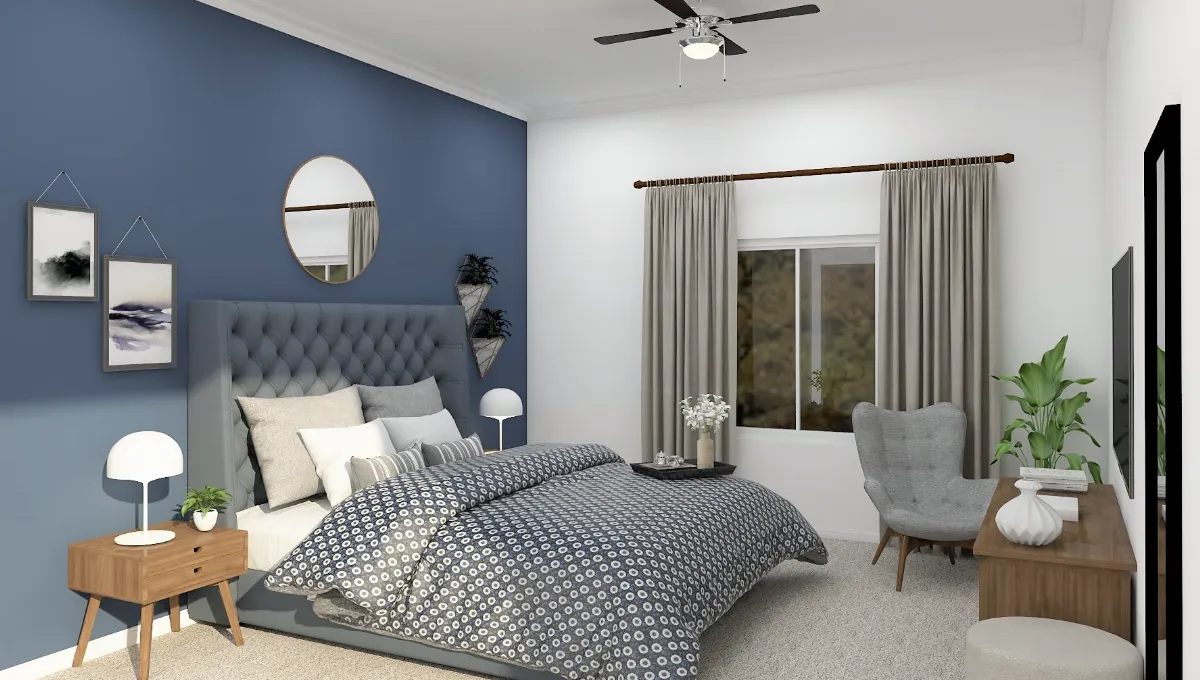
Pull everything off the bed. Start with your sleeping pillows two, standing upright against the headboard. In front of those, add one or two euro shams if you have them, or fold a throw blanket horizontally across the lower third of the bed. That’s it. The goal is layering that reads as intentional, not decorative for decoration’s sake.
If you have a throw blanket living on a chair somewhere in the room, move it to the bed. If you have decorative pillows scattered across the floor or stuffed in a closet, pick two that work together and use only those. Restraint is the whole point. A bed with three well-chosen elements looks more expensive and more considered than a bed drowning in twelve.
Swap Three: The Nightstand Edit
The nightstand is where good intentions go to accumulate. A book you finished three weeks ago. A lip balm. A phone charger that’s become permanently tangled with a hair tie. A glass of water from Tuesday. A candle you’ve never lit.
This swap is less about adding and almost entirely about removing. Clear the surface completely put everything on the floor temporarily and then only return what you actually use in the last thirty minutes before sleep and the first thirty minutes after waking. For most people, that’s a lamp, a phone charger, and one book. Maybe a small plant if you have one nearby. Maybe a candle if you actually light it.
The discipline here is in the “maybe.” Every item you return to that surface should earn its place. The nightstand isn’t storage. It’s the last thing you see before you close your eyes and the first thing you see when you open them. What it holds shapes the texture of those moments more than you’d expect.
Once the surface is edited, take a look at what’s underneath or inside the nightstand if there is one. You don’t have to deal with all of it today. But pulling out the most obvious clutter the things that have no reason to be there takes five minutes and makes the whole piece of furniture feel lighter.
Swap Four: What’s Happening at the Window
Windows are where bedrooms most often reveal their neglect. The curtains are too short, or too thin, or they’re the ones that came with the apartment and you never got around to replacing them. Or there are no curtains at all, just a blind that doesn’t quite close all the way.
The swap here depends on what you’re working with. If you have curtains that are the wrong length meaning they hover awkwardly above the floor instead of grazing or pooling on it the fix is to move the rod higher. Most curtain rods are installed too low, which makes ceilings feel shorter and windows feel smaller. Raising the rod by even four to six inches, and letting the curtains hang from there, changes the entire vertical proportion of the room. You don’t need new curtains. You need a drill and twenty minutes.
If your curtains are fine but your room gets too much morning light, consider swapping them temporarily with a heavier panel from another room, or adding a blackout liner behind what you already have. Sleep quality is directly tied to light exposure in the early morning hours, and a room that lets in full sun at 6 a.m. is quietly undermining your rest regardless of what time you went to bed.
If you have no curtains and bare windows, even a single inexpensive linen panel on each side not for coverage, just for softness changes the acoustic and visual warmth of the room in a way that’s hard to quantify but immediately felt.
Swap Five: One Wall, One Decision
This is the swap people overthink the most, so let’s simplify it. Look at the wall directly across from your bed the one you see when you’re lying down. What’s on it?
If the answer is nothing, that’s not necessarily a problem. A clean wall can feel intentional. But if it feels empty in a way that reads as unfinished rather than minimal, one well-placed mirror or a single piece of art changes that entirely. Not a gallery wall. Not a collection. One thing, hung at the right height (center of the piece at roughly eye level when standing, which is around 57 to 60 inches from the floor), in a frame that doesn’t fight with everything else in the room.
If you already have art on that wall but it’s hung too low, or too high, or slightly croked in a way you’ve been tolerating for years fix it now. A level and a hammer take five minutes. The visual correction is immediate.
Mirrors deserve a specific mention because they double work: they add light by reflecting it, and they add perceived space by extending the visual field. A large mirror leaned against the wall rather than hung is a particularly low-commitment, high-impact move. It looks deliberate without requiring you to put a hole in anything.
The Hour, Accounted For
Bulb swap and lamp repositioning: ten minutes. Bed and pilow rearrangement: fifteen minutes. Nightstand edit: ten minutes. Window adjustment: fifteen minutes. Wall decision: ten minutes. That’s an hour, give or take, and none of it requires a trip to a store if you work with what you already have.
The rooms we live in are in constant conversation with us, whether we’re paying attention or not. A bedroom that feels clutered or dim or unfinished doesn’t just look that way it registers somewhere below conscious thought as a place that doesn’t quite work, a space that hasn’t been tended to. And that registers as something about you, about your life, about whether things are under control.
None of that is true, of course. But the feeling is real. And the antidote, it turns out, is closer than you think usually just a few swaps away.