
7 Awkward Living Room Layouts and Exactly How to Fix Them
There’s a particular kind of frustration that comes from a living room that just doesn’t work. You’ve bought the furniture, arranged it three different ways, maybe even repainted the walls and still, something feels off. The proportions are wrong, or the room swallows conversation, or you can’t figure out why sitting in it never quite feels comfortable. The problem, more often than not, isn’t the furniture. It’s the layout. And layouts are fixable.
Most living rooms that feel awkward are dealing with one of a handful of recurring structural problems. Ceilings too high, walls too wide, doors in all the wrong places. These aren’t design failures so much as architectural realities that nobody warned you about when you signed the lease or closed on the house. The good news is that interior designers have been solving these exact problems for decades, and the solutions are more accessible than you’d think.
The Long, Narrow Room That Feels Like a Hallway
This is probably the most common complaint. You walk in and the room stretches away from you like a corridor, with no obvious center, no natural place to anchor the furniture. Most people make the mistake of pushing everything against the walls two sofas facing each other from opposite ends, a coffee table floating in the middle and the result is a room that looks like a waiting room at a dentist’s office.
The fix is counterintuitive: pull the furniture away from the walls and create two distinct zones within the length of the room. A seating area closer to the entrance, defined by a rug, and a secondary zone a reading nook, a small desk setup, a bar cart moment at the far end. Breaking the room into chapters instead of treating it as one long sentence changes everything. A sofa placed perpendicular to the long wall, rather than parallel to it, does more to solve this problem than almost anything else you can buy.
The Square Room With No Focal Point
Square rooms are deceptively difficult. They feel balanced in theory but end up feeling directionless in practice. Without a natural focal point no fireplace, no dramatic window, no architectural feature to organize the room around the eye doesn’t know where to land, and the furniture ends up arranged in a way that feels arbitrary.
The solution is to create a focal point rather than wait for one to appear. A large piece of art, hung slightly higher than you think looks right, can anchor an entire wall. A media console with intentional styling books, objects, a lamp with presence can do the same. Once you have a focal point, the furniture arrangement becomes obvious: face it. A sofa and two chairs angled toward that wall, a rug underneath to define the conversation area, and suddenly the room has a logic it was missing.
The Room With a Door on Every Wall
Traffic flow is one of the least glamorous aspects of interior design, and also one of the most important. A living room with four doors or even three means that every wall is interrupted, every potential furniture placement is cut off by a pathway, and you’re essentially decorating the space between corridors.
The key here is to map the traffic lanes first, before you move a single piece of furniture. Where do people actually walk? Draw it out if you have to. The furniture then lives in the zones between those lanes, not across them. Floating a sofa in the center of the room, with its back creating a subtle division between the entry path and the seating area, often works better than any wall-adjacent arrangement. Rugs become critical here they define the seating zone even when walls can’t.
The Open-Plan Room That Bleeds Into Everything
Open-plan living sounds ideal until you’re living in it. The living room connects to the dining room connects to the kitchen, and nothing has edges, nothing has definition, and the whole space feels like one large undifferentiated room that can’t quite be any of the things it’s supposed to be.
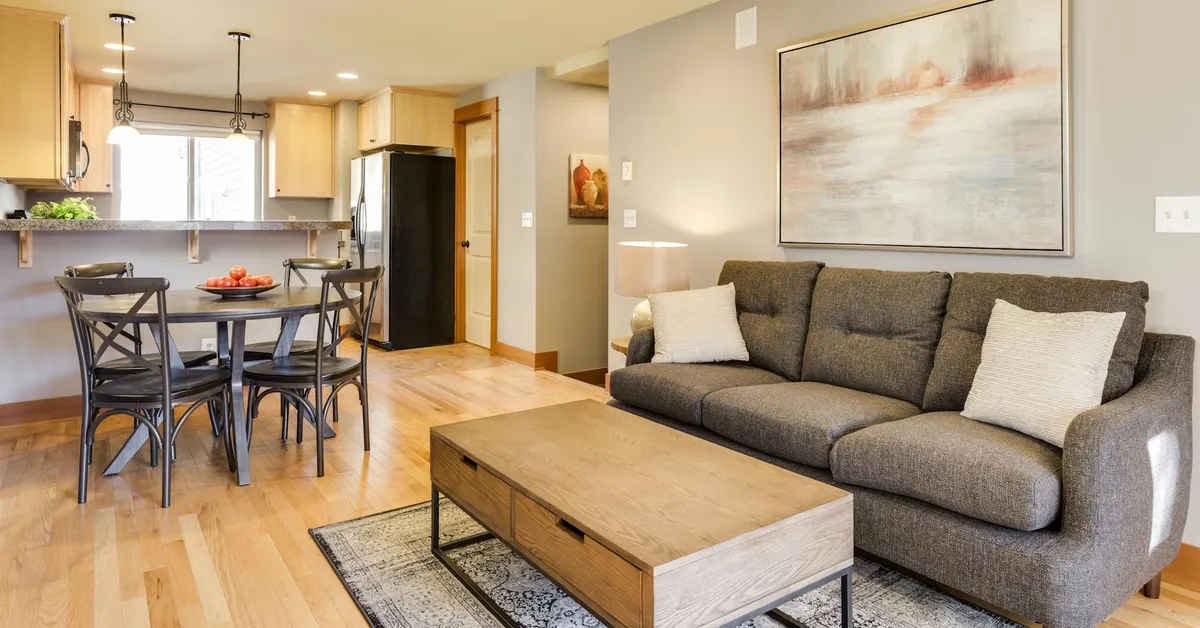
Rugs are doing the heavy lifting in this scenario, but they can’t work alone. Furniture placement needs to be decisive the sofa’s back should face the dining area, creating a psychological boundary even without a wall. Pendant lighting hung low over the dining table pulls that zone into its own identity. A console table placed behind the sofa reinforces the division. The goal isn’t to close off the space but to give each zone enough definition that it feels intentional rather than accidental.
The Room With Ceilings So High They Feel Cold
High ceilings photograph beautifully and feel oppressive to live in. The volume of air above your head creates a disconnect the furniture sits at human scale while the room soars above it, and the result is that sitting in it never quite feels cozy or grounded.
The fix works downward, not upward. Hang curtains from the ceiling but let them pool slightly at the floor the vertical line draws the eye down rather than up. Choose a chandelier or pendant light that hangs low enough to feel present in the room, not lost somewhere near the ceiling. Layer rugs if the floor area allows it. Go darker on the ceiling paint color, which sounds wrong but visually lowers the ceiling to a more human proportion. The room starts to feel inhabited rather than vaulted.
The Awkward Fireplace That’s Off-Center
An off-center fireplace is one of those architectural quirks that can make an otherwise lovely room feel permanently unresolved. You want to arrange furniture around it it’s a fireplace, it demands attention but centering your sofa on it means everything else in the room is crooked relative to the walls.
The answer is to stop fighting the asymmetry and lean into it. Arrange the seating to face the fireplace at a slight angle rather than dead-on, which actually feels more natural in conversation anyway. Use a large piece of art or a mirror on the adjacent wall to create a secondary visual anchor that balances the room without competing with the fireplace. Asymmetrical rooms can feel dynamic and interesting rather than wrong it’s a matter of committing to the geometry rather than apologizing for it.
The Small Room Stuffed With Too Much Furniture
The impulse when decorating a small living room is to fill it to prove that it can hold a full sofa, two armchairs, a coffee table, side tables, and a media console. It can’t, not without feeling claustrophobic. But the solution isn’t simply to remove furniture. It’s to reconsider what the room actually needs to do.
One large, well-proportioned sofa beats two mismatched pieces every time. A single armchair placed at an angle creates more visual interest than two chairs that crowd the space. Leggy furniture pieces raised on visible legs rather than pieces that sit directly on the floor lets light pass underneath and makes the room feel larger than it is. Mirrors, placed to reflect natural light, expand the sense of space without adding any physical volume. The small room that works is the one that’s been edited ruthlessly, where every piece earns its place not just by being useful but by not getting in the way.
Living rooms are where we actually live where we collapse after long days, where we talk to people we love, where we spend the quiet hours. When the layout is wrong, all of that feels harder than it should. When it’s right, the room disappears into the background the way good design always does, and what’s left is just the life happening inside it.