
There’s a particular kind of frustration that comes with a small outdoor space. You stand at the back door, coffee in hand, and the math just doesn’t seem to work a few square feet of concrete or decking, hemed in by fences or walls, and a mental catalog of everything you wish you could fit out there. A dining table. A lounge chair. Maybe a little fire. The instinct is usually to scale everything down, to buy the smallest furniture and leave the rest empty. But that instinct is almost always wrong.
The spaces that feel genuinely expansive the boutique hotel terraces, the urban rooftop bars, the tiny Parisian balconies that somehow feel like a whole world don’t achieve that feeling through restraint alone. They achieve it through intention. Every element is doing more than one job. Every decision is made with the eye in mind, not just the tape measure. What follows are seven ideas that work precisely because they understand that distinction.
Anchor Everything With an Outdoor Rug
Walk into any well-designed interior and you’ll notice that the furniture isn’t just scattered across the floor it’s organized around something. Usually arug. That same principle applies outside, and it might be the single highest-impact change you can make to a small patio.
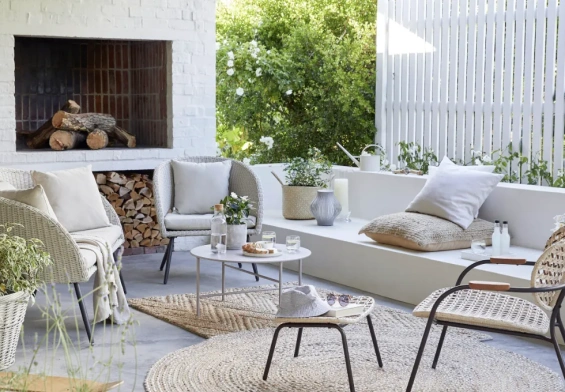
A rug defines a zone. It tells the eye where the “room” begins and ends, which paradoxically makes the space feel more deliberate and therefore larger. The key is to resist the urge to buy small. A rug that’s too modest will make your furniture look like it’s floating on a sea of concrete. Instead, size up let the front legs of your chairs and sofa sit on the rug, and let the material extend generously beneath the table. Natural fibers like jute or sisal weather beautifully and bring a warmth that hard surfaces can’t replicate. Flatweave polypropylene rugs handle rain and sun without complaint and come in patterns that can visually push the boundaries of a tight footprint outward.
The rug is the foundation. Everything else builds from it.
Build Up, Not Out
Floor space is finite. Vertical space almost never is. A small patio that treats its walls and fences as blank boundaries is leaving its most valuable real estate completely untouched.
Vertical gardens are the obvious answer, and they’ve earned their popularity. A modular planting system mounted to a fence transforms a dead boundary into a living, breathing backdrop one that draws the eye upward and creates a sense of enclosure that reads as cozy rather than cramped. Trailing plants like pothos, string of pearls, or climbing jasmine add movement and depth that no piece of furniture can replicate. If full vertical gardens feel like too much maintenance, even a few well-placed wall-mounted planters at varying heights will do the work.
Beyond plants, think about shelving. Slim floating shelves on an exterior wall can hold lanterns, small pots, a speaker, a stack of outdoor-safe books. They add layers to the visual field without consuming any floor space. The eye reads layered depth as spaciousness, which is why a flat, empty patio always feels smaller than one with visual complexity built into its vertical planes.
Choose Furniture That Earns Its Footprint
Every piece of furniture on a small patio is taking up irreplaceable square footage. The question isn’t just whether you like it it’s whether it’s doing enough to justify the space it occupies.
Built-in seating is one of the smartest investments you can make. A bench built along a fence or wall consolidates seating into the perimeter, freing up the center of the patio for movement and breathing room. Add hinged lids and you’ve also solved your storage problem cushions, garden tools, and outdoor accessories disappear inside, keeping the surface clean and uncluttered. Clutter is the enemy of perceived space. A tidy patio always reads as larger than a mesy one of identical dimensions.
For freestanding pieces, look for furniture with legs rather than solid bases. A chair or table that lets you see the floor beneath it creates visual continuity across the space. Glass tabletops do the same thing they take up physical space without interrupting the sightline. Folding or stackable chairs that can be tucked away when not in use give you flexibility without permanent sacrifice.
Let the Light Do the Heavy Lifting
Lighting is where small patios most consistently underperform. A single overhead fixture, or worse, no dedicated outdoor lighting at all, flattens the space and makes it feel utilitarian. Layered lighting, on the other hand, creates atmosphere and atmosphere is what makes a space feel like somewhere you actually want to be.
String lights strung overhead at slight drape create an implied ceiling, which is a counterintuitive trick: defining the vertical boundary of a space makes it feel more room-like, not more confined. Warm-toned Edison bulbs are the classic choice for good reason they cast a glow that’s flatering to both people and plants, and they make even a modest patio feel like an event.
Ground-level lighting adds a second layer. Solar stake lights along a path or border, candles in hurricane lanterns, or low-profile LED strips tucked under a built-in bench all create pools of light that give the eye multiple places to land. When a space has visual depth near, middle, far it reads as larger. Lighting is one of the most effective tools for manufacturing that depth after dark.
Commit to One Bold Focal Point
The temptation with small spaces is to keep everything neutral, small, everything safe. The result is usually a space that feels timid rather than refined. One bold focal point something that commands attention and anchors the design does the opposite. It gives the space a reason to exist.
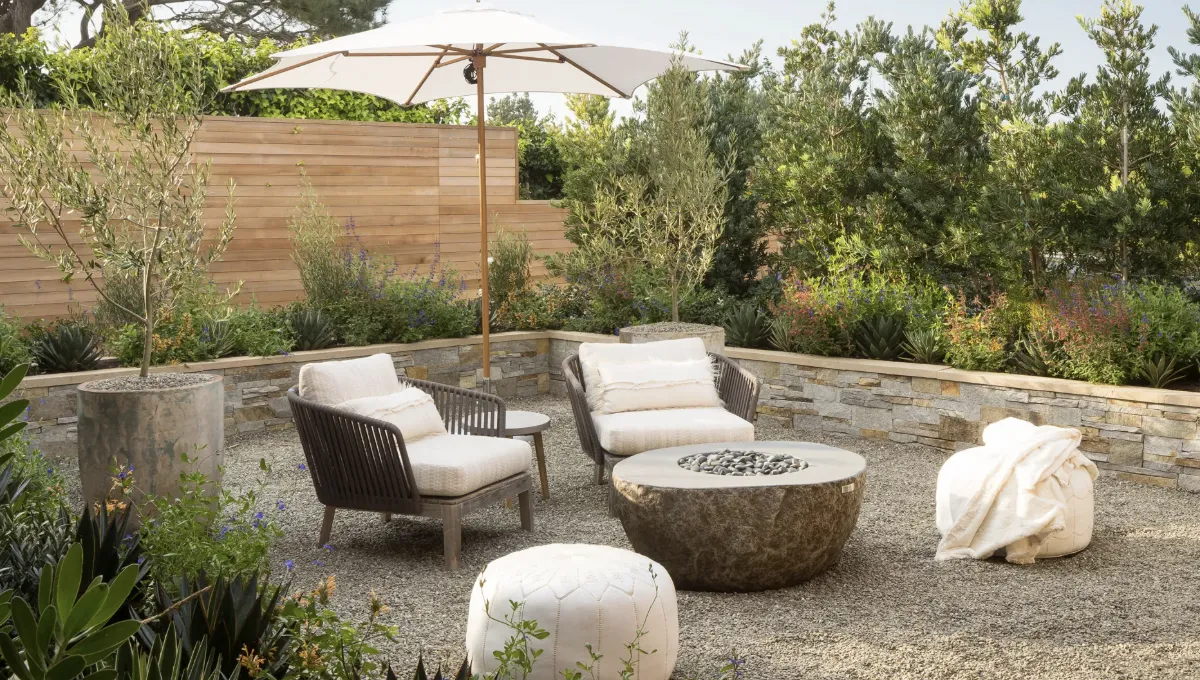
A small fire pit or tabletop fire bowl is the most transformative option. Fire draws people in, extends the usable hours of the patio into cooler evenings, and creates a warmth that no amount of throw pillows can replicate. Even a modest propane fire bowl on a side table changes the entire character of an outdoor space.
If fire isn’t practical, consider a water feature. A small wall-mounted fountain adds sound and sound is a dimension of space that’s easy to forget. The gentle movement of water masks street noise, creates a sense of privacy, and makes a small patio feel like a retreat rather than just an outdoor extension of the living room. A single oversized planter with a dramatic specimen plant an olive tree, a large agave, a sculptural bamboo can serve the same anchoring function with less maintenance.
Blur the Line Between Inside and Out
One of the most effective ways to make a small patio feel larger is to make it feel like a continuation of the interior rather than a separate, lesser space. When the transition between inside and outside is seamless, the eye reads both areas as part of a single, larger whole.
Floring is the most direct way to achieve this. If your interior has large-format tile or light wood floors, extending a similar material or at least a complementary tone onto the patio creates visual continuity. Porcelain pavers that echo interior tile are now widely available and enginered to handle outdoor conditions. The effect is immediate: the patio stops feeling like an afterthought and starts feeling like a room.
Consistent color temperature in your textiles helps too. Outdoor cushions and throws that share the palette of your interior furnishings reinforce the connection. It sounds like a small thing, but the brain is constantly reading visual cues about where one space ends and another begins. When those cues are softened, the perceived square footage expands.
Use Mirrors and Reflective Surfaces Strategically
Mirrors in outdoor spaces remain underused, which is a shame, because they work exactly as well outside as they do inside. A large outdoor-rated mirror mounted on a fence or exterior wall doubles the visual depth of the space instantly. It reflects light, reflects greenery, and creates the impression of a garden or room beyond a trick that’s been used in formal European garden design for centuries.
The key is placement. A mirror that reflects a beautiful planted corner or a string-lit pergola multiplies the best parts of the space. One that reflects a plain fence or a neighbor’s wall does the opposite. Take a moment to stand where the mirror will hang and look at what it will show before you commit.
Beyond mirrors, consider other reflective surfaces: a metalic planter, a glass-topped table, glazed ceramic pots in deep jewel tones. These elements catch and scatter light in ways that add visual richness without adding visual weight. A small patio that glimmers a little that has surfaces that respond to sunlight and candlelight feels alive in a way that matte, flat surfaces simply don’t.
The truth about small patios is that their limitations are mostly perceptual. Square footage is fixed, but the experience of a space is not. It’s shaped by light, by layers, by the relationship between elements and those are all things you can control. The patios that feel luxuriously huge aren’t the ones that pretend to be something they’re not. They’re the ones that know exactly what they are, and make every inch count.