
There’s a moment every homeowner eventually faces standing in a kitchen that looks perfectly fine on paper, maybe even beautiful in the listing photos, yet somehow exhausting to actually cook in. You reach for a pot, pivot to the stove, turn back to the sink, walk three steps to the fridge, and by the time dinner is on the table, you’ve logged what feels like a quarter mile inside a twelve-by-fourteen-foot room. Something is wrong, but you can’t quite name it. Chances are, the kitchen was designed without any serious thought given to the work triangle.
The work triangle isn’t a trendy concept cooked up by some design influencer. It’s a principle that emerged from research conducted at the University of Illinois in the 1940s, when architects and home economists started studying how women who were, at the time, assumed to be the primary kitchen users actually moved through the space while preparing meals. What they found was elegantly simple: nearly all kitchen activity revolves around three fixed points. The refrigerator, where food is stored. The sink, where food is prepped and cleaned. The stove, where food is cooked. Connect those three points and you get a triangle. Keep that triangle tight and efficient, and the kitchen becomes a place of genuine pleasure rather than low-grade daily frustration.
What the Triangle Actually Measures
The original guidelines suggested that each leg of the triangle the distance between any two of the three work centers should be no shorter than four feet and no longer than nine feet. The total perimeter of the triangle should ideally land between thirteen and twenty-six feet. These numbers aren’t arbitrary. Go too small and the cook feels cramped, constantly spinning in place with no room to set anything down. Go too large and the kitchen becomes a cardio workout, with too much dead ground between every task.
What makes this framework genuinely useful, decades after it was first proposed, is that it doesn’t care about aesthetics. It doesn’t care whether your cabinets are shaker-style or flat-front, whether your countertops are quartz or butcher block, whether you’ve chosen a farmhouse sink or an undermount. The triangle operates at the level of pure spatial logic. A kitchen can be visually stunning and functionally miserable. The triangle is the part that determines which one it is.
That said, the triangle works differently depending on the layout of the kitchen itself, and understanding that relationship is where the real design thinking begins.
How Layout Shapes the Triangle
A galley kitchen two parallel runs of cabinetry facing each other naturally produces a very compressed triangle. The refrigerator might sit at one end of one wall, the stove midway down the opposite wall, the sink somewhere in between. The cook pivots back and forth rather than walking in a loop. Done well, this is actually one of the most efficient kitchen configurations ever devised. Professional restaurant kitchens are essentially galley kitchens scaled up. The problem arises when the galley is too narrow, turning that efficient pivot into a claustrophobic squeeze, or when traffic cuts directly through the work zone because the galley doubles as a corridor.
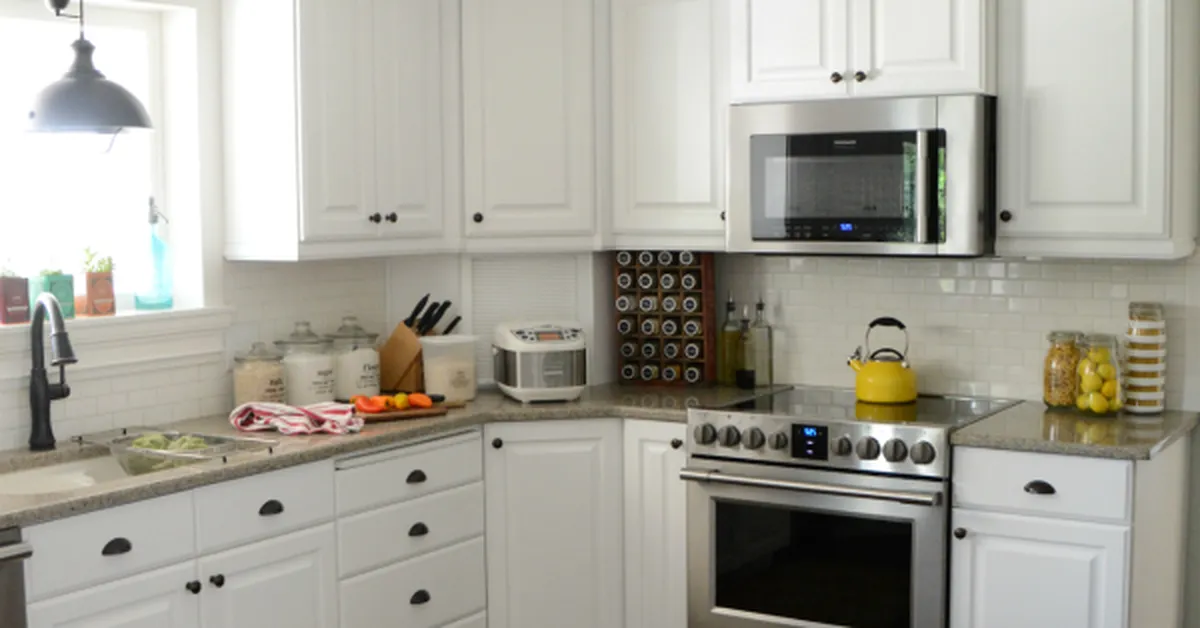
An L-shaped kitchen places two work walls at a right angle, which gives the triangle a natural corner to work around. This layout tends to handle the triangle well as long as the designer resists the temptation to push the three points too far apart. The corner itself can become dead space those deep base cabinets that require a lazy susan or a pull-out system to make them remotely functional but within the triangle logic, the L-shape is forgiving and adaptable.
The U-shaped kitchen wraps the cook on three sides, which sounds ideal and often is, but it creates a specific trap. When all three walls are available, there’s a temptation to spread the refrigerator, sink, and stove too generously around the perimeter. Suddenly the triangle’s perimeter creeps past twenty-six feet, and what should have been the most efficient layout becomes the most exhausting. The U-shape rewards restraint. The three work centers should be clustered within one section of the U, not distributed evenly around it.
Then there’s the open-plan kitchen with an island, which is where the triangle concept gets genuinely complicated.
The Island Problem Nobody Talks About
Islands have become so standard in contemporary kitchen design that their presence is almost assumed. Buyers expect them. Designers propose them. Contractors build them. And yet an island, positioned without careful thought, is one of the most reliable ways to destroy an otherwise functional work triangle.
The issue is obstruction. If the island sits directly between the sink and the stove, every trip between those two points requires a detour around a fixed structure. The triangle’s straight lines become bent, its distances artificially inflated. You’re no longer moving efficiently between work centers you’re navigating around a large piece of furniture in the middle of your kitchen.
A well-placed island doesn’t interrupt the triangle. It either sits outside the triangle’s perimeter entirely, functioning as a prep zone or a social gathering point, or it incorporates one of the three work centers itself typically a secondary sink or, occasionally, a cooktop. When the cooktop moves to the island, the triangle reconfigures around the new geometry, and the cook gains the social benefit of facing the room while cooking. This is a legitimate design choice. What isn’t legitimate is dropping an island into the space without first mapping how it affects the triangle’s legs.
There’s also the question of clearance. The National Kitchen and Bath Association recommends at least forty-two inches of walkway space around an island for a single-cook kitchen, and forty-eight inches if multiple people are likely to be in the kitchen simultaneously. These aren’t suggestions. Violate them and you’ll have a kitchen where two people cannot pass each other without one of them pressing against the counter.
When the Triangle Isn’t Enough
Here’s where the honest conversation gets interesting. The work triangle was designed for a single cook preparing a single meal, in an era when kitchen technology was far simpler. Today’s kitchens often contain a second oven, a steam oven, a wine refrigerator, a dedicated beverage fridge, a coffee station, a microwave drawer, and sometimes a secondary prep sink. The idea that all meaningful kitchen activity flows through three points is, in the modern context, a simplification.
Some designers have moved toward the concept of work zones dedicated areas for specific tasks, each with its own storage and counter space. A baking zone with the stand mixer, baking sheets, and measuring tools stored nearby. A coffee zone with the machine, the beans, the mugs, all within arm’s reach. A plating zone near the stove where finished dishes are assembled before they go to the table. This approach acknowledges that the modern kitchen serves multiple functions simultaneously, often with multiple people working at once.
But here’s what the zone advocates sometimes understate: the work triangle doesn’t become irrelevant just because the kitchen has grown more complex. It becomes the foundation on which the zone thinking sits. You still need the primary cooking workflow fridge to sink to stove to be spatially coherent. The zones extend the logic outward; they don’t replace the core geometry.
Think of it like building a sentence. The work triangle is the subject, verb, and object the essential structure that makes communication possible. The zones are the modifying clauses, the descriptive phrases, the texture that makes the sentence rich. You can’t have the texture without the structure underneath it.
Reading a Floor Plan Before You Sign Anything
If you’re evaluating a kitchen whether in a home you’re considering buying, a renovation you’re planning, or a new build where you still have input the work triangle gives you a precise diagnostic tool. Sketch it out. Measure the legs. Walk the path physically if you can, or trace it with your finger on the floor plan if you can’t.
Ask yourself whether the refrigerator is positioned near the kitchen’s entry point, so groceries can be unloaded without crossing the entire cooking zone. Ask whether the sink has adequate counter space on both sides a sink jammed into a corner with eighteen inches of counter on one side and nothing on the other is a daily inconvenience that no amount of beautiful tile can fix. Ask whether the stove is positioned away from a window where curtains could become a fire hazard, and whether there’s landing space on either side for hot pots.
These aren’t the glamorous questions. Nobody posts their work triangle measurements on a design blog. But they’re the questions that separate a kitchen that photographs beautifully from a kitchen that actually works that makes cooking feel less like a chore and more like something you might actually want to do at the end of a long day.
The golden triangle isn’t a design trend. It’s closer to a quiet contract between the space and the person living in it a promise that the room has been thought about at the level of real human movement, not just surface beauty. And once you know how to read it, you’ll never look at a floor plan quite the same way again.