

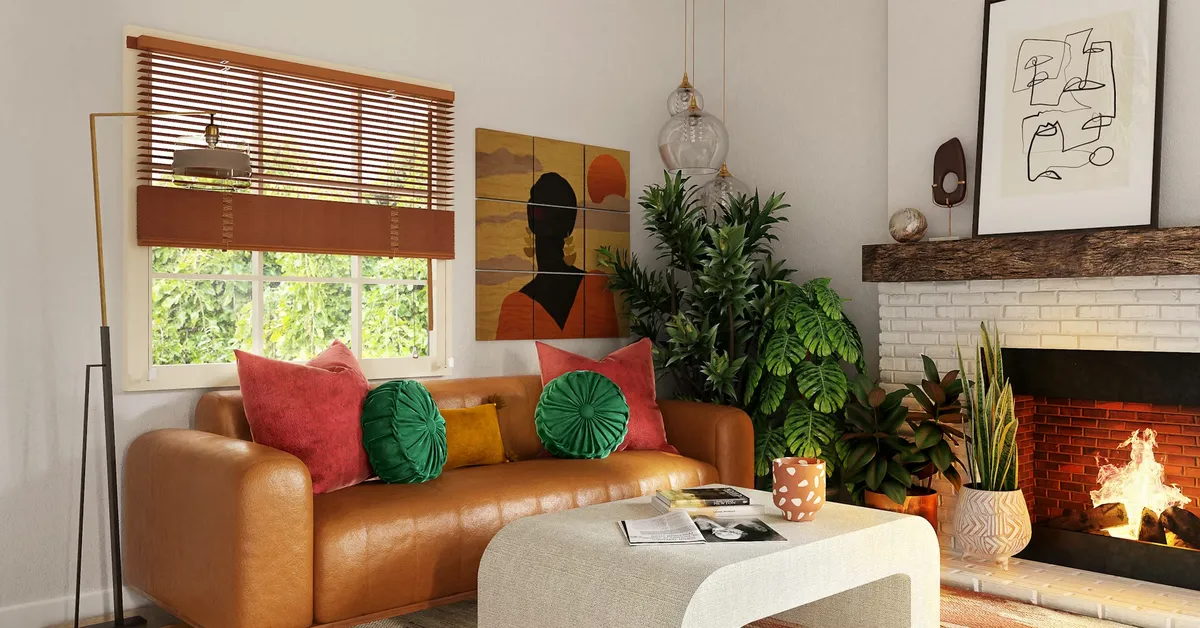
The Rug Is Too Small: And Other Sins of Living Room Decor
The Rug Problem Nobody Talks About Honestly
Walk into almost any living room in America a friend’s place, an Airbnb, a freshly staged home on Zillow and you will see it. The rug, floating in the center of the room like a postage stamp on a dining table, front legs of the sofa barely grazing its edge, the coffee table perched on top as though it’s been placed there by accident. Everyone in the room can feel that something is off. Almost nobody can name it.
The too-small rug is the original sin of living room decorating. It is so common that it has become invisible, normalized by the sheer volume of its repetition. People buy rugs the way they buy throw pillows intuitively, emotionally, without measurement and then wonder why the room never quite coheres. The answer is almost always on the floor.
A rug’s job, at its most fundamental, is to define a zone. It tells the eye where the seating arrangement begins and ends. It creates a sense of enclosure in a space that might otherwise feel like furniture scattered across an open field. When the rug is too small, it fails at this task entirely. Instead of anchoring the room, it becomes a decorative afterthought, a rectangle of pattern and texture that floats beneath the coffee table while the sofa legs hover on bare floor, belonging to no particular territory. The visual result is a room that feels unresolved, slightly anxious, like a sentence that trails off mid-thought.
The correct approach the one that interior designers will tell you the moment you hire them is to go bigger than feels comfortable in the showroom. All four legs of the sofa on the rug, ideally. At minimum, the front two. The rug should extend beyond the edges of the seating group, giving each piece of furniture a sense of shared ground. In a standard living room, this often means a 9×12 or even a 10×14. People balk at the size in the store. They buy the 6×9 instead. And then they wonder.
Furniture Pushed Against the Walls
The second great sin follows naturally from the first, and it is almost the inverse problem. If the rug is too small and makes the room feel scattered, furniture pushed flush against every wall creates a different kind of wrongness a room that feels like a waiting area. A dentist’s office. Somewhere you sit until your name is called.
This impulse is understandable. Rooms feel bigger when furniture is against the walls, or so the logic goes. In reality, the opposite tends to be true. When every sofa and chair retreats to the perimeter, the center of the room becomes a dead zone a vast, empty expanse of floor that no one uses and nothing inhabits. The furniture, meanwhile, is so far from each other that actual conversation becomes a project. You find yourself raising your voice slightly to talk to someone on the opposite sofa, which kills the intimacy that a living room is supposed to provide.
Pull the furniture in. Float it. Let the sofa live two or three feet from the wall. Place chairs at angles. Create a conversation zone that has a center of gravity. The room will feel simultaneously smaller and more purposeful and that is exactly the point. A living room is not a gymnasium. It does not need to maximize open floor space. It needs to feel like somewhere a person would want to be.
The Lighting Situation, Which Is Usually a Disaster
Most American living rooms are lit by a single overhead fixture, often a ceiling fan with an integrated light kit, often controlled by a dimmer that nobody uses, often casting a flat, shadowless light that makes everyone look slightly unwell. This is not a design choice so much as a default the builder put it there, and nobody thought to question it.
Good lighting in a living room requires layers. An overhead source for general illumination, yes, but also table lamps that bring light down to eye level, floor lamps that create warmth in corners, maybe a picture light or two if there’s art worth drawing attention to. The goal is to create a room that can be adjusted bright and functional when you need it, warm and atmospheric when you want it. A single overhead fixture cannot do this. It can only do one thing, and that one thing is rarely right.
The specific failure of the ceiling fan light kit deserves its own moment of attention. The light points downward, often harshly. It illuminates the tops of heads and the surfaces of tables. It creates no warmth, no shadow, no sense of depth. It is the lighting equivalent of fluorescent tubes in a break room, and it is in millions of living rooms right now, doing its flat, indiscriminate work while the people beneath it wonder why the space never feels relaxing.
Lamps are not expensive. A decent floor lamp from a hardware store, placed in a dark corner, will transform a room more dramatically than almost any other single intervention. This is not a secret. And yet.
The Gallery Wall That Has Lost the Plot
There is a version of the gallery wall that works beautifully a thoughtfully curated collection of frames, varied in size but unified by theme or palette, arranged with intention and a little controlled asymmetry. And then there is the version that exists in most homes: a collection of frames that accumulated over years, arranged in a rough rectangle on the wall, representing every aesthetic phase the homeowner has passed through since college.
The problem is not the gallery wall concept. The problem is the execution, and specifically the absence of any governing principle. A black-and-white photo from a vacation in 2015 sits next to a motivational quote in a rose gold frame next to a child’s finger painting next to a framed print from a home goods store that was purchased because it had the right dimensions to fill a gap. Each of these objects might be meaningful individually. Together, they produce visual noise.
A gallery wall needs an editor. It needs someone to look at the whole and ask what it is trying to say, and then to ruthlessly remove anything that contradicts the answer. This is hard to do with objects that carry personal meaning. It is also necessary.
The same principle applies to the shelves, the mantel, the console table behind the sofa. Every surface in a living room tells a story, whether you intend it to or not. The question is whether that story is coherent, or whether it is simply a record of accumulation of things bought, gifted, kept out of guilt or inertia, arranged without much thought and then stopped seeing entirely.
The Curtains That Are Hung Too Low
Hang your curtains at the ceiling, not at the top of the window frame. This is the single piece of advice that designers repeat so often it has become a cliché, and it remains a cliché because people keep hanging their curtains at the top of the window frame.
When curtains are mounted at window height, they make the window look small and the ceiling look low. When they are mounted near the ceiling or at the ceiling itself and allowed to fall all the way to the floor, they create the illusion of height, of grandeur, of a room that has more vertical space than it actually does. The window looks taller. The room looks taller. The whole space breathes differently.
The panels should also be wide enough. Most people buy curtains that, when open, just barely clear the glass. The result is that even in daylight, the curtains block a portion of the window, reducing light and making the whole arrangement look pinched. The panels should extend well beyond the window frame on each side so that when they’re open, all the glass is fully exposed and the fabric frames the window rather than competing with it.
These are small adjustments. A few inches up, a few inches out. The difference they make is disproportionate to their simplicity, which is perhaps the most frustrating thing about them the solution was available the whole time.
On Living With What Isn’t Working
There is a particular kind of domestic blindness that sets in after you’ve lived somewhere long enough. The rug stops looking too small because you’ve stopped seeing the rug. The furniture against the walls stops feeling like a waiting room because this is just how the room is now. The overhead light is just the light. The curtains are just the curtains.
This is not laziness, exactly. It’s adaptation the same cognitive mechanism that lets you stop hearing the hum of the refrigerator or noticing the crack in the ceiling above your bed. The brain learns to edit out the familiar. The problem is that the body still registers it. The room still feels slightly off, slightly unresolved, in ways that are hard to articulate but easy to feel. You spend time in the space but you don’t quite settle into it. You sit on the sofa but you don’t fully relax. Something is wrong that you can no longer see clearly enough to fix.
The exercise worth doing, occasionally, is to walk into your living room as though you’ve never been in it before. Stand in the doorway. Look at the rug. Look at the furniture. Look at the light. Try to see what a stranger would see in the first five seconds before the familiarity floods back and renders everything invisible again.
What you find might surprise you. Or it might just confirm what some part of you already knew.