
There’s a particular kind of room that stays with you. You walk in, feel immediately at ease, and can’t quite explain why. Nothing jumps out. Nothing competes for attention. The wardrobe against the wall doesn’t announce itself it simply belongs. That quality, that sense of quiet coherence, is not accidental. It’s the result of someone making deliberate choices about how a piece of furniture relates to the space it inhabits.
Most people approach wardrobe shopping the way they approach buying a car: they look at features, capacity, price. How many hanging rails? Does it have soft-close drawers? Will it fit the corner? These are reasonable questions, but they’re the wrong starting point. Before any of that, the real question is architectural. What is this room actually made of, and how does a wardrobe become part of it rather than a guest in it?
Reading the Room Before You Shop
Every room has a visual grammar a set of proportions, materials, and details that give it its character. A Victorian terace with high ceilings, cornicing, and original skirting boards speaks a completely different language than a 1970s bungalow with low ceilings and flush-panel doors. A converted warehouse loft with exposed steel and raw concrete is operating in a different register entirely.
The mistake most people make is treating the wardrobe as a neutral object that can be dropped into any context. It can’t. A slek, handle-free wardrobe with a high-gloss lacquer finish will look like a spaceship in a room full of period moldings. A rustic oak armoire will feel like a prop in a minimalist apartment. The wardrobe doesn’t need to match the architecture literally, but it needs to be in conversation with it.
Start by identifying the dominant material palette of the room. Is the floor warm-toned timber or cool stone? Are the walls painted in deep, saturated colors or kept neutral? What do the door frames and window surrounds look like are they chunky and traditional, or slim and modern? These details are your reference points. They tell you what the room is already saying, and your job is to find a wardrobe that speaks the same language, even if it has its own accent.
The Proportions Question Nobody Talks About Enough
Scale is where most wardrobe decisions go quietly wrong. A wardrobe that’s technically the right size for the clothes it needs to hold can still feel completely wrong in a room if its proportions don’t align with the architecture around it.
Ceiling height is the most important variable. In a room with 9-foot ceilings, a standard 7-foot wardrobe leaves an awkward gap at the top a dead zone that reads as an afterthought. The eye naturally wants the wardrobe to either reach the ceiling or stop at height that feels intentional, like the top of a door frame. In rooms with high ceilings, floor-to-ceiling wardrobes don’t just maximize storage; they anchor the room. They make the height feel purposeful rather than accidental.
Width matters too, but in a subtler way. A wardrobe that’s too narrow for a wide wall will look stranded. One that’s too wide for a small alcove will feel oppressive. The ideal is a wardrobe whose width relates to the wall it occupies in a way that feels balanced not necessarily centered, but considered. Sometimes that means a custom solution. Sometimes it means choosing a modular system and configuring it thoughtfully rather than defaulting to whatever fits.
Material Choices as Architectural Dialogue
Wood is the most forgiving material in this context, partly because it appears in so many architectural elements floors, doors, window frames, beams and partly because its warmth tends to read as belonging rather than imposing. But not all wood is equal, and the species, grain, and finish matter enormously.
In a room with pale oak floors and white walls, a wardrobe in a similar pale oak will feel like it grew there. The same wardrobe in dark walnut will create a focal point which might be exactly what you want, or might feel like a collision depending on the other elements in the room. Dark wood in a room with dark floors and rich wall colors can feel deeply intentional and luxurious. The same dark wood in a bright, airy room can feel heavy and out of place.
Painted wardrobes offer a different kind of integration. When the wardrobe is painted the same color as the walls or a tone that’s close enough to read as the same family it recedes. The eye doesn’t register it as furniture; it registers it as architecture. This is the principle behind built-in wardrobes that are painted out to match the room, and it works just as well with freestanding pieces if the color relationship is handled carefully. The wardrobe doesn’t disappear, exactly, but it stops competing.
Hardware as the Detail That Decides Everything
It’s easy to underestimate hardware. Handles and knobs are small, and they seem like a finishing touch rather than a structural decision. In practice, they’re often the detail that determines whether a wardrobe feels at home in a room or slightly off.
In a room with traditional architectural details paneled doors, brass fixtures, ornate moldings hardware with a period sensibility will reinforce the coherence of the space. Brushed brass, aged bronze, ceramic knobs: these materials echo what’s already present and signal that the wardrobe belongs to the same era, or at least the same aesthetic conversation.
In a contemporary space, the logic inverts. Minimal hardware recessed pulls, thin bar handles in matte black or brushed nickel keeps the wardrobe from introducing visual noise. Some modern wardrobes dispense with hardware entirely, using push-to-open mechanisms that leave the surface completely clean. In the right context, this reads as sophisticated restraint. In a room with more traditional bones, it can feel cold and clinical.
The key is to look at what the room already has. Door handles, light switch plates, curtain rods, towel rails these are the hardware vocabulary of the space. The wardrobe’s hardware should feel like it belongs to the same family.
Built-In vs. Freestanding: A More Nuanced Question Than It Appears
The conventional wisdom is that built-ins always look better because they’re custom-fitted to the space. This is often true, but not universally. A well-chosen freestanding wardrobe in the right room can feel just as integrated as a built-in and it has the advantage of being movable, which matters if you’re renting or if your needs are likely to change.
The real distinction isn’t built-in versus freestanding; it’s whether the wardrobe acknowledges the architecture or ignores it. A built-in that’s poorly proportioned, finished in the wrong material, or fitted with hardware that clashes with the room will still feel wrong. A freestanding wardrobe that’s been chosen with genuine attention to the room’s character can feel like it was always meant to be there.
Alcoves are a special case. A wardrobe fitted into an alcove whether built-in or a freestanding piece that happens to fit precisely benefits from the architectural containment the alcove provides. The walls on either side frame the wardrobe and give it a sense of belonging that a wardrobe floating in the middle of a wall doesn’t automatically have. If your room has alcoves, use them. They’re one of the most powerful tools for making furniture feel architectural.
The Role of Light in How Integration Is Perceived
Light changes everything, and it’s worth thinking about how the wardrobe will look at different times of day and under different lighting conditions. A wardrobe that looks perfectly integrated in the afternoon light might feel disconnected under artificial evening light if the color temperature shifts significantly.
Matte finishes tend to be more forgiving across lighting conditions than high-gloss ones. Gloss surfaces reflect light in ways that can beautiful or harsh depending on the angle and source. In rooms with strong directional light a south-facing room with large windows, for example a high-gloss wardrobe will catch that light dramatically. Whether that’s an asset or a liability depends on the room and your tolerance for visual drama.
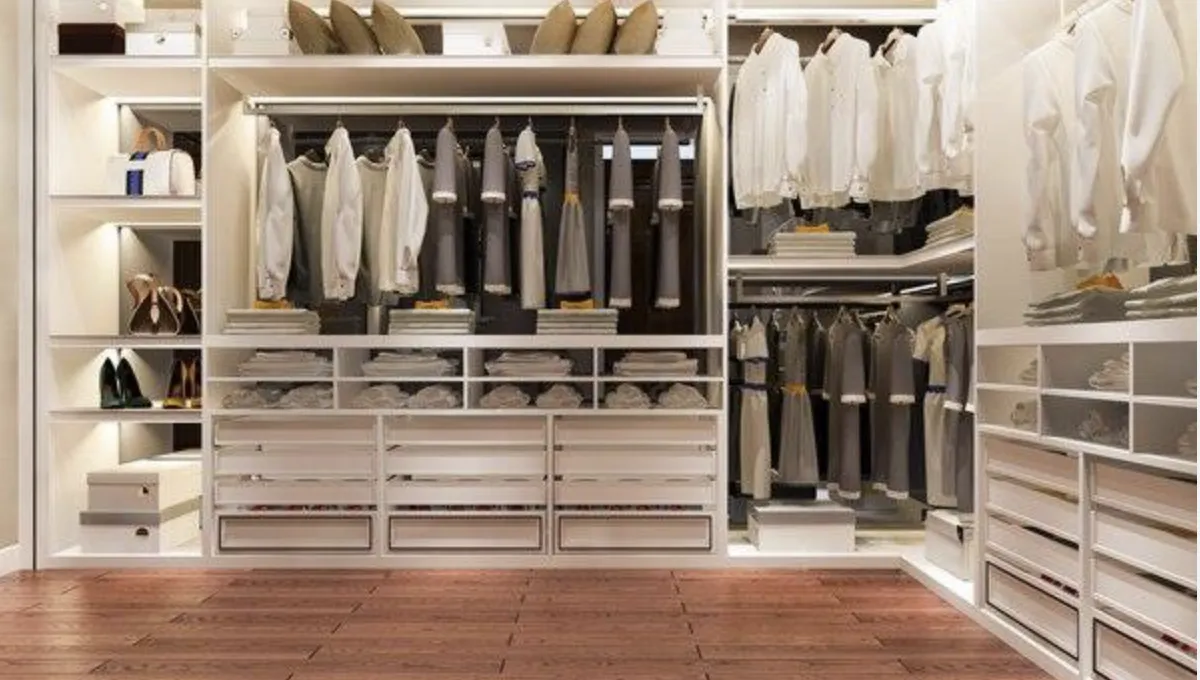
Interior lighting inside the wardrobe is a separate consideration, but it affects the room too. When the wardrobe doors are open, the interior becomes part of the visual field. A well-lit interior with a clean, considered organization reads as an extension of the room’s character. A dark, chaotic interior breaks the spell.
When the Wardrobe Is Meant to Be Seen
Not every wardrobe needs to disappear. There’s a legitimate design tradition of treating the wardrobe as a statement piece a beautiful object that earns its place in the room through its own presence rather than through self-effacement. An antique armoire in a room that’s otherwise contemporary can create a productive tension, a sense of history and layering that makes the space feel lived-in and personal rather than showroom-perfect.
The difference between a wardrobe that creates interesting tension and one that simply clashes is intentionality. If the wardrobe is clearly result of a deliberate choice if it’s beautiful on its own terms and the room has been arranged to accommodate it the contrast reads as design. If it looks like it ended up there by accident, it reads as a mistake.
There’s a version of seamless integration that isn’t about invisibility at all. It’s about a piece of furniture that’s so right for the room so perfectly matched in spirit, even if not in literal material or style that it feels inevitable. You look at it and think: of course. That’s the wardrobe this room was always going to have.
That feeling doesn’t come from following a formula. It comes from paying attention to the room, to the light, to the proportions, to the small details that most people walk past without noticing. The wardrobe is just furniture. But furniture, chosen carefully, is how a room becomes a place.