
There is a moment in every room’s evolution when you stand back and realize something feels off. The walnut dining table you love clashes with the oak floors you inherited. The maple bookshelf seems to exist in a different universe than the cherry side table your grandmother left you. And suddenly, a space that should feel collected and warm reads as chaotic, like a furniture showroom where nothing belongs together.
This is the wood tone problem, and almost everyone encounters it. The instinct most people follow is to match everything, to buy the same finish across every piece of furniture in a room. Designers will tell you this is actually the less sophisticated route. A room where every wood is identical often looks flat, like it was purchased in a single afternoon from a single catalog page. The spaces that feel truly alive, the ones you linger in and photograph and try to replicate, almost always contain deliberate mix of wood tones working in quiet harmony.
But how do you get there without chaos?
Why Matching Everything Is the Wrong Instinct
Walk into any well-designed home featured in Architectural Digest or Elle Decor and count the wood tones. You will rarely find fewer than three. A bleached oak floor might sit beneath a rich walnut credenza, with a warm teak lamp and a painted black wood frame on the wall. None of it matches. All of it works.
The reason is roted in how our eyes process visual information. When every surface shares the same tone, the room loses depth. There is no contrast to guide the eye, no hierarchy of warmth and coolness to create dimension. It is the design equivalent of speaking in a monotone. Technically correct, but lifeless.
Professional designers treat wood tones the way a painter treats a palette. You need a dominant note, a secondary accent, and a few supporting players. The goal is not uniformity. The goal is conversation between materials.
Understanding Undertones Before You Start
Here is where most people go wrong. They look at a piece of furniture and think “dark” or “light” without considering what lives beneath the surface color. Every wood has an undertone, a subtle lean toward warm, cool, or neutral that determines whether it will play nicely with its neighbors.
Oak, for instance, tends to carry yellow or golden undertones. Walnut leans toward chocolate and sometimes purple. Cherry runs warm and red. Ash stays relatively neutral. Ebony-stained pieces can read cool or warm depending on the base wood and the specific stain formula used.
The Undertone Test
Place two wood samples side by side in natural light. If one looks suddenly orange next to the other, their undertones are fighting. If both seem to settle comfortably, sharing a general warmth or coolness even at different depths of color, you have compatibility.
This does not mean every piece in a room must share the same undertone family. But your dominant woods, the largest surfaces like floors, dining tables, and major case goods, should share an undertone kinship. Your accent pieces have more freedom to deviate because they occupy less visual real estate.
The 3-Tone Framework
Designers often work with a simple internal framework that never appears on any mood board but governs every decision. Think of your wood tones in threeiers.
Your anchor tone is the largest wood surface in the room. Usually floor, sometimes a massive dining table or a wall of built-in shelving. This is your baseline. Everything else responds to it.
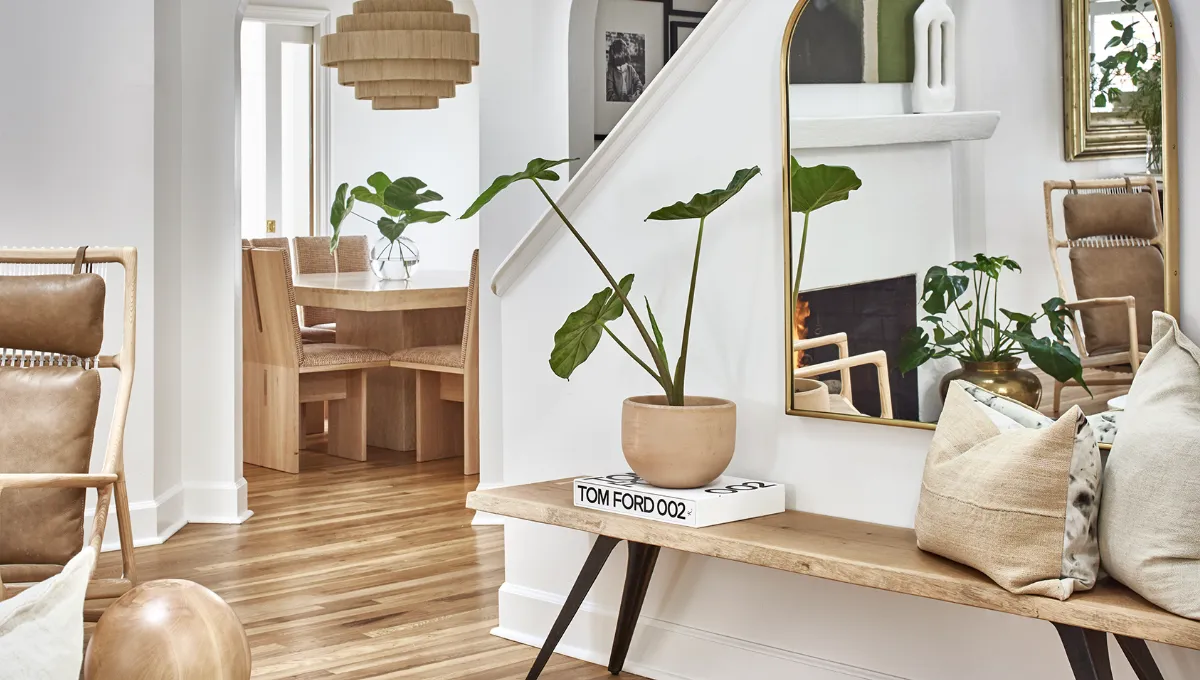
Your primary contrast is the second most prominent wood. It should differ noticeably from the anchor in depth or warmth, but share enough DNA in undertone that the two feel related rather than random. If your floors are light white oak, your primary contrast might be a medium walnut. Different enough to create interest, connected enough to feel intentional.
Your accent tones are the smaller moments. A picture frame, a turned wood bowl, a side table, a cutting board leaning against the backsplash. These can push further from your anchor because their scale is small. A single ebony-stained object in a room full of honey tones becomes a punctuation mark, not a disruption.
Distribution Matters More Than Selection
You could choose the three most beautiful wood tones in existence and still create a disjointed room if you cluster them poorly. Imagine all your dark wood one side of the room and all your light wood on the other. The eye reads that as two separate zones rather than one cohesive space.
The trick is triangulation. Place your secondary tone in at least two or three spots around the room so eye travels. If your walnut dining table sits at center, echo that walnut in a small tray on the console by the door and perhaps in the legs of a chair across the room. The repetition tells the brain this was a choice, not an accident.
This principle is why designers will sometimes add a seemingly unnecessary object to a room. That small wooden box on the mantel is not there because anyone needs a box. It is there because the room needed one more touch of that particular tone on the north wall to balance the credenza on the south wall.
Texture and Grain as Secret Weapons
Two pieces of wood can share nearly the same color and still look entirely different based on grain pattern and surface texture. A smooth, tight-grained maple reads modern and clean. A rough-sawn reclaimed beam in a similar lightness reads rustic and aged. Placing them together creates richness without introducing a new color variable.
This is an underused strategy. When you are nervous about adding another tone, consider adding another texture instead. A driftwood-finish piece with heavy grain variation can bridge the gap between a slek dark floor and a pale smooth tabletop because it introduces visual complexity without pulling the palette in a new chromatic direction.
Live-edge pieces work similarly. The natural variation within a single slab, sapwood lighter at the edges, heartwood darker at the center, can contain within itself the range of tones present in the rest of the room. It becomes a unifying element precisely because it is not uniform.
The Role of Non-Wood Elements
No wood exists in isolation. The metals, fabrics, wall colors, and stone surfaces surrounding your wood tones dramatically affect how those tones read. A warm brass lamp will pull the golden undertones out of an oak table, making it look richer and more intentional. A cool chrome fixture next to that same table might make the oak look slightly mudy or out of place.
White walls tend to make wood contrasts more stark. Warm-toned walls soften transitions between different woods. A deep green or navy wall can act as a neutral backdrop that lets multiple wood tones coexist peacefully because the eye is processing color information from the wall rather than scrutinizing the relationship between the maple and the mahogany.
Rugs and upholstery serve as bufers too. A large area rug between mismatched wood floors and a wood coffee table creates a visual pause. The eye does not jump directly from one tone to the other. It rests on the textile in between, which makes the transition feel natural rather than jaring.
Common Combinations That Rarely Fail
Certain pairings have proven themselves across decades of interior design because their undertone relationships are inherently stable.
White oak floors with walnut furniture is perhaps the most reliable combination in contemporary design. The oak provides a neutral-to-warm light base, and the walnut offers depth without introducing red or orange. Add a touch of black-stained wood in frames or hardware-adjacent pieces, and you have a palette that feels modern, warm, and layered.
Teak and rosewood have coexisted beautifully in mid-century modern interiors since the 1950s. Both carry warm undertones but at different depths, and their grain patterns complement rather than compete.
Maple and cherry is classic pairing in traditional American interiors. The maple stays cool and pale while the cherry brings warmth and richness. They share enough yellow undertone to feel familial without looking like they are trying to be the same thing.
Painted or stained black wood works as a universal bridge. Because it reads almost as a non-wood, more like a graphic element, it can sit comfortably between any combination of natural tones without creating conflict. This is why black picture frames, black chair legs, and black floating shelves appear so frequently in well-designed spaces. They are doing quiet diplomatic work.
When to Break the Rules
Everything above assumes you want harmony. But some of the most striking rooms deliberately introduce tension. A single piece of high-contrast wood, something agressively red or deeply chared, can serve as the focal point of a room precisely because it refuses to blend.
The difference between intentional tension and accidental clash comes down to isolation and confidence. If you are going to introduce a wood tone that fights with everything else, give it space. Let it breathe. Do not place it directly adjacent to its opposite. And commit to it. One bold piece reads as a statement. Two or three pieces in that same fighting tone reads as a mistake you could not decide about.
Interior design has always been a practice of controlled contradiction. You want enough cohesion that a room feels considered, and enough variation that it feels human. Wood tones are simply one of the most visible arenas where this tension plays out. The professionals are not following a formula. They are developing an eye, a sensitivity to the way materials speak to each other across a room, and trusting that conversation to unfold without forcing every piece into agreement.
Your rooms will never look like a catalog spread, and that is the point. They will look like yours.