
There’s a particular kind of sadness to a piece of wood furniture left to the elements the gray, cracked surface, the grain buried under years of oxidation and grime. Most people walk past it at a garage sale or drag it to the curb without a second thought. But if you know what you’re looking at, that sad, sun-bleached chair or porch table is about thirty dollars away from being something genuinely beautiful again.
This isn’t about being crafty or having a workshop full of tools. It’s about understanding what actually happened to the wood and reversing it with a little patience and the right cheap materials.
What Weathering Actually Does to Wood
Wood doesn’t just get dirty when it’s left outside. It undergoes a slow chemical transformation. UV rays break down lignin the natural polymer that holds wood fibers together and gives it that warm, rich color. Moisture works its way into the grain, swelling and contracting the fibers with every rain and dry spell until the surface starts to check and crack. Mold and mildew settle into those cracks. Tannins leach out. The result is that familiar silver-gray, rough-textured surface that looks like the wood has given up.
The good news is that most of this damage is surface-level. Unless the piece has structural rot soft, punky wood that crumbles when you press it the wood underneath is almost always sound. Weathering is largely cosmetic, and cosmetic problems are solvable.
Before you spend a dollar, press your thumb firmly into a few spots on the piece. If the wood feels solid and doesn’t compress or flake away, you’re working with something worth saving. If it sinks like wet cardboard, that section has rotted through and you’ll need to either cut it out or accept that this particular piece isn’t a candidate.
The $30 Budget, Broken Down
You don’t need a lot. Here’s roughly where the money goes:
A bottle of wood cleaner or a simple oxalic acid deck brightener runs about $8to $12 at any hardware store. This is the step most people skip, and it’s the one that makes the biggest difference. Oxalic acid neutralizes the gray oxidation and pulls tannin stains out of the grain it’s essentially a bleach specifically designed for wood.
Sandpaper in two grits 80 and 150 costs maybe $5 for a small pack. You won’t need much.
A penetrating teak oil, danish oil, or outdoor wood conditioner is your finishing product. Brands like Watco or Hope’s are widely available and typically run $10 to $14for a small can. For most furniture projects, a quart is more than enough.
That’s it. A few rags you probably already own, a bucket, and a brush or two round out the kit. The whole thing lands comfortably under $30, often under $25.
Start With a Real Clean
The instinct is to jump straight to sanding, but that’s backwards. Sanding dirty, oxidized wood just grinds the grime deeper into the grain and clogs your sandpaper within minutes. Clean first, always.
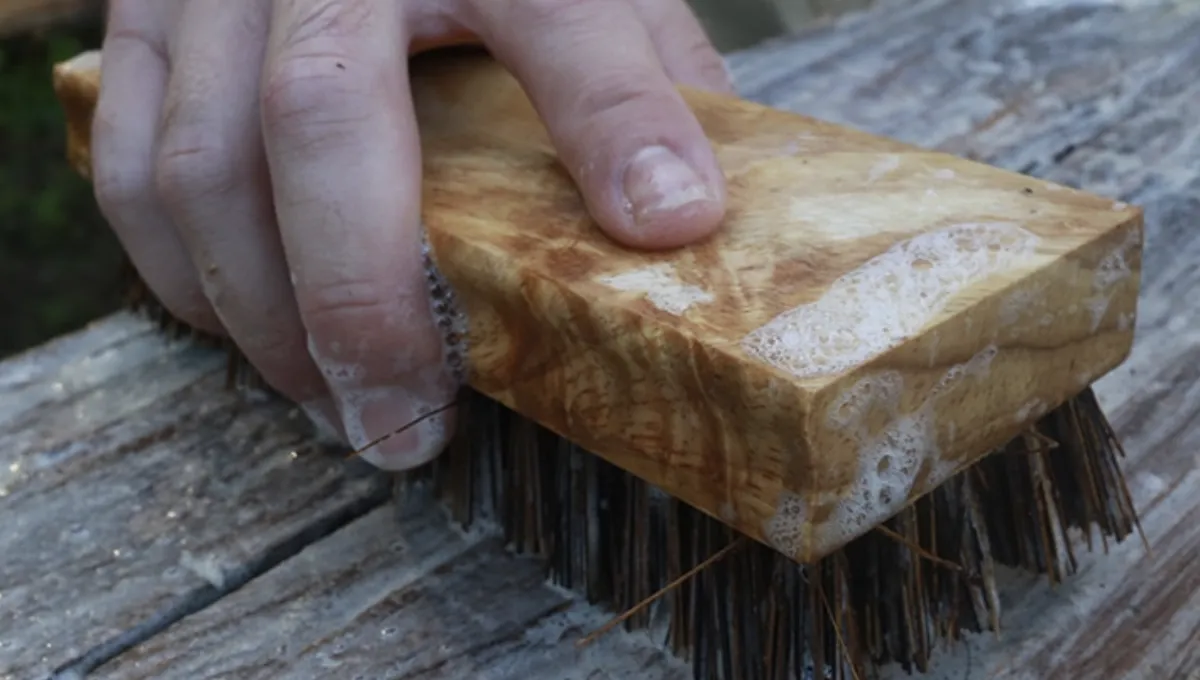
Mix your wood cleaner or oxalic acid solution according to the label usually a few tablespoons per gallon of warm water. Scrub the entire piece with a stiff brush, working with the grain. You’ll see the water run gray and brown almost immediately. That’s the oxidation and surface contamination lifting out.
Let the solution sit for five to ten minutes before rinsing. On a really weathered piece, you might do this twice. After the final rinse, let the wood dry completely and completely means at least 24 hours in decent weather, longer if it’s humid. Wet wood sands terribly and won’t absorb finish evenly.
When the piece is dry, look at it again. You’ll often be surprised. A lot of the gray will already be gone, and the grain will have started to reappear. Some pieces barely need sanding after a good cleaning.
Sanding: Less Than You Think
The goal of sanding weathered outdoor furniture isn’t to strip it down to bare, smooth wood. It’s to knock off the raised grain fibers, open the surface slightly for better oil absorption, and remove any remaining rough patches. You’re not refinishing a dining table.
Start with the80-grit if the surface is still rough or has visible checking. Keep your strokes long and consistent, always moving with the grain. Cross-grain scratches catch light and look terrible under a finish. Once the surface feels relatively even, switch to 150-grit and go over everything again. This smooths out the scratches left by the coarser paper and leaves the wood ready to drink in the oil.
Don’t obsess over perfection. Outdoor furniture has character. A few small checks or marks in the wood aren’t flaws they’re evidence of a life lived outside, and the oil will settle into them beautifully.
Wipe the piece down with a dry cloth to remove all the dust before you move on. Some people use a tack cloth, which works well, but a slightly damp rag followed by a dry one does the same job.
The Oil Is Where the Magic Happens
Penetrating oils teak oil, danish oil, linseed-based outdoor conditioners work by soaking into the wood fibers rather than sitting on top as a film. This is exactly what weathered wood needs. The fibers have been dried out and depleted of their natural oils over years of sun and rain. You’re essentially rehydrating them.
Apply the first coat generously with a brush or rag, working it into the grain. Don’t be shy. The wood will absorb more than you expect on the first coat, especially in the end grain and any cracks. Let it soak in for about 15 minutes, then wipe off the excess with a clean rag. Any oil left sitting on the surface will get tacky and sticky as it cures you want it in the wood, not on it.
Wait a few hours, then apply a second coat the same way. On very dry or porous wood, a third coat the following day isn’t overkill. Each coat goes on thinner than the last as the wood becomes more saturated.
Watch the color shift as you work. The grain comes back. The warmth returns. It’s one of those genuinely satisfying moments in a project the wood looks like it’s waking up.
One practical note: oil-soaked rags are a fire hazard. Lay them flat outside to dry completely before throwing them away, or submerge them in water in a metal container. This isn’t a scare tactic spontaneous combustion from improperly stored oily rags is a real thing.
Knowing When to Stop
There’s a temptation, once you see how good the piece looks, to keep going to add a topcoat, to sand it smother, to make it look like it just came out of a furniture store. Resist that impulse for outdoor pieces.
A heavy film finish like polyurethane on outdoor furniture will eventually peel and crack as the wood moves with temperature and humidity changes. Then you’re dealing with a much harder restoration job. Penetrating oil finishes are forgiving precisely because they don’t form a rigid surface layer. They can be refreshed with a light sanding and another coat of oil in a year or two, and the piece just keeps getting better.
The goal isn’t to make the furniture look new. It’s to make it look cared for which is a different and arguably more interesting thing.
A Few Pieces Worth Targeting
Teak, cedar, and white oak are the best candidates for this kind of restoration. They’re dense, naturally rot-resistant woods that weather gracefully and respond beautifully to oil. Teak in particular has such high natural oil content that even severely weathered pieces often come back looking extraordinary.
Pine and softer woods are trickier. They absorb oil unevenly and can look blotchy. A wood conditioner applied before the oil helps with this it pre-seals the more porous areas so the finish goes on more evenly. Add a few dollars to the budget if you’re working with pine.
Painted outdoor furniture is a different project entirely. If the paint is peeling, you’re looking at a stripper and a repaint, which is still doable on a budget but requires more time and a slightly different set of materials.
The Longer Argument for Restoration
There’s something worth saying about why this matters beyond the thirty dollars. A solid wood piece of furniture even a simple Adirondack chair or a basic porch table represents real material and real craft. Replacing it with something new usually means buying something made of composite materials or low-grade wood that will look worse in two years than the weathered piece you started with.
Restoration is slower. It requires you to actually look at the object, understand what happened to it, and work with the material rather than against it. That’s not a romantic notion it’s just a more honest relationship with the things you own.
The chair that’s been sitting gray and forgotten on your back porch for three years isn’t a problem to solve. It’s a Saturday afternoon waiting to happen.