
There’s a particular kind of frustration that comes from standing in front of a beautifully made piece of furniture and feeling like something is off. The buffet cabinet is one of those pieces that carries enormous potential it anchors a dining room, grounds a living space, and offers a surface that practically begs to be styled. And yet, more often than not, it becomes a landing strip for mail, candles bought on a whim, random frames, and whatever else didn’t find a home elsewhere. The result isn’t a styled surface. It’s a surface that quietly stresses you out every time you walk past it.
Getting this right isn’t really about following a rigid formula. It’s about understanding why clutter happens in the first place, and then making intentional choices that work with the way you actually live.
Why Buffet Cabinets Attract Chaos
The buffet is, by design, a horizontal surface at a convenient height. That combination is practically a magnet for accumulation. Psychologically, flat surfaces at waist level trigger what designers sometimes call “drop behavior” the unconscious habit of setting things down without thinking because the surface is right there and accessible. Add to that the fact that buffets are often positioned in transitional spaces between rooms, and you have a piece of furniture that absorbs the entropy of daily life faster than almost anything else in a home.
Understanding this isn’t just interesting it’s actionable. When you know why clutter collects, you can design against it. The goal isn’t to create a surface so precious that no one dares touch it. The goal is to make intentional placement so satisfying and complete that there’s no psychological room for random additions.
Start With the Cabinet Itself, Not the Objects
Before you place a single thing on top, spend a moment with the cabinet alone. Look at its proportions. Is it low and wide, or taller and more narrow? Does it have legs that create visual breathing room underneath, or does it sit flush to the floor? These physical characteristics should inform everything that goes on top of it.
A wide, low buffet the kind that stretches across most of a dining room wall can handle a more expansive arrangement. It has the visual weight to support a large mirror above it, a pair of substantial lamps, and a layered grouping of objects in between. A narrower cabinet, or one that’s more vertical in proportion, calls for restraint. Overcrowding it doesn’t make it look styled. It makes it look anxious.
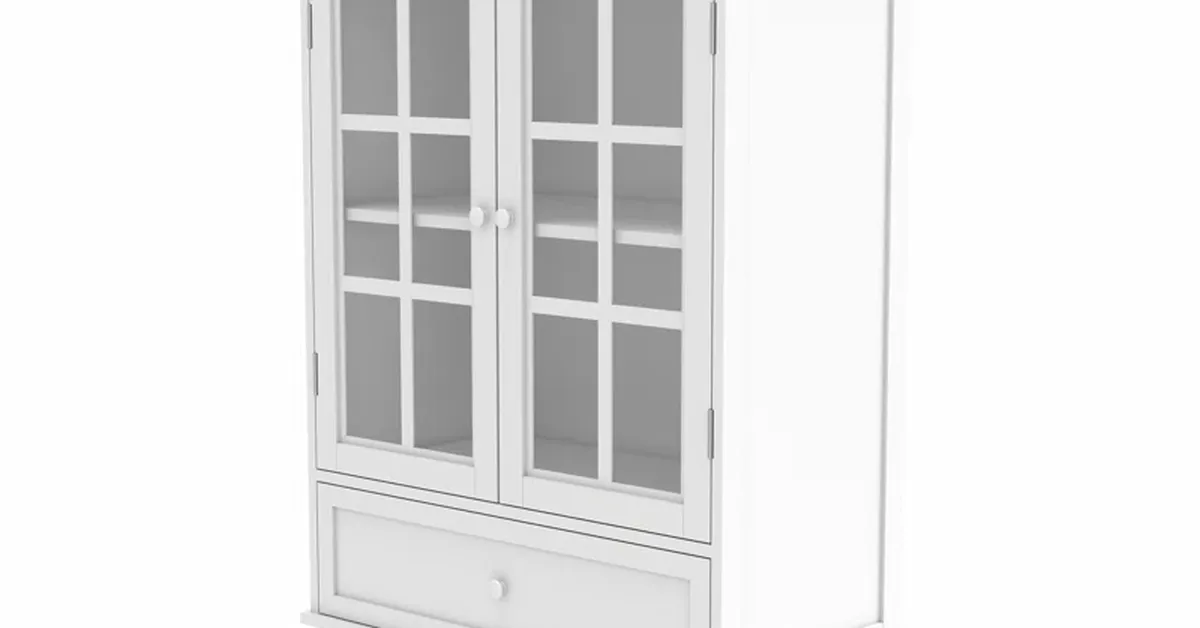
The finish matters too. A dark walnut cabinet with clean lines is already making a strong visual statement. The objects on top should complement that statement, not compete with it. A painted white cabinet with more decorative detailing can absorb a bit more visual complexity without feeling chaotic.
The Rule of Odd Numbers Is Real, But It’s Not the Whole Story
You’ve probably heard that odd numbers of objects create more visually dynamic arrangements than even numbers. That’s true, and it holds up in practice. Three objects almost always look more interesting than two or four. But the rule only works when the objects themselves have meaningful variation in height, texture, and form.
Three identical candlesticks in a row is technically an odd number grouping. It’s also completely static and a little boring. Three objects that vary say, a tall sculptural vase, a medium-height stack of art books, and a small ceramic bowl create a silhouette that moves. Your eye travels up, across, and down. That movement is what makes a vignette feel alive rather than arranged.
Think in terms of a triangle when you’re composing a grouping. The tallest element forms the apex. The medium element sits slightly in front of or beside it. The smallest anchors the base. This isn’t a rigid rule so much as a way of training your eye to think about negative space and visual flow at the same time.
Choosing Objects That Actually Belong Together
This is where most people go wrong. They pick things they love individually and place them together, then wonder why the surface looks cluttered even when there aren’t that many objects on it. The issue isn’t quantity it’s coherence.
Objects on a buffet should share at least one unifying characteristic, even if they’re otherwise quite different. That characteristic might be color a collection of objects in varying shades of cream, ivory, and warm white will feel cohesive even if they’re wildly different in material and form. It might be material mixing glass, stone, and ceramic can work beautifully when the forms are simple and the palette is restrained. Or it might be era a grouping of mid-century objects, even if they span different categories, will read as intentional rather than random.
What creates the feeling of clutter, even on a relatively sparse surface, is visual competition. Too many colors fighting for attention. Too many patterns. Too many objects of similar height with no variation. The eye doesn’t know where to rest, so it reads the whole surface as noise.
One practical approach: pull everything off the cabinet, lay it on the floor, and look at it as a collection. Does it tell a story? Does it feel like it belongs to a single point of view? If not, editing is easier when you can see everything at once rather than making decisions piece by piece on the surface itself.
The Role of Negative Space
Empty space on a buffet is not wasted space. This is genuinely difficult to internalize if you’re someone who equates fullness with effort or care. But negative space the areas of the cabinet surface that hold nothing is what gives the objects that are there room to be seen.
A common mistake is to feel like a styled buffet needs to fill the entire surface. It doesn’t. In fact, some of the most compelling buffet arrangements are asymmetrical, with a strong grouping on one end and a deliberate emptiness on the other. That emptiness creates tension. It makes the eye move. It suggests confidence the confidence of someone who knows that not every inch needs to be occupied.
If you have a longer buffet, consider anchoring one side with a lamp and a layered grouping, leaving the center relatively clear, and placing a single meaningful object a sculptural piece, a small plant, a beautiful bowl on the opposite end. The asymmetry feels considered rather than incomplete.
Lamps Change Everything
If there’s one single object that transforms a buffet from a surface to a moment, it’s a lamp. Table lamps bring warmth, height, and a sense of intimacy that overhead lighting simply cannot replicate. They also solve the height problem instantly a well-proportioned lamp gives you your tallest element without requiring you to find a vase tall enough to anchor the composition.
Buffets in dining rooms particularly benefit from lamps because dining spaces are often lit by a single overhead fixture that creates a flat, even light. A pair of lamps on a buffet or even a single lamp in an asymmetrical arrangement introduces pools of warm light that make the entire room feel more layered and inviting.
The shade matters as much as the base. A linen or fabric shade diffuses light softly. A metal or opaque shade creates more directional light and a slightly more graphic silhouette. Neither is wrong they just create different moods.
Living Elements and Why They Earn Their Place
Plants, branches, and flowers do something on a buffet that no inanimate object can quite replicate: they introduce organic irregularity. A perfectly trimmed topiary has a different effect than a loose arrangement of eucalyptus branches. Both are valid, but the looser, more natural forms tend to soften the rigidity that can make a styled surface feel like a display rather than a home.
A single stem in a simple vessel can be more effective than an elaborate floral arrangement. The restraint signals intention. It says this was placed here thoughtfully, not assembled for effect.
The key is maintenance. A wilted plant or dried-out flowers undermine everything else on the surface. If you’re not someone who reliably refreshes botanicals, high-quality faux options have improved dramatically and are a completely reasonable alternative. The goal is vitality, whether it’s real or convincing.
Editing as an Ongoing Practice
The styled buffet is not a project you complete once and never revisit. It’s more like a habit of attention. Seasons change. Objects lose their freshness when they’ve been in the same position for too long. Something that felt right in November might feel heavy by March.
The willingness to remove things to take an object off the surface because it’s stopped earning its place is what separates a home that feels genuinely curated from one that simply accumulated over time. Styling isn’t about addition. It’s about the ongoing negotiation between what stays and what goes.
The buffet cabinet, at its best, is a small argument for the idea that restraint is its own form of abundance. What you choose not to put there matters as much as what you do.