
There’s a moment most homeowners know well standing in a dining room that feels just a little too tight, watching guests squeeze past each other to reach their seats, wondering if the room itself is working against you. Square footage is expensive. Walls don’t move. And yet, some of the most beautifully proportioned dining spaces you’ve ever admired in a restaurant or a friend’s home weren’t actually larger than yours. They just felt that way.
The secret, more often than not, was a mirror.
Why the Dining Room Is the Hardest Space to Get Right
The dining area occupies a strange position in the home. It’s ceremonial a place for gatherings, celebrations, long Sunday meals but it’s also deeply functional, which means it has to accommodate furniture that’s inherently bulky. A table. Chairs that push out. A sideboard, maybe. Lighting that hangs low. All of this crowds a room before a single person sits down.
Unlike a living room, where you can float furniture toward the center and leave breathing room at the edges, a dining room is organized around one immovable object. Everything radiates outward from the table. So when the room is small, there’s nowhere for the eye to rest, nowhere for the space to exhale.
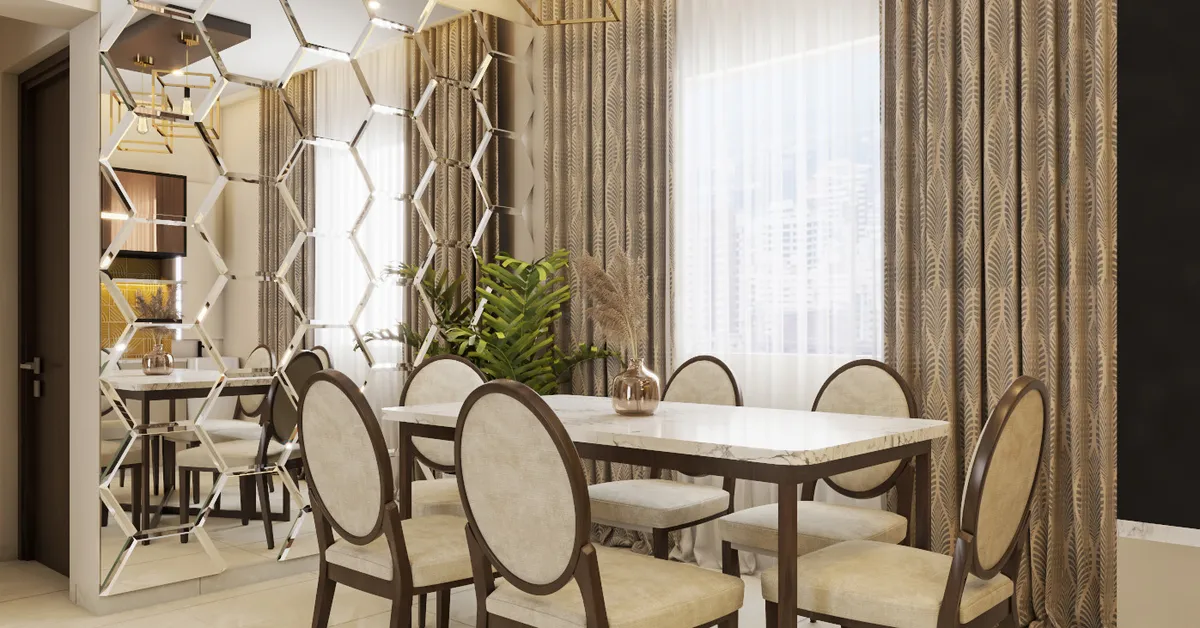
This is exactly why mirrors work so powerfully here. They don’t just reflect light they manufacture depth. They give the eye somewhere to travel when the walls are too close.
The Illusion Is Real, Even When You Know It’s an Illusion
Here’s what’s interesting about mirrors in interior design: the perceptual trick doesn’t stop working just because you understand it. You can know, intellectually, that the room ends at that wall and still feel the space open up when a large mirror hangs there. The brain processes spatial information faster than conscious thought, and it reads reflection as extension.
In a dining room, this means a well-placed mirror can functionally double your sense of the room’s size. Not its actual square footage, obviously. But the experience of being in it, which is what actually matters when you’re sitting across from someone at dinner.
Restaurants figured this out decades ago. Walk into almost any beloved neighborhood bistro the kind with close tables and low ceilings that somehow still feels intimate rather than cramped and you’ll find mirrors. Floor-to-ceiling panels along one wall, or a single oversized vintage frame propped against the wainscoting. The effect is the same: the room breathes.
Placement Is Everything and Most People Get It Wrong
Hanging a mirror in a dining room isn’t complicated, but it does require thinking about what the mirror will actually reflect. This is where most homeowners make their mistake. They choose a wall, they hang the mirror, and then they discover that what it’s reflecting is a blank wall, a dark corner, or the back of a cabinet. The mirror becomes decorative at best, and at worst it makes the room feel stranger rather than larger.
The goal is to reflect something worth doubling.
Ideally, a dining room mirror should face a window. When it does, it captures natural light and throws it back into the room brightening the space while also creating the illusion of a second source of light. On a gray afternoon, this can transform the mood of the room entirely. The light feels ambient rather than directional, and the space loses that closed-in quality that small rooms often have.
If a window isn’t available on the opposite wall, the next best option is to position the mirror so it reflects the table itself, along with whatever’s on it candles, flowers, a bowl of fruit. A dining table that’s set or styled, even casually, becomes a composition worth multiplying. The mirror turns one table into the suggestion of a room beyond a room.
Size Matters More Than Style
There’s a temptation, especially in design-conscious households, to choose a mirror for its frame first and its function second. The ornate gilded oval, the sleek black rectangle, the rustic driftwood surround all of these can work beautifully. But none of them will do much for your dining room if the mirror itself is too small.
Scale is the variable that separates a decorative mirror from a transformative one. In a dining room, you generally want a mirror that occupies at least two-thirds of the wall it’s on, either in width or in height. A mirror that’s too small reads as an object a piece of art, essentially rather than as an architectural element. The eye registers it, appreciates it, and moves on. It doesn’t fall into it.
A large mirror, by contrast, stops feeling like a mirror at all. It becomes a presence. Guests glance toward it and their brain hesitates is that another room? It’s a fraction of a second of confusion, quickly resolved, but in that fraction of a second the space has expanded.
Leaning a large mirror against a wall, rather than hanging it, can amplify this effect. The slight angle changes what it reflects as you move through the room, creating a sense of dynamic space rather than a static reflection. It also reads as more casual, which suits dining rooms that lean toward the relaxed rather than the formal.
The Candlelight Effect No One Talks About Enough
There’s one specific moment when a dining room mirror earns its place beyond any doubt, and that’s dinner by candlelight.
Candles in a mirrored room don’t just flicker they multiply. A single taper becomes two. A cluster of votives becomes a constellation. The warm, unsteady light bounces between the mirror’s surface and the glass of wine on the table and the faces of the people gathered there, and the room takes on a quality that’s almost impossible to achieve any other way. It feels larger, yes, but it also feels richer. More alive.
This is the part of the mirror conversation that rarely comes up in design guides focused on square footage and spatial tricks. The mirror isn’t just solving a size problem. It’s participating in the atmosphere of the meal. It turns a Tuesday dinner into something that feels considered.
When to Use Multiple Mirrors Instead of One
A single large mirror is usually the right call for a dining room, but there are configurations where multiples make more sense. Long, narrow dining rooms the galley-style spaces common in urban apartments and older homes can feel like corridors no matter what you do with the furniture. In these cases, placing mirrors on both of the long walls creates a hall-of-mirrors effect that, used thoughtfully, reads as depth rather than disorientation.
The key is to keep the mirrors at the same height and in frames that share at least one visual characteristic material, finish, or proportion. Mismatched mirrors in a narrow room create visual noise that compounds the sense of constriction rather than relieving it.
Another approach that works well in compact dining areas is a mirrored sideboard or buffet. The reflective surface is lower and more horizontal, which draws the eye outward rather than upward, making a room with low ceilings feel wider rather than taller. It’s a subtler effect than a wall mirror, but in the right space it’s exactly the right kind of subtle.
What the Mirror Is Really Doing
Step back from the mechanics for a moment the angles, the reflections, the light and consider what a mirror in a dining room actually offers: it gives people a reason to linger.
A room that feels spacious and warm and alive doesn’t make you want to clear the plates quickly and move on. It makes you want to refill your glass and keep talking. The conversation stretches. The evening extends. And the room, which was always the same size, feels like it was made for exactly this.
That’s not a small thing. In a home, the spaces that invite you to stay are the ones that matter most.