
There’s a specific kind of magic that happens in a well-lit backyard after dark. The lawn furniture you’ve walked past a hundred times suddenly looks intentional. The tree in the corner becomes a focal point. Guests linger longer than they planned. None of this is accidental it’s the result of light placed with purpose, and it’s more achievable than most people think.
The problem is that most backyards fall into one of two traps: either a single overhead floodlight that turns the whole space into a parking lot, or a scattering of solar path lights that barely glow by 9 PM. Neither creates atmosphere. Both miss the point entirely.
Good outdoor lighting isn’t about brightness. It’s about dimension.
Start With Layers, Not Fixtures
Interior designers have known for decades that layered lighting ambient, task, and accent is what separates a space that feels alive from one that feels flat. The same principle applies outside, maybe even more so.
Ambient light sets the overall mood. Think string lights draped overhead, a softly glowing lantern on the table, or low-wattage wall sconces near the back door. These aren’t meant to illuminate anything specific. They’re the background hum of the whole scene.
Task lighting is functional the light over the grill, the fixture above the outdoor kitchen counter, the reading lamp next to the lounge chair. It should be bright enough to be useful but contained enough that it doesn’t bleed into the rest of the space.
Accent lighting is where the personality lives. A spotlight aimed at a sculptural plant. Uplights buried at the base of a tree. A strip of LED tucked under a deck railing. These are the details that make people stop and say, “I love what you’ve done out here.”
Most backyards only have one layer, usually ambient, and it’s doing all the heavy lifting. Add the other two and the whole space transforms.
The String Light Problem (And How to Solve It)
String lights are everywhere, and for good reason they’re affordable, warm, and genuinely beautiful when done right. The issue is that most people hang them wrong.
Draping them loosely from a single hook to a fence post creates a sad, drooping line that looks more like a forgotten holiday decoration than intentional design. The fix is structure. Run them in a grid pattern overhead, anchored to sturdy posts or a pergola, so they create a canopy effect. When you’re sitting beneath them, the result is something close to dining under stars.
Bulb choice matters more than people realize. The classic Edison-style bulbs with visible filaments cast a warm, amber glow that photographs beautifully and feels genuinely romantic. Avoid the cool white or daylight options they read as clinical outdoors, especially against the natural darkness of a yard. Stick to 2200K to 2700K color temperature. That range is where warmth lives.
Spacing matters too. Bulbs set 6 to 9 inches apart create a denser, more luxurious look. The bargain sets with 12-inch spacing tend to look sparse once they’re actually up.
Uplighting Changes Everything
If there’s one technique that separates a thoughtfully designed backyard from a generic one, it’s uplighting. The concept is simple place a light source at ground level and aim it upward but the effect is dramatic in a way that’s hard to achieve any other way.
A mature tree with uplights at its base becomes a centerpiece. The light catches the texture of the bark, throws shadows through the canopy, and creates depth that no overhead fixture can replicate. Even a modest shrub or ornamental grass can look architectural with a single well-placed uplight.
The key is restraint. Two or three uplights placed strategically will do more for your backyard than a dozen scattered randomly. Pick your best features the tree with the interesting silhouette, the stone wall, the pergola post and light those. Let the rest stay in shadow. Contrast is what makes the lit elements pop.
Spike-mounted spotlights are the easiest entry point. They’re inexpensive, adjustable, and you can reposition them as your plants grow or your layout changes. For a more permanent setup, in-ground well lights are cleaner and more weather-resistant, but they require a bit more planning before installation.
Path Lighting That Doesn’t Look Like an Airport Runway
Path lights serve a real purpose they guide people safely through the yard, mark the edge of a walkway, and prevent the kind of stumbling that ends parties early. But the standard approach, a row of matching fixtures spaced evenly down both sides of a path, tends to look institutional rather than inviting.
A few adjustments change the whole feel. Alternate the placement put lights on one side, then the other, in a staggered pattern rather than parallel rows. It reads as more organic, less like a landing strip.
Consider the fixture height too. Most path lights sit about 12 to 18 inches off the ground, which puts the light source right at eye level when you’re seated. That creates glare. Lower-profile fixtures, or ones with shielded tops that direct light downward, are far more comfortable to be around.
The path itself doesn’t need to be bright it just needs to be visible. A soft wash of light along the edges is enough. Save the brighter fixtures for areas where people will actually stop and gather.
Fire and Candles: The Irreplaceable Element
No amount of electric lighting fully replicates what fire does to a space. There’s something about a flame the movement, the warmth, the slight unpredictability that draws people in and slows the pace of conversation.
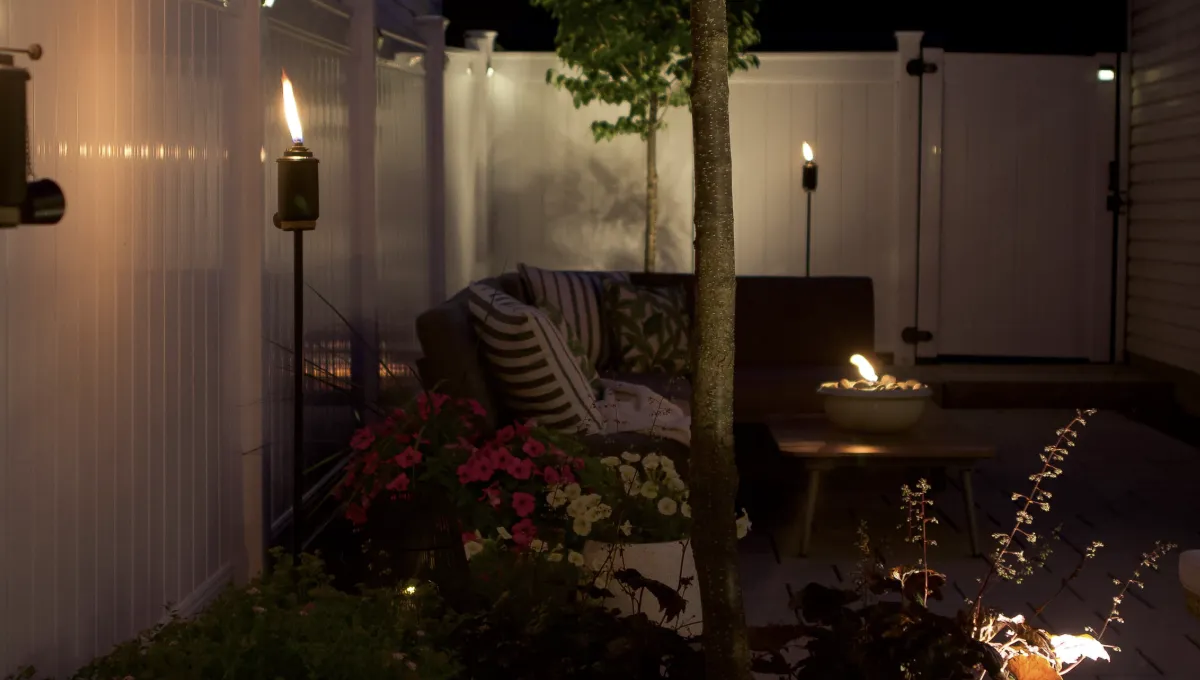
A fire pit is the obvious choice, and if you have the space and the budget, it’s worth every penny. But even without one, candles and lanterns can do real work. A cluster of pillar candles on the dining table, varying heights, creates a centerpiece that’s both functional and beautiful. Hurricane lanterns hung from shepherd’s hooks around the perimeter add warmth without requiring any wiring.
For areas where open flame isn’t practical a covered patio, a space near dry landscaping flameless LED candles have gotten genuinely good. The flicker algorithms on the better ones are convincing enough that guests often don’t notice the difference until they reach out to touch one.
The trick with fire elements is placement. They work best as focal points, not fill lighting. A fire pit in the center of a seating area, a cluster of candles on the table, a lantern marking the entrance to the garden each one becomes a destination, a reason to move through the space.
Color Temperature Is the Detail Most People Skip
Walk through any hardware store and you’ll find outdoor bulbs labeled “warm white,” “cool white,” and “daylight.” Most people grab whatever’s on sale. This is a mistake that quietly undermines everything else.
Color temperature is measured in Kelvins. Lower numbers are warmer and more amber. Higher numbers are cooler and bluer. For evening outdoor use, you almost always want to stay below 3000K. The 2700K range is the sweet spot warm enough to feel intimate, bright enough to be functional.
Cool white and daylight bulbs (4000K and above) are fine for security lighting or task areas where you need to see clearly. In social spaces, though, they create a harshness that makes people feel like they’re being examined rather than relaxed. The color of the light affects how people feel in a space, often without them being able to articulate why.
If you’re mixing different light sources string lights, path lights, spotlights try to keep them all within the same color temperature range. Mixing warm and cool sources creates a visual discord that’s subtle but real.
Dimmers and Smart Controls: The Underrated Upgrade
The ability to adjust your lighting based on the moment is more valuable than any single fixture. A backyard set up for a dinner party needs different light than one winding down at midnight with a few close friends and a bottle of wine.
Outdoor dimmer switches are widely available and relatively easy to install. For string lights and most standard fixtures, a simple plug-in dimmer is enough. For hardwired systems, an outdoor-rated dimmer switch at the circuit level gives you more control.
Smart plugs and smart bulbs take this further. Being able to adjust the brightness of your string lights from your phone, or set them to automatically dim after 10 PM, removes the friction of managing the mood manually. Some systems let you create scenes a “dinner” setting, a “late night” setting that you can trigger with a single tap. The investment is modest. A few smart plugs and a basic app can transform a static lighting setup into something genuinely responsive.
The One Mistake Worth Avoiding
The most common error in backyard lighting isn’t a wrong fixture or a bad bulb. It’s over-lighting. The instinct to make everything visible, to eliminate all shadow, works directly against the atmosphere you’re trying to create.
Shadow is not the enemy. It’s part of the composition. A backyard where every corner is equally lit feels flat and a little anxious, like a space that doesn’t trust itself. The backyards that feel genuinely magical are the ones where light and dark exist in conversation where the lit areas feel warm and intentional precisely because the unlit areas give them contrast.
Light what matters. Let the rest breathe.
The best evening backyards aren’t the ones with the most lights. They’re the ones where every light was placed with a reason, and where the darkness between them was left alone on purpose. That’s the difference between a backyard that’s lit and one that actually glows.