
There’s a particular kind of longing that comes with a small outdoor space. You stand on your balcony, or look out at a narrow side yard, and you feel the pull of something grener, wilder, more alive but the square footage just isn’t there. A patio table takes up half the floor. A few poted plants crowd the rest. And the dream of a lush, breathing garden starts to feel like something reserved for people with acreage.
Vertical gardening quietly dismantles that assumption.
It’s not a new concept humans have been training vines up walls and trellises for centuries but the modern iteration has evolved into something far more intentional and far more accessible. What was once a niche technique for serious horticulturalists has become one of the most practical design movements in urban living. And the reason is simple: when you can’t go out, you go up.
Why the Walls Became the Garden
The shift toward vertical growing didn’t happen in a vacuum. It’s a direct response to the way cities have changed. Apartment living has become the norm for a growing share of the population, and with it comes the reality of outdoor spaces measured in square feet rather than acres. Roftop terraces, juliet balconies, narrow courtyard strips these are the gardens people actually have.
At the same time, there’s been a cultural reckoning with what greenery does for us. Research has consistently shown that access to plants reduces stress, improves air quality, and creates a psychological sense of refuge. People aren’t just growing tomatoes for the harvest. They’re growing things because the act of tending something alive, and being surrounded by it, genuinely changes how a space feels.
Vertical gardens sit at the intersection of those two realities. They answer the spatial constraint without asking you to sacrifice the experience of being immersed in green.
The Spectrum of Vertical Systems
Walk into any garden center or scroll through any outdoor design platform and you’ll find that “vertical garden” covers a surprisingly wide range of approaches. Understanding the differences matters, because the right system depends entirely on your space, your climate, and how much ongoing attention you’re willing to give.
The simplest entry point is the trellis or wire grid. You mount a structure to a wall or fence, and you let climbing plants do the work. Clematis, jasmine, climbing roses, passionflower these plants are essentially designed for this purpose. They reach, they grip, they spread. The maintenance is relatively low once established, and the visual payoff can be dramatic. A bare concrete wall can become a cascade of bloms within a single growing season.
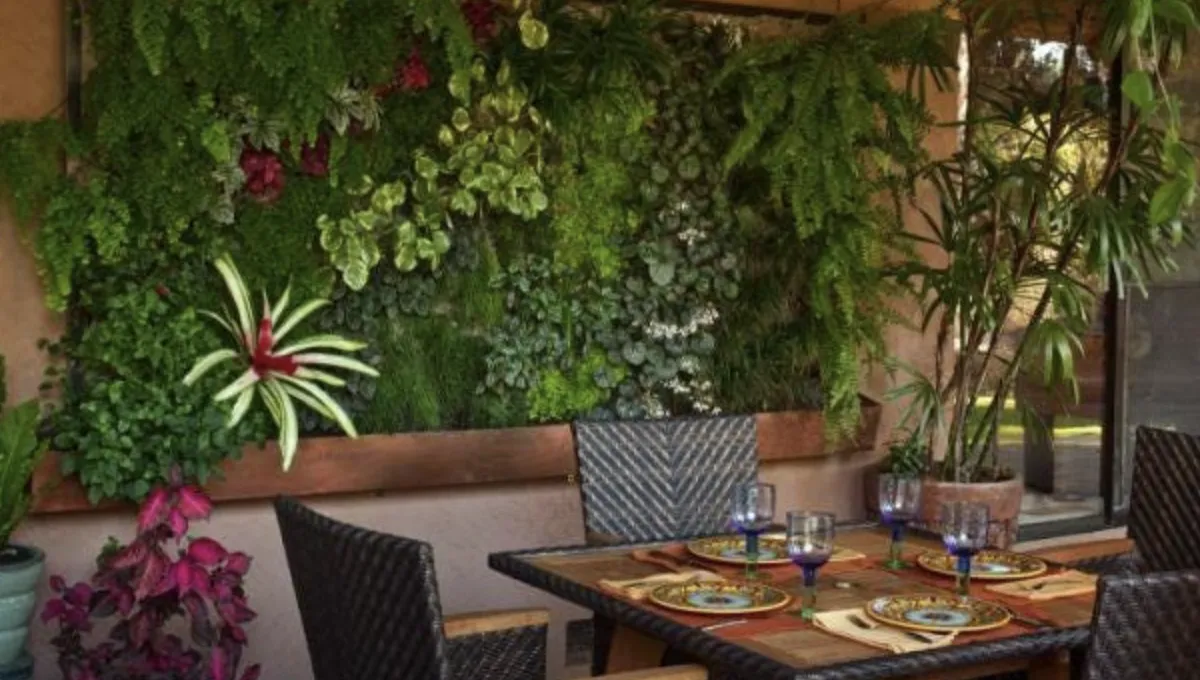
Pocket planters and modular panel systems take a more architectural approach. These are the living walls you see on restaurant patios and boutique hotel facades rows of individual planting pockets arranged in a grid, each holding a small plant or cluster of herbs. They’re visually striking and highly customizable, but they come with real demands. Each pocket holds a limited volume of soil, which means watering needs are frequent and consistent. In hot climates, a pocket wall can dry out within a day. Many serious installations incorporate drip irrigation systems precisely because hand-watering at scale becomes unsustainable.
Then there are freestanding vertical planters tiered towers, ladder shelves, stacked containers which offer flexibility without requiring you to drill into a wall. These work particularly well on rental balconies where permanent installation isn’t an option. They can be repositioned to follow sunlight, brought indoors during frost, or reconfigured as your plant collection changes.
Each approach has its logic. The mistake most people make is choosing based on aesthetics alone, then discovering the maintenance reality too late.
Choosing Plants That Actually Want to Grow This Way
The plant selection question is where vertical gardening either succeeds or quietly falls apart. Not every plant is suited to vertical life, and forcing the wrong species into a wall system leads to the kind of slow, dispiriting decline that makes people give up on the whole idea.
For pocket and panel systems, the most reliable performers tend to be shallow-rooted and drought-tolerant. Suculents are the obvious choice sedums, echeverias, and sempervivums thrive in limited soil volume and forgive inconsistent watering. Ferns and moses work beautifully in shadier, more humid conditions. Herbs like thyme, oregano, and mint are practical and resilient, though mint’s aggressive spreading habit is actually an asset in a contained pocket rather than a liability.
Edible vertical gardens have become their own subgenre. Strawberries are almost perfectly designed for tower planters their trailing habit means the fruit hangs freely and is easy to harvest. Letuces and spinach grow quickly in shallow soil and tolerate partial shade, making them ideal for walls that don’t get full sun all day. The satisfaction of cutting salad greens from a wall-mounted planter outside your kitchen door is, frankly, disproportionate to the effort involved.
For trelis systems, the key is matching the plant’s vigor to the structure’s capacity. A delicate wire grid will be overwhelmed by a wisteria within two seasons. Wisteria is beautiful and it will absolutely destroy your fence if you let it. Lighter climbers sweet peas, black-eyed Susan vine, nasturtiums are more forgiving and easier to manage in tight spaces.
One underappreciated consideration is weight. A fully saturated living wall panel is heavy. If you’re mounting anything substantial to a fence or exterior wall, the structural integrity of that surface matters. This is the kind of detail that gets skipped in the excitement of planning, and it’s the kind of detail that leads to a collapsed installation on a rainy Tuesday.
The Design Logic Behind a Vertical Garden
Beyond the practical mechanics, there’s a design intelligence to vertical gardening that’s worth thinking through deliberately. A well-executed vertical garden doesn’t just add plants to a space it changes the spatial experience entirely.
Height draws the eye upward, which makes a small area feel larger. This is the same principle that interior designers use when they hang curtains close to the ceiling rather than just above the window frame. A wall of greenery creates a visual boundary that feels organic rather than constructed, softening the hard edges of fences, concrete, and brick. In a narrow courtyard, a planted wall one end can create the illusion of depth, making the space feel like it extends beyond its actual dimensions.
Color and texture layering matters here in ways it doesn’t always in traditional garden beds. Because you’re working on a vertical plane, the composition is more like a painting than a landscape. Mixing fine-textured plants like ferns with bold, graphic leaves like hostas or caladiums creates visual rhythm. Trailing plants that spill out of their pockets add movement and soften the geometry of the structure beneath.
Lighting is another dimension that often gets overlooked in the planning phase. A vertical garden that looksush and green in daylight can become a completely different thing at night with the right uplighting. Low-voltage LED spotlights positioned at the base of a planted wall cast dramatic shadows and turn an ordinary balcony into something that feels genuinely designed.
The Maintenance Reality Nobody Talks About Enough
There’s a version of the vertical garden conversation that focuses almost entirely on inspiration the gorgeous Instagram walls, the lush hotel courtyards, the before-and-after transformations. What gets less airtime is the ongoing relationship you’re entering into when you build one.
Living walls are not set-and-forget installations. They require consistent watering, periodic fertilizing, and regular editing removing dead or struggling plants, replacing them with healthy ones, managing growth so that vigorous species don’t crowd out their neighbors. The more complex the system, the more attention it demands.
This isn’t an argument against vertical gardens. It’s an argument for honesty about what you’re signing up for. A simple trellis with a single climbing plant is genuinely low-maintenance once established. A 40-pocket living wall panel with a diverse plant mix is a commitment that requires weekly attention at minimum.
The people who have the most success with vertical gardens tend to be the ones who started smaller than they thought they needed to, learned the rhythms of their specific system and microclimate, and expanded from there. The ones who struggle are usually the ones who installed something ambitious all at once and then discovered that the gap between the vision and the daily reality was wider than expected.
There’s also the question of seasonal change. In colder climates, a vertical garden that looks spectacular in July will need a plan for October. Some plants can be overwintered in place with protection. Others need to come down entirely. Building that transition into your thinking from the beginning rather than confronting it as a surprise makes the whole endeavor more sustainable.
What It Actually Feels Like to Live With One
Ask someone who has a thriving vertical garden what they notice most, and the answers tend to be less about aesthetics and more about atmosphere. The way the light moves through layered leaves in the late afternoon. The sound of bees working through a wall of flowering herbs on a warm morning. The smell of wet soil after rain, concentrated and immediate in a way that a ground-level garden somehow isn’t.
Small outdoor spaces have a particular intimacy that larger gardens don’t. You’re closer to everything. The scale is human in a way that a sprawling backyard isn’t always. A vertical garden amplifies that intimacy it brings the living world right up to the edge of where you sit, eat, read, or simply exist outside.
That proximity changes things in ways that are hard to quantify but easy to feel. The balcony stops being a transitional space between inside and outside and becomes a destination in itself. The narrow side yard stops being a problem to solve and starts being a place you actually want to spend time in.
That transformation from constraint to character is probably the most honest argument for vertical gardening. Not the square footage math, not the design theory, not even the plant science. Just the simple fact that a wall covered in living things makes you want to stay.