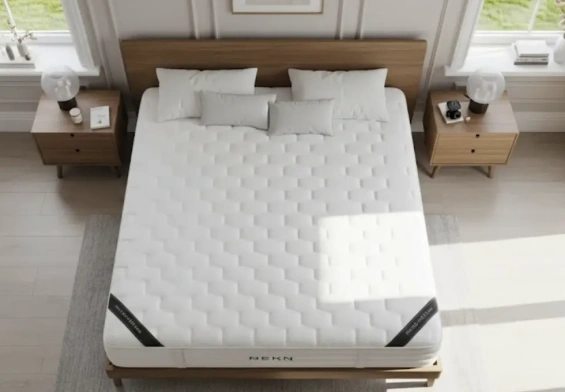

There’s a wall in your home that sees you at your most unguarded. It watches you fall asleep mid-sentence with a book on your chest. It’s the backdrop to Sunday mornings that stretch past noon, to the quiet dread of Monday alarms, to the conversations that only happen in the dark. And yet, for most people, that wall the one directly behind the bed is painted the same builder-grade white as every other surface in the room, completely ignored, utterly forgettable.
That’s a strange kind of neglect when you think about it. We obsess over throw pillows. We agonize over duvet covers. We spend real money on nightstands that photograph well. But the largest vertical surface in the bedroom, the one that frames the entire space and anchors every other design decision, gets a coat of eggshell and a shrug.
It deserves better. And honestly, so do you.
The Wall That Sets the Tone for Everything Else
Interior designers have a term for it the focal wall, sometimes called the feature wall or accent wall but the concept is older than the terminology. Long before anyone was pining bedroom inspo to a mood board, architects and decorators understood that a room needs a visual anchor. Something the eye travels to first, something that gives the space a sense of intention.
In a bedroom, that anchor is almost always the wall behind the bed. It’s where your gaze lands when you walk through the door. It’s the frame around the headboard, the backdrop to the lamps, the context that makes everything else in the room either cohere or clash. When that wall is blank, the room feels unfinished in a way that’s hard to articulate but impossible to ignore. It’s like a sentence that trails off without The moment you do something deliberate with it, the whole room shifts. Not because you’ve added more stuff, but because you’ve given the space a center of gravity.
Why We Keep Ignoring It
Part of the problem is practical. The wall behind the bed is partially hidden by the headboard, by pillows stacked three deep, by the general visual noise of a lived-in bedroom. It’s easy to convince yourself that nobody really sees it, that the effort isn’t worth it.
But that logic falls apart the second you actually look. The wall above the headboard is fully visible. The portions on either side of the bed are fully visible. And even the section the headboard covers matters, because it affects the overall depth and richness of the room in ways that register subconsciously even when they’re not consciously noticed.
There’s also a fear factor. A statement wall feels permanent in a way that a new throw blanket doesn’t. What if you get tired of it? What if it’s too bold? What if it dates the room? These are reasonable concerns, but they tend to be overweighted. Wallpaper comes down. Paint gets repainted. The risk of doing something interesting is almost always lower than it feels in the planning stage.
The real risk, the one people underestimate, is spending years in a bedroom that never quite feels like yours.
What “Statement” Actually Means
Here’s where a lot of people go wrong: they conflate “statement” with “loud.” They picture a wall covered in neon geometric wallpaper or a mural of a tropical forest and immediately decide it’s not for them. Which is fair. That might genuinely not be for them.
But a statement wall isn’t about volume. It’s about intention. A single coat of deep, saturated color a mody forest green, a dusty teracotta, a near-black navy can be a statement without being aggressive. A wall of limewash paint that shifts between warm white and pale gray depending on the light is a statement. A grid of matching frames, carefully spaced, is a statement. Shiplap painted the same color as the rest of the room is a statement. The common thread isn’t drama. It’s deliberateness.
The question to ask isn’t “Is this bold enough?” It’s “Does this feel like a choice I made, rather than a default I accepted?”
The Case for Wallpaper (Even If You’ve Dismissed It)
Wallpaper has had a complicated reputation in American homes. For a generation that grew up stripping their parents’ floral borders in the nineties, the word alone can trigger a mild anxiety response. But the wallpaper available now is genuinely different in quality, in design, and in how it’s applied and removed.
Peel-and-stick options have made the commitment question almost irrelevant. You can cover an entire accent wall in a textured grasscloth-look paper, live with it for two years, and remove it without damaging the drywall underneath. Traditional paste wallpaper, meanwhile, has become a legitimate art form, with independent designers producing patterns that feel more like collected prints than mass-produced product.
For the wall behind the bed specifically, wallpaper works particularly well because the scale is right. A large-format botanical print, a subtle geometric, a mody abstract these patterns need room to breathe, and single wall gives them exactly that without overwhelming the space. You get the full effect of the design without the room starting to feel like the inside of a gift box.
Paint Alone Can Do More Than You Think
If wallpaper still feels like too much, paint is more powerful than most people give it credit for as long as you’re willing to commit to a real color.
The mistake is going halfway. Choosing a color that’s almost the same as the adjacent walls, or picking a shade so pale it only reads as different in direct sunlight, produces a result that looks like an accident rather than a decision. The wall behind the bed can handle depth. It can handle saturation. In fact, it often benefits from it, because the darkness or richness of the color creates a sense of enclosure that makes the bed feel more like a destination and less like furniture that happens to be in the room.
Limewash and color-wash techniques add another dimension entirely. Unlike flat paint, these finishes have movement they absorb and reflect light differently across the surface, creating a texture that reads almost like plaster or aged stone. The effect is warm and organic in a way that flat paint simply can’t replicate, and it works in rooms that might feel too small or too formal for wallpaper.
Texture, Wood, and the Tactile Dimension
There’s something worth saying about the difference between a wall you look at and a wall you want to touch. Texture changes the sensory register of a room in a way that color alone doesn’t, and the bedroom more than any other space in the house benefits from that kind of warmth.
Wood paneling has made a serious comeback, and for good reason. A wall of vertical shiplap, horizontal planks, or even a more architectural board-and-batten treatment adds depth and craftsmanship that paint can’t fake. Painted in a single color especially a warm white, a soft sage, or a deep charcoal it reads as sophisticated rather than rustic. The shadow lines created by the individual boards give the wall a three-dimensional quality that shifts subtly throughout the day as light changes.
Fabric panels are another option that rarely gets enough attention. Upholstered wall panels, whether DIY or custom, add acoustic softness to a room while creating a visual richness that’s genuinely hard to achieve any other way. In a bedroom, where sound matters and comfort is the whole point, that combination of visual and tactile warmth is hard to argue with.
Scale, Proportion, and the Details That Make It Work
A statement wall that doesn’t account for the proportions of the room can feel off in ways that are hard to diagnose. The most common mistake is treating the wall as an isolated surface rather than as part of a composition that includes the bed, the ceiling height, the width of the room, and the placement of windows and doors.
In a room with low ceilings, vertical elements tall headboards, vertical paneling, floor-to-ceiling curtains on adjacent walls help draw the eye upward and create the illusion of height. In a room with high ceilings, horizontal treatment or a wallpaper with a strong horizontal pattern can bring the scale back down to something that feels intimate rather than cavernous.
Lighting matters more than most people realize. The wall behind the bed is often the least naturally lit surface in the room, which means artificial lighting sconces, picture lights, even a well-placed floor lamp can dramatically change how a treatment reads. A dark paint color that looks oppressive in a showroom can feel deeply cozy and enveloping when it’s lit from the sides by warm-toned sconces. The light is part of the design.
The Emotional Argument
All of this the wallpaper options, the paint techniques, the paneling choices is really in service of something simpler. The bedroom is the room where you begin and end every single day. It’s where you’re most yourself, most vulnerable, most in need of an environment that feels genuinely considered.
There’s a version of interior design that’s entirely about impressing guests, about the living room that photographs well and the kitchen that signals a certain kind of taste. The bedroom isn’t that. Nobody else is really in there. Which means the choices you make in that room are purely for you and that makes them more important, not less.
Waking up to a wall that feels intentional, that reflects something about who you are or what you find beautiful, is a small thing in the grand scheme. But small things, repeated every morning for years, have a way of adding up. The wall behind your bed isn’t just a surface. It’s the first thing your eyes find when the alarm goes off and the last thing they rest on before you close them. That’s nothing. That’s actually quite a lot.