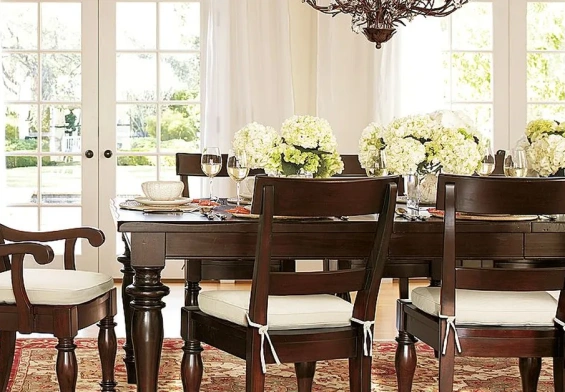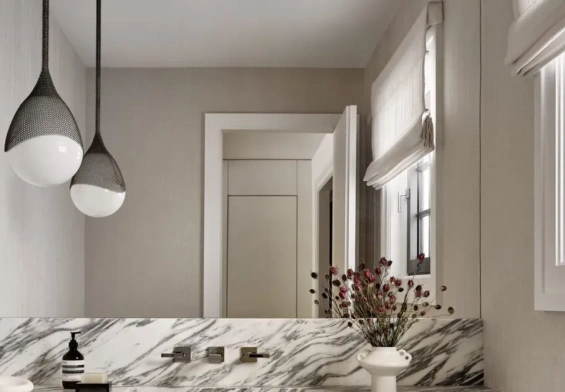


There’s a moment most people have experienced but rarely examined you sit down at a dining table, glance sideways, and catch your own reflection in a large mirror across the room. For a split second, the space feels bigger, the light warmer, and the meal somehow more ceremonial. It’s not magic. It’s not even particularly mysterious. But it is deliberate, and the people who understand it are eating better, living better, and hosting with a quiet confidence that’s hard to pin down until you realize what’s different about their rooms.
The oversized mirror near the table is one of those design decisions that operates on multiple levels simultaneously spatial, psychological, social, and deeply personal. Most people treat mirrors as afterthoughts, something to check your collar before leaving the house. But positioned correctly, a large mirror adjacent to your dining or work table becomes one of the most quietly powerful objects in any room.
The Physics of Perceived Space
Let’s start with the obvious and work toward the less obvious. A large mirror reflects light. That’s elementary. But what it does with that light bouncing it from windows, from candles, from overhead fixtures is something no paint color or open shelving can replicate. Light that enters a room from one direction suddenly appears to come from two. A window reflected in a full-length or oversized wall mirror creates the illusion of a second window, and the brain, which is not particularly sophisticated when it comes to spatial parsing in real time, accepts this without argument.
In smaller dining rooms or apartments where the table is necessarily pressed against a wall, this effect is transformative rather than merely decorative. The room doesn’t just look bigger it feels less pressured. You’re not sitting in a box. You’re sitting at the edge of something that extends beyond what you can directly see. That psychological release, subtle as it is, changes how long people want to stay at the table.
Restaurants have known this for decades. The mirrored walls of classic Parisian brasseries weren’t purely aesthetic choices. They were crowd management and atmosphere engineering. A room that feels expansive encourages lingering. A room that feels cramped encourages people to eat quickly and leave. If you’ve ever wondered why certain dinner parties at someone’s apartment feel effortless and others feel slightly claustrophobic despite similar guest counts, the answer is often spatial perception and a well-placed mirror is one of the most efficient corrections available.
Light Has Memory, and Mirrors Are Its Archive
There’s a quality of light that exists only when it has been reflected rather than received directly softer, slightly diffused, less harsh on faces and food alike. Photographers and cinematographers call it “bounced light,” and they spend considerable effort and equipment recreating what a large mirror does naturally and for free.
At a dining table specifically, this matters more than people realize. Overhead lighting, which is how most tables are lit, creates unflattering shadows on faces and makes food look flat. A large mirror positioned to the side of the table catches that overhead light and throws it back horizontally, filling in shadows, warming the scene, making everyone at the table look better without anyone quite understanding why.
This isn’t a trivial point. The experience of a meal is inseparable from the visual experience of the people you’re sharing it with. When faces are lit well, conversation feels easier. There’s less unconscious strain, less of that slightly uncomfortable feeling of sitting under a spotlight while trying to be relaxed. The mirror doesn’t just change the room it changes the people in it, or at least the way they appear to themselves and each other.
The Social Architecture of Reflection
Here’s where things get genuinely interesting. A large mirror near a table doesn’t just reflect space and light it reflects activity. When you’re seated at a table, the mirror shows you what’s happening behind you, to the side of you, slightly outside your direct field of vision. This creates a particular kind of ambient awareness that is, for most people, unconsciously pleasurable.
In restaurants, this is why corner seats with mirror views are consistently preferred. You get the security of having a wall behind you while also maintaining visual access to the broader room. It satisfies something old in human psychology the desire to see without being fully exposed, to be part of a scene while also being able to observe it.
In a home dining room, this translates differently but no less powerfully. A mirror near the table means you can watch someone in the kitchen without turning your head. It means the room feels inhabited from multiple angles even when you’re alone. Eating alone at a table with a large mirror nearby is a genuinely different experience from eating alone in a bare room less isolating, more like being a participant in a scene rather than a solitary figure in an empty stage.
Some people find this uncomfortable at first. There’s a self-consciousness that comes with being reflected, a sense of being watched by yourself. But this tends to dissolve quickly, and what replaces it is something closer to presence a heightened awareness of being in a specific place, at a specific time, doing a specific thing. Meals become less automatic.
Proportion and the Art of Getting It Wrong
The word “oversized” in this context is doing important work. A small mirror near a table accomplishes almost none of what’s been described above. It reflects a fragment. It creates a focal point without creating an experience. The mirror needs to be large enough that it captures the table, the people at it, the light sources, and a meaningful portion of the room otherwise it’s decoration, not transformation.
The common mistake is choosing a mirror that feels appropriately sized when viewed alone on a wall, then discovering it’s swallowed by the room once furniture is present. Interior designers generally recommend going larger than feels comfortable in the showroom or on the floor of a home goods store. The mirror that seems almost too big in isolation is usually exactly right once it’s doing its job within the full context of a furnished room.
Height matters too. A mirror hung at eye level when standing is hung too high for a dining context. The center of the mirror should sit closer to seated eye level, which means lower than most people instinctively hang them. When the reflection captures the table itself the food, the glasses, the hands of the people eating the effect becomes complete. You’re not just reflecting the room. You’re reflecting the life happening in it.
When the Table Is a Desk
Everything above applies equally to a work table or desk, and perhaps even more so. The long hours spent at a desk are hours spent in a fixed position, in a fixed direction, in a fixed psychological state. A large mirror adjacent to a work table introduces peripheral movement, reflected light, and a subtle expansion of the visual field that counteracts the tunnel-vision quality that deep work can produce.
There’s also something about seeing yourself work not obsessively, not distractingly, but in the peripheral way a mirror allows that creates a mild sense of accountability and presence. You’re less likely to drift into a phone scroll when you’re faintly visible to yourself. The reflection is not a surveillance mechanism. It’s more like a soft reminder that you exist in a body, in a room, doing something with your time.
Some designers and architects refer to this as “soft environmental feedback” the way a space can gently orient your behavior without explicit instruction. The mirror near a work table is one of the cleanest examples of this principle in domestic design.
Choosing the Frame as Carefully as the Glass
The frame of an oversized mirror near a table is not merely cosmetic. It’s the object’s relationship with everything else in the room. A heavy ornate gold frame in a spare, modern dining room creates tension sometimes productive tension, sometimes just noise. A frameless mirror in a room full of warm wood and textile layers can feel clinical and cold.
The frame is how the mirror speaks to its surroundings. It’s worth spending as much time on the frame as on the size and placement, because a mirror that fights its environment will always feel like an intrusion rather than an anchor.
When it works when the size is right, the placement is thoughtful, the frame belongs the oversized mirror near a table stops being a mirror. It becomes part of the room’s logic, part of why the room feels the way it does. Guests won’t mention it. They’ll just stay longer, eat slower, talk more. And you’ll know why, even if you never say it.