
10 No-Cost Decorating Ideas Using Things You Already Own
There’s a particular kind of satisfaction that comes from looking at a room you’ve lived in for years and suddenly seeing it differently. Not because you’ve spent anything, but because you’ve finally paid attention. Most of us are sitting on a small treasure trove of decorating potential stacked in closets, tucked behind cabinet doors, or quietly gathering dust on shelves. The problem isn’t a lack of resources. It’s a failure of imagination.
Before you scroll through another furniture website or add something new to your cart, try this first: walk slowly through your home as if you’re a stranger seeing it for the first time. What catches your eye? What feels cluttered, flat, or uninspired? Chances are, the solution is already somewhere in the same building.
Here are ten genuinely useful, zero-cost ways to transform your space using only what you already own.
Rearrange the Furniture and Mean It
Most people rearrange furniture the way they rearrange their schedule: reluctantly, minimally, and only when forced. But a real rearrangement the kind where you drag the sofa to the opposite wall and sit in it for twenty minutes before deciding can make a room feel like a completely different space.
The goal isn’t symmetry. It’s conversation. Think about how people actually move through the room, where the natural light falls in the afternoon, whether the focal point you’ve been decorating around (usually a television) is really worth centering everything on. Sometimes rotating a rug forty-five degrees or pulling a chair away from the wall is all it takes to break the stiffness a room has been carrying for years.
Raid Your Own Bookshelves
Books are underused as decorative objects. Most people line them up spine-out in a row and call it done. But consider what happens when you pull a few off the shelf and stack them horizontally, using the pile as a pedestal for a small plant or a candle. Or turn a handful spine-inward, so the pages face out, creating a soft, creamy texture that reads as intentional rather than accidental.
Grouping books by color is a technique that interior designers charge real money to implement. You already have the books. It just takes an hour and a willingness to break the alphabetical order you’ve been maintaining since college.
Move Art to Where It Actually Belongs
That print you’ve had above the couch for six years have you ever really looked at it? Or has it become visual wallpaper, something your eyes slide past without registering? Art has a way of disappearing when it stays in one place too long.
Try moving pieces to unexpected locations: a small framed photo on a bathroom shelf, a large canvas leaning casually against a bedroom wall instead of hanging formally, a collection of smaller frames clustered in a hallway where there used to be nothing. The shift in context can make familiar pieces feel genuinely new, both to you and to anyone who visits.
Bring Things Down From High Shelves
There’s a specific category of object that lives on the highest shelf in most homes: the beautiful, the sentimental, and the slightly too-good-for-everyday. The ceramic bowl someone brought back from a trip. The glass vase that’s been waiting for a special occasion. The wooden box you’ve been meaning to do something with for three years.
Bring them down. Put them somewhere they’ll actually be seen and used. A beautiful bowl on a kitchen counter becomes a fruit bowl, a key holder, a small still life. Objects that are hidden away contribute nothing to the life of a room. Objects that are lived with and touched become part of the atmosphere.
Rethink Your Textiles
Blankets draped over the back of a sofa. A linen tablecloth folded and placed across the foot of a bed. A scarf hung loosely over a curtain rod as a panel of color. Textiles are one of the fastest ways to change the mood of a room, and most homes are full of them just not necessarily in the right places.
Go through your linen closet with fresh eyes. That guest bedroom duvet in a color you love? It might look extraordinary as a throw in the living room. The tablecloth you only use for holidays might be exactly the right size to drape over a side table that’s been looking bare. Textiles are forgiving, moveable, and they carry warmth in a way that furniture simply can’t.
Create a Vignette From What’s Already on Your Counters
A vignette is just a small, intentional grouping of objects but the word makes it sound like something that requires a degree in interior design. It doesn’t. It requires three things: objects of varying heights, a surface, and a willingness to edit.
Look at your kitchen counter, your bathroom shelf, your bedside table. Remove two-thirds of what’s there. What remains? Now arrange those items so they relate to each other something tall next to something short, something round next to something angular. Add a single natural element if you have one: a pinecone, a smooth stone, a small cutting of greenery from outside. The restraint is the point. Less, arranged thoughtfully, always reads as more.
Use Mirrors You’ve Been Ignoring
Mirrors are one of the most powerful tools in a decorator’s kit, and they’re frequently underused or badly positioned. If you have a mirror propped in a corner, leaning against a wall in a bedroom, or hanging in a spot that reflects nothing interesting, it’s not doing its job.
Position a mirror to reflect a window, and it doubles the light in the room. Lean a large mirror against a wall in a narrow hallway, and the space immediately feels wider. A small mirror placed on a low shelf or mantel, angled slightly forward, catches the ceiling and creates the illusion of height. The mirror hasn’t changed. The placement has.
Bring the Outside In
This one costs nothing and requires only a few minutes outside. A branch with interesting bark or structure, placed in a tall vase, becomes sculptural. A handful of wildflowers or garden cuttings in a simple glass jar can do more for a kitchen than a hundred dollars’ worth of new accessories. Stones, pinecones, dried seed heads, a single large leaf natural objects carry a texture and authenticity that manufactured décor often spends years trying to imitate.
The key is not to overthink it. The slightly imperfect arrangement, the branch that’s a little too long for the vase, the flowers that are already starting to open these things look lived-in rather than staged, and that’s exactly the quality most people are trying to buy.
Edit Your Surfaces Ruthlessly
Clutter is not a personality. It’s a habit, and it’s one of the most reliable ways to make a well-furnished room feel chaotic and small. The fastest decorating intervention in any home isn’t adding something it’s removing things.
Pick one surface: a coffee table, a dresser top, a kitchen island. Clear it completely. Then put back only what is either beautiful or genuinely necessary. Notice how the room breathes differently. Notice how the pieces you’ve kept suddenly have presence and weight they didn’t have before. You haven’t bought anything. You’ve just given what you already own room to exist.
Change the Lighting You’re Already Working With
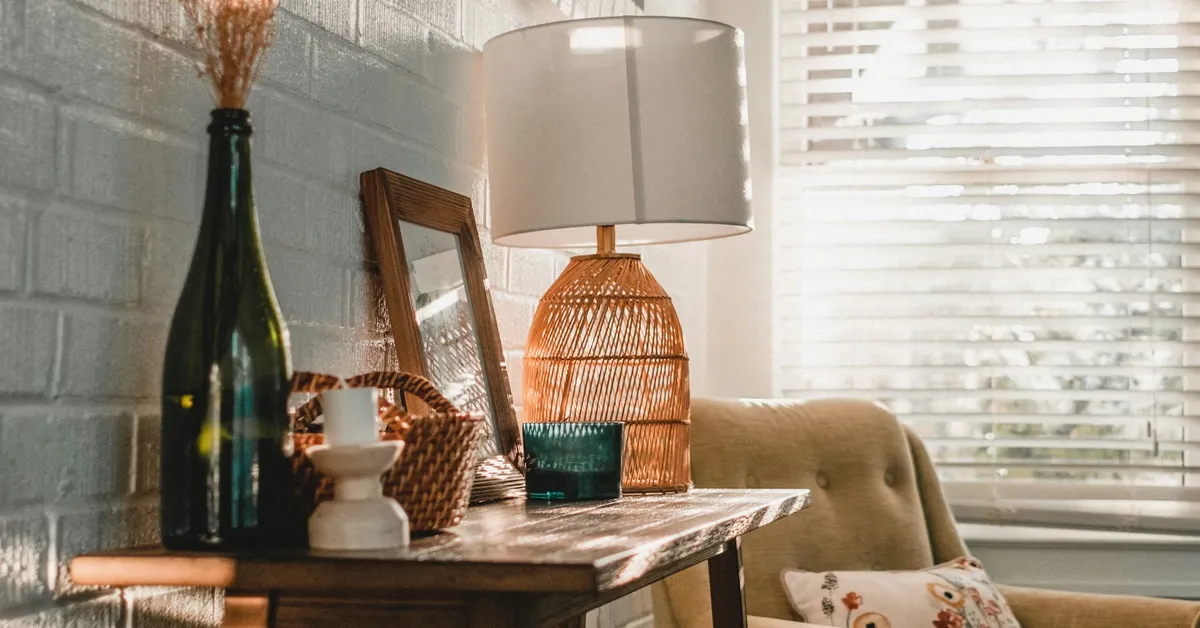
This is the one that people consistently overlook, possibly because it feels too simple. But the difference between overhead lighting and lamp lighting in the same room, at the same hour, is the difference between a waiting room and somewhere you actually want to be.
If you have lamps that aren’t being used in a bedroom, in storage, in a room where they feel redundant move them. Put them in rooms where they’re needed. Turn off the overhead lights in your living room one evening and use only lamps and candles. The room will look completely different, and you’ll wonder why you haven’t been living this way all along.
The deeper truth underneath all of this is that most homes don’t need more things. They need more attention. The objects you’ve accumulated over years of living carry history, texture, and meaning that no new purchase can replicate. The work is in learning to see them again to pick them up, move them around, and let them do what they were always capable of doing.
That’s not a decorating project. That’s a relationship with the place you live.