
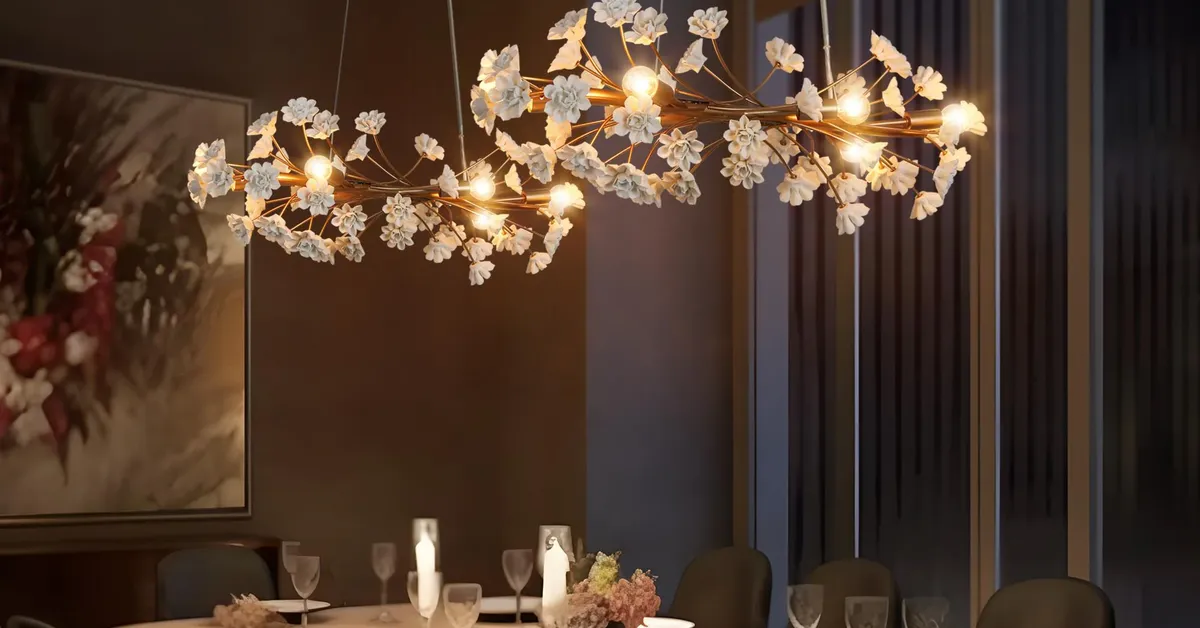
There’s a moment that happens in almost every home renovation story the moment someone walks into a newly finished dining room, looks up, and everything clicks. Not the table. Not the chairs. Not even the carefully chosen paint color on the walls. It’s the light. More specifically, it’s what’s hanging from the ceiling, casting its glow downward like a quiet declaration of intent. A chandelier, chosen well, doesn’t just illuminate a room. It defines it.
The dining room is one of the few spaces in a home that still carries genuine ritual. Meals happen here. Conversations stretch long past dessert. Birthdays are celebrated, arguments are had, and sometimes, in the best of circumstances, nothing is said at all just the comfortable silence of people who know each other well. The lighting above all of that matters more than most people realize. Too harsh, and it strips the warmth from everything. Too dim, and the room loses its sense of occasion. A statement chandelier gets that balance right while adding something else entirely: a personality.
What follows is a curated look at seven chandelier styles that genuinely transform mealtimes not through gimmick or trend-chasing, but through the kind of considered design that earns its place at the table.
The Sculptural Cluster: When Chaos Becomes Composition
Cluster chandeliers those arrangements of multiple pendants or bulbs gathered at varying heights have a way of making a dining room feel curated rather than decorated. The best versions look almost accidental, like someone gathered a handful of beautiful objects and suspended them from the ceiling. But there’s real intention behind the asymmetry.
A bronze cluster chandelier with amber glass globes, for instance, throws light in overlapping pools that shift subtly as people move around the table. Dinner under that kind of light feels less like a meal and more like an event. It’s the visual equivalent of background music that you don’t consciously notice but would immediately miss if it stopped.
These work especially well in rooms with high ceilings, where the cascading arrangement fills vertical space without overwhelming the horizontal plane. They’re also surprisingly versatile scaled down, a cluster of three or five pendants can anchor even a modest dining nook with the same sense of intentionality.
The Oversized Rattan: Bringing the Outside In
Natural materials have been having a sustained moment in interior design, and rattan chandeliers sit at the center of that movement for good reason. There’s something about woven organic texture overhead that immediately softens a space it introduces warmth without color, and visual interest without noise.
The key word here is oversized. A rattan chandelier that’s too small reads as an afterthought. One that genuinely commands the space say, 36 inches in diameter or larger over a six-seat table becomes the room’s anchor point. Light filters through the weave in patterns that shift across the ceiling and walls as the day progresses, which gives the room a quality of aliveness that fixed, opaque fixtures simply can’t replicate.
In coastal homes or spaces with a lot of linen, wood, and natural stone, an oversized rattan chandelier doesn’t compete with anything. It completes the picture.
The Vintage Candelabra: Formality Without Stiffness
There’s a persistent myth that candelabra-style chandeliers belong exclusively to formal dining rooms with dark wood paneling and oil portraits on the walls. That myth deserves retirement.
A well-chosen candelabra chandelier particularly one in an aged brass or matte black finish with exposed flame-tip bulbs brings a sense of occasion to even a casual dining space. The difference is in the styling around it. Pair a traditional candelabra form with a raw linen tablecloth, mismatched vintage chairs, and a simple ceramic centerpiece, and suddenly the formality becomes character rather than stiffness.
What candelabra chandeliers do exceptionally well is create intimacy. The multiple light sources at eye-adjacent height (rather than a single bright point overhead) wrap the table in a glow that feels genuinely candlelit. Conversation flows differently under that kind of light. People lean in. The meal slows down. That’s not nothing.
The Geometric Metal Frame: Structural Honesty
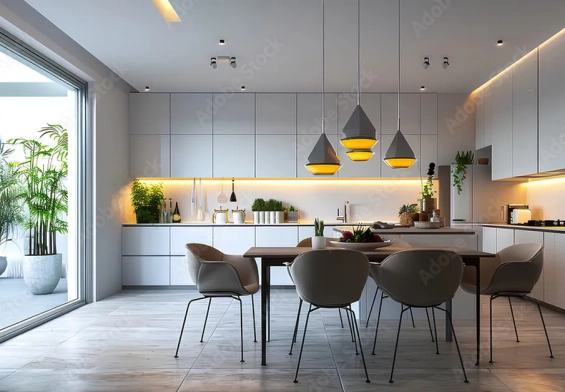
If rattan is about softness and candelabras are about warmth, geometric metal frame chandeliers are about something else entirely: clarity. These fixtures typically open-frame cubes, hexagons, or rings in brass, black iron, or brushed nickel make no attempt to hide what they are. They’re architectural objects that happen to hold light.
That transparency is their strength. In a dining room with clean lines and a modern sensibility, a geometric chandelier doesn’t interrupt the visual logic of the space it extends it. The negative space inside the frame becomes part of the design, and the light sources (usually exposed Edison bulbs or small integrated LEDs) are presented rather than concealed.
These fixtures also photograph beautifully, which matters in an era when people document meals as much as they eat them. But more practically, they age well. A black iron geometric chandelier over a dining table will look as intentional in ten years as it does the day it’s installed.
The Cascading Crystal: Unapologetic Glamour
Crystal chandeliers have been declared dated so many times that their persistence starts to feel like a statement in itself. And perhaps it is. There’s a certain confidence required to hang a cascading crystal chandelier in a contemporary home a willingness to commit to beauty for beauty’s sake, without hedging toward minimalism.
The contemporary crystal chandelier has evolved considerably from its Victorian predecessors. Modern versions often feature irregular crystal arrangements, matte metal frames, or asymmetrical silhouettes that bring the drama without the museum-piece quality. Hung low over a dining table closer than most people dare a crystal chandelier creates a kind of enclosure, a sense that the table is its own world.
The light behavior is unmatched. Crystals scatter and refract in ways that no other material does, covering walls and ceilings in shifting prismatic patterns that change with every movement, every candle lit on the table below. A meal under that light doesn’t feel ordinary. That’s the point.
The Linen Drum Shade: Quiet Confidence
Not every statement is made loudly. The linen drum shade chandelier makes its argument through restraint and in the right room, that restraint is more powerful than any crystal or sculptural cluster could be.
A wide drum shade in natural linen, perhaps 24 to 30 inches in diameter, hung at the right height over a dining table, creates a pool of warm, diffused light that feels almost domestic in the best sense of the word. It says: this is a place where people are comfortable. Where the food matters more than the performance of eating it.
These fixtures work particularly well in farmhouse-adjacent spaces, Scandinavian-influenced interiors, or any room where the design philosophy leans toward considered simplicity. They’re also one of the more forgiving chandelier styles the soft shade conceals the bulb type, allows for easy dimming, and doesn’t compete with art, wallpaper, or a statement piece of furniture elsewhere in the room.
The confidence comes from knowing that you don’t need to shout to be heard.
The Artisan Blown Glass: Light as Object
There’s a category of chandelier that exists somewhere between furniture and sculpture pieces where the glass itself is the point, and the light inside is almost secondary. Artisan blown glass chandeliers occupy that space, and they bring something to a dining room that no mass-produced fixture can replicate: singularity.
Murano-style glass, hand-blown borosilicate, or studio-crafted organic forms in amber, smoke, or sea glass tones create a visual centerpiece that rewards sustained attention. The imperfections the slight variations in thickness, the bubbles caught in the glass, the color shifts where the blowing process changed pace are precisely what make them interesting. You notice something new every time you sit beneath one.
These chandeliers tend to work best in rooms that are otherwise relatively quiet. They need space to be seen. But in the right context, a single artisan blown glass chandelier above a dining table does something that most lighting can’t: it makes the room feel inhabited by someone with genuine taste, not just good purchasing instincts.
That distinction between taste and acquisition is ultimately what separates a statement chandelier from a decorative accessory. The seven styles here each make that argument differently. Some through drama, some through restraint, some through material honesty or sheer visual pleasure. But they all share the same underlying premise: that the light above a table shapes the life lived beneath it, and that choosing it well is one of the quieter acts of hospitality a home can offer.