
”
There’s a moment in almost every home renovation conversation where someone gestures broadly at the walls, the floors, maybe the trim and the ceiling just sits there, ignored, like the quiet kid in the back of the classroom who actually has all the answers. We’ve become so conditioned to think horizontally that the plane directly above our heads has been reduced to a canvas for smoke detector placement and the occasional water stain we keep meaning to address.
But here’s the thing: the ceiling is the one surface in any room that nobody ever has to share visual real estate with furniture, art, or foot traffic. It’s entirely yours. And most people leave it white.
That’s not a moral failing. It’s just a missed opportunity and a significant one.
Why the “Fifth Wall” Framing Actually Matters
The term “fifth wall” has been floating around interior design circles for years, but it’s worth pausing on why the language is useful beyond being a clever hook. When you call something a wall, you activate a completely different mental framework. Walls get painted. Walls get wallpapered. Walls get architectural detail, paneling, texture, color theory. The moment you stop thinking of your ceiling as a ceiling a structural necessity, a blank overhead fact and start thinking of it as a wall that happens to be horizontal, your entire approach to a room shifts.
Designers who work at the higher end of residential interiors have understood this for a long time. They’ll spend considerable time on ceiling treatments not because clients demand it, but because they know what happens to a room when the eye has nowhere interesting to travel upward. It flattens. It shrinks, paradoxically, even in rooms with generous square footage. A room without a considered ceiling is a room that stops at shoulder height.
The ceiling, treated intentionally, does something almost architectural it completes the room as a three-dimensional experience rather than a backdrop for your furniture.
Color: The Simplest Move With the Biggest Return
Paint is the obvious starting point, and it remains the highest-value, lowest-barrier intervention available. The traditional advice has always been to paint ceilings white or a shade lighter than the walls to “open up” the space. That advice isn’t wrong it’s just incomplete. It describes one effect among many, and it assumes that openness is always the goal.
Sometimes intimacy is the goal. A dining room painted with a deep, moody ceiling navy, forest green, even a rich terracotta creates an enveloping quality that makes candlelit dinners feel genuinely cinematic. The ceiling comes down visually, yes, but in a way that draws people together rather than making them feel exposed under a vast white sky.
In contrast, painting the ceiling the exact same color as the walls a technique sometimes called “color drenching” produces a cocoon-like continuity that’s become one of the more striking trends in contemporary interiors. Done in a warm greige or a dusty sage, a fully drenched room feels considered and calm in a way that white ceilings simply cannot replicate.
Then there’s the ceiling-as-accent approach: keeping walls neutral and letting the ceiling carry a single bold color. Burnt orange. Pale lavender. A dusty, unexpected pink. The ceiling becomes the element that makes people stop, look up, and feel like something deliberate happened here because it did.
Texture and Material: When Paint Isn’t Enough
Color is the entry point, but texture is where ceiling treatments start to feel genuinely architectural. Wallpaper on ceilings was once considered eccentric. Now it reads as sophisticated particularly in smaller rooms like powder rooms or home offices, where a patterned ceiling can transform a functionally awkward space into something people remember.
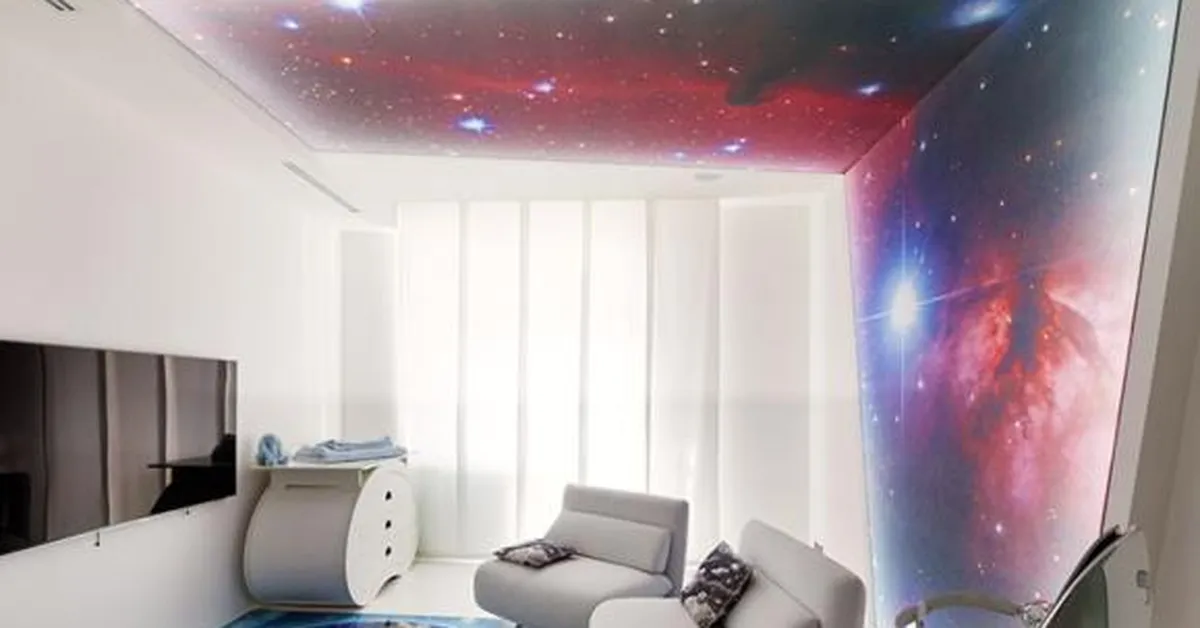
Grasscloth, linen-textured papers, bold geometric prints, even mural-style wallpapers applied overhead each creates a completely different spatial effect. A tightly patterned ceiling in a narrow hallway draws the eye upward and makes the passage feel intentional rather than incidental. A hand-painted cloud mural in a child’s bedroom is the kind of detail that becomes part of family memory. These aren’t decorating choices. They’re experiences.
Wood planking has seen a significant resurgence, particularly in spaces that lean toward organic or Scandinavian-influenced aesthetics. Shiplap ceilings, tongue-and-groove pine, reclaimed barn wood all of these introduce warmth and dimension that painted drywall simply cannot approximate. In a kitchen or sunroom, wood ceiling planks can single-handedly shift the entire room’s character from generic to genuinely distinctive.
Coffered ceilings, tray ceilings, and beamed ceilings occupy the higher end of the investment spectrum, but they also produce results that no amount of paint can replicate. A coffered ceiling adds a grid of recessed panels that give a room a sense of gravitas and craftsmanship. A tray ceiling where the center of the ceiling is raised and the perimeter steps down creates layered depth that makes even a modestly sized bedroom feel considered and complete. These are the treatments that photograph beautifully and sell houses.
Lighting as Ceiling Treatment
This is where the conversation often gets separated from the broader design discussion, and it shouldn’t be. Lighting fixtures are ceiling treatments. The decision of where to place them, what style to choose, and how many to include is as much a design decision as any paint color or wallpaper pattern.
A single, centered overhead fixture is the default. It’s also frequently the wrong choice not because centered fixtures are bad, but because the default is rarely the most interesting option. A cluster of pendants hung at varying heights. A linear chandelier that runs the length of a dining table. Recessed lighting arranged in a deliberate pattern rather than scattered by a contractor’s intuition. Cove lighting that washes the ceiling itself in soft, indirect illumination and makes the room feel like it’s glowing from within.
The relationship between the ceiling and its light sources is reciprocal. A beautifully painted or textured ceiling that’s lit with a single harsh overhead bulb loses most of its effect. Conversely, thoughtful lighting can make even a plain white ceiling feel more dynamic by controlling where shadows fall and how the room transitions from day to night.
The Practical Constraints Nobody Talks About
Ceiling height is the variable that governs everything. In a room with nine-foot or higher ceilings, almost any treatment is on the table dark colors, heavy textures, elaborate millwork. In a room with eight-foot ceilings, the calculus changes. Dark colors can feel oppressive rather than intimate. Heavy beams can make a space feel cramped rather than rustic. The goal is always to work with the room’s proportions rather than against them.
Older homes present their own specific challenges. Plaster ceilings that have developed hairline cracks over decades need remediation before any decorative treatment. Popcorn ceilings that textured acoustic finish that was ubiquitous in mid-century American construction are notoriously difficult to work with and often contain materials that require professional testing before removal. The popcorn ceiling is a whole separate conversation, but the short version is: if you’re dealing with one, get it tested, get it removed properly, and then treat the ceiling like the fifth wall it’s been waiting to become.
Starting Small, Thinking Big
The powder room is the universally recommended starting point for ceiling experimentation, and the recommendation holds up. It’s a small space, it’s a space where people are briefly captive and inclined to notice their surroundings, and the material investment is minimal. A patterned wallpaper ceiling, a deep jewel-toned paint, a small but striking light fixture in a powder room, these choices cost relatively little and deliver outsized impact.
From there, the logic tends to spread. Once you’ve experienced what a considered ceiling does to a room, the white expanse overhead in every other space starts to feel less like a neutral and more like an absence.
That’s the real shift. Not from white to color, or from flat to textured but from not seeing the ceiling at all to understanding it as an active participant in how a room feels. Every room has a floor. Every room has walls. The ones that stay with you, the ones that make you stop and feel something, almost always have a ceiling worth looking at.