
There’s a particular kind of envy that hits when you walk into a pre-war apartment or a Georgian townhouse. The ceiling medallions, the deep crown molding, the wainscoting that wraps a dining room in quiet authority. These details whisper old money, careful craftsmanship, decades of someone giving a damn. And if you live in a builder-grade box from 1994 or a rental with walls so flat they might as well be cardboard that whisper can feel like a taunt.
But here’s the thing nobody in the renovation industry wants to broadcast too loudly: a staggering number of those “original” architectural details in homes people swoon over are themselves illusions. Plaster moldings cast from molds. Faux stone painted onto flat surfaces. Trompe l’oeil panels that trick the eye into seeing depth where none exists. The history of interior architecture is, in many ways, a history of elegant fakery. Which means you have more permission than you think to play the same game.
The Psychology of Why It Works
Our brains process architectural detail in a surprisingly lazy way. We don’t measure the depth of a panel molding with our eyes. We read shadow, contrast, and pattern then fill in the rest with assumption. A painted shadow line beneath a chair rail registers as dimension. A thin strip of molding applied in a rectangular pattern on a flat door reads as a raised panel. The illusion doesn’t need to be perfect. It needs to be consistent.
This is why paint and molding work so well together as a faking strategy. Paint provides the tonal shifts that suggest depth and material variation. Molding provides just enough three-dimensional reality to anchor the illusion. Together, they can simulate stonework, coffered ceilings, elaborate trim packages, and paneled walls at a fraction of the cost and structural commitment of the real thing.
Interior designers have known this for centuries. The Italians perfected trompe l’oeil painting in the Renaissance, turning flat plaster walls into convincing colonnades and open skies. English country houses used applied moldings and strategic paint colors to make modest rooms feel grander. What we’re doing today with a miter saw and a quart of Benjamin Moore is the same impulse, just democratized.
Wainscoting and Wall Paneling Without the Millwork
Full traditional wainscoting the kind with raised panels, stiles, and rails requires a woodworker, a healthy budget, and walls plumb enough to receive it cleanly. Most walls in most homes fail that last test spectacularly.
The workaround is picture frame molding. Thin rectangular strips of molding (usually a simple profile, nothing ornate) applied directly to the wall in evenly spaced rectangular patterns. Paint everything wall and molding the same color, and the result reads as paneling. The single color unifies the surface while the molding creates shadow lines that imply depth and craftsmanship.
The key to making this convincing sits in the proportions. Panels that are too tall and narrow look like prison bars. Too short and wide, and they feel squat. A ratio somewhere around 2:3 (width to height) tends to feel classical without being fussy. Spacing between panels should be consistent, and the bottom rail the horizontal strip running along the base should align with or sit just above existing baseboards.
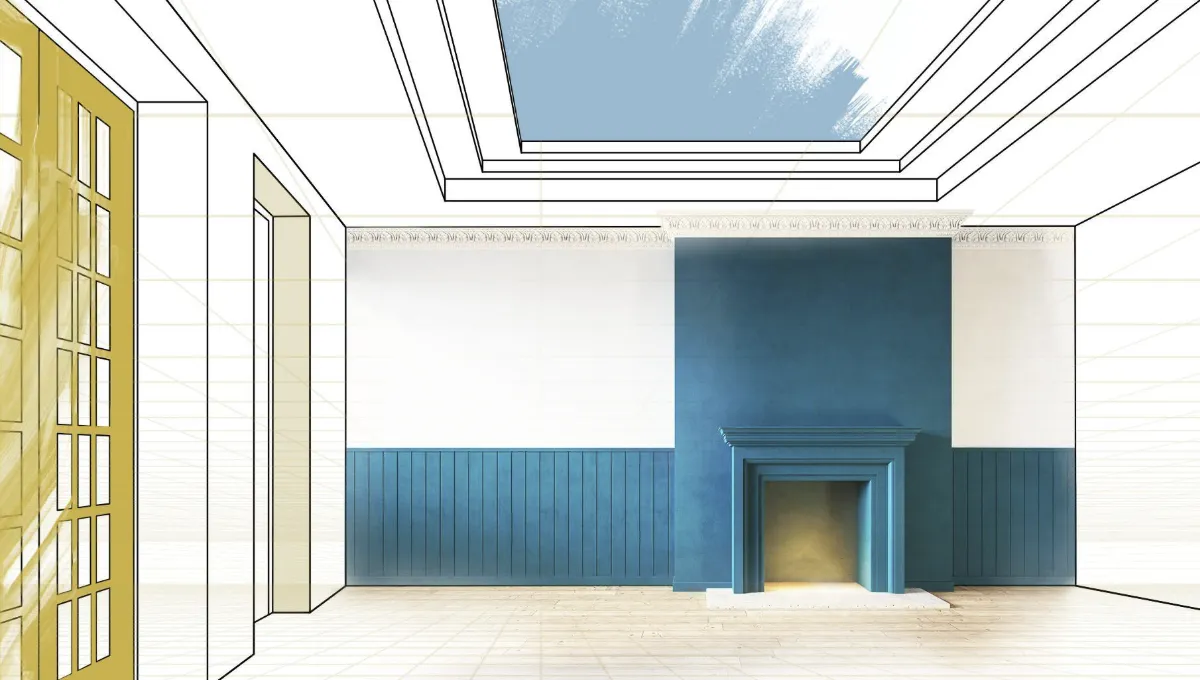
Color choice matters more than people expect. A deep, saturated hue (navy, forest green, charcoal) makes the shadow lines from the molding more dramatic, which sells the illusion harder. White or cream works too, but it leans on the molding doing all the visual labor, which means your caulking and paint finish need to be flawless.
Crown Molding and the Ceiling Trick
Crown molding is the single fastest way to make a room feel finished and intentional. But here’s where most people stop: they install a single strip of crown and call it done. The rooms that actually look expensive the ones that make you pause in the doorway almost always use built-up crown. Multiple pieces of molding layered together to create what appears to be one massive, deeply profiled trim piece.
A flat board mounted to the ceiling, a strip of cove molding beneath it, and then the crown itself mounted below that. Three cheap pieces of stock molding from any home center, combined, create a profile that looks custom-milled. Paint it all the ceiling color, and the assembly disappears into a single sculptural element.
For ceilings themselves, paint can do remarkable work. A ceiling painted even two shades darker than the walls creates the optical suggestion of a tray ceiling that recessed center panel you see in higher-end construction. Add a thin molding strip in a rectangle about twelve inches in from the walls, paint inside the rectangle one shade and outside another, and you’ve manufactured architectural dimension on a perfectly flat plane.
Faux Coffered Ceilings
Real coffered ceilings involve structural beams or at minimum deep box frames suspended from the ceiling plane. They’re heavy, expensive, and require ceiling joists that can handle the load. The faux version uses flat boards (1x4s or 1x6s) applied directly to the ceiling in a grid pattern, with a small molding tucked into the inside corners where board meets ceiling.
Painted uniformly in a semi-gloss white or a soft warm tone, the grid creates enough shadow to read as genuine cofers from eye level. Nobody is getting on a ladder to check the depth. They’re registering the pattern, the rhythm, the sense that someone invested this room. That’s all the illusion needs to accomplish.
The spacing of the grid should relate to the room’s proportions. Square cofers in a square room. Rectangular coffers in a long room, oriented to visually shorten the space. Odd numbers of divisions tend to feel more balanced than even three across rather than four, for instance.
Doors That Lie Beautifully
Hollow-core flat doors are the hallmark of budget construction, and they broadcast cheapness like nothing else in a home. Replacing them with solid panel doors runs several hundred dollars per opening once you factor in hanging and hardware. But a flat door is essentially a blank canvas.
Applied molding in a panel configuration two tall rectangles stacked, or one large rectangle over a square transforms a flat slab into something that passes for a Shaker or traditional panel door. The molding gets glued and pined on, seams get caulked, and two coats of paint unify everything. From three feet away, which is where most people experience a closed door, the result is indistinguishable from a factory panel door.
Some people take this further, adding a thin half-round molding inside the rectangles to simulate a more ornate raised-panel style. It works, though it demands more precision in your cuts and more patience in your caulking.
The Fireplace Suround That Isn’t Stone
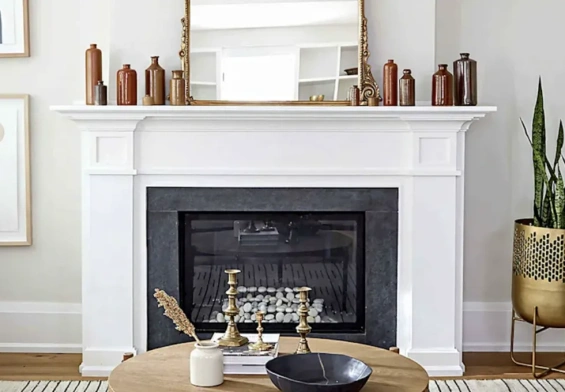
A painted wood mantel with the right proportions can command a room as effectively as marble. MDF boards, some panel molding, and a few hours of assembly can produce a suround that photographs like millwork. The secret is in the layering building out from the wall in steps so the mantel shelf has genuine depth and the legs have enough projection to cast real shadows.
But paint can push this further. Faux stone techniques layering grays and taupes with a seaponge or dry brush can make an MDF surround read as limestone from across the room. Faux brick painted onto a flat panel insert gives the firebox area texture without the weight or expense of actual masonry. These techniques require some practice and willingness to step back frequently and assess, but they’re far more forgiving than most people assume.
Exterior Tricks Worth Mentioning
The same principles apply outside. Flat garage doors gain presence with applied molding in cariage-house patterns. Smooth fiber cement siding gets visual weight from painted horizontal bands that suggest a water table or belt course. Porch columns wrapped in flat trim with a simple capital molding at the top look structural and classical, even when the actual load-bearing post inside is a plain4x4.
Paint color does heavy lifting on exteriors. A darker shade on the lower third of a house suggests a stone foundation. Contrasting trim color makes flat casing around windows appear deeper and more substantial. Shuters even purely decorative ones add shadow and rhythm to a facade that would otherwise read as a blank plane with holes punched in it.
Where the Line Sits
There’s a reasonable question buried in all of this: when does faking it cross into dishonesty? If you’re selling a house and representing applied molding as original millwork, that’s a problem. But as a design strategy for the home you’re living in? There’s no ethical line being crossed. You’re doing exactly what builders and architects have done for centuries using available materials and techniques to create beauty and visual interest within a budget.
The best faux details share one quality: they commit fully. A single strip of picture frame molding one wall looks like a half-finished project. An entire room wrapped in consistent paneling, painted with care, caulked cleanly that looks like intention. Like someone who understood what they wanted a space to feel like and made it happen.
Which, when you strip away the pretense, is all that architecture ever really was.