
There’s a particular kind of frustration that comes with a narrow bedroom. You’ve done everything right a low-profile bed frame, light-colored walls, maybe even a mirror strategically placed to bounce light around. And then you try to squeeze in a nightstand, and the whole illusion colapses. Suddenly the room feels like a hallway with a mattress in it.
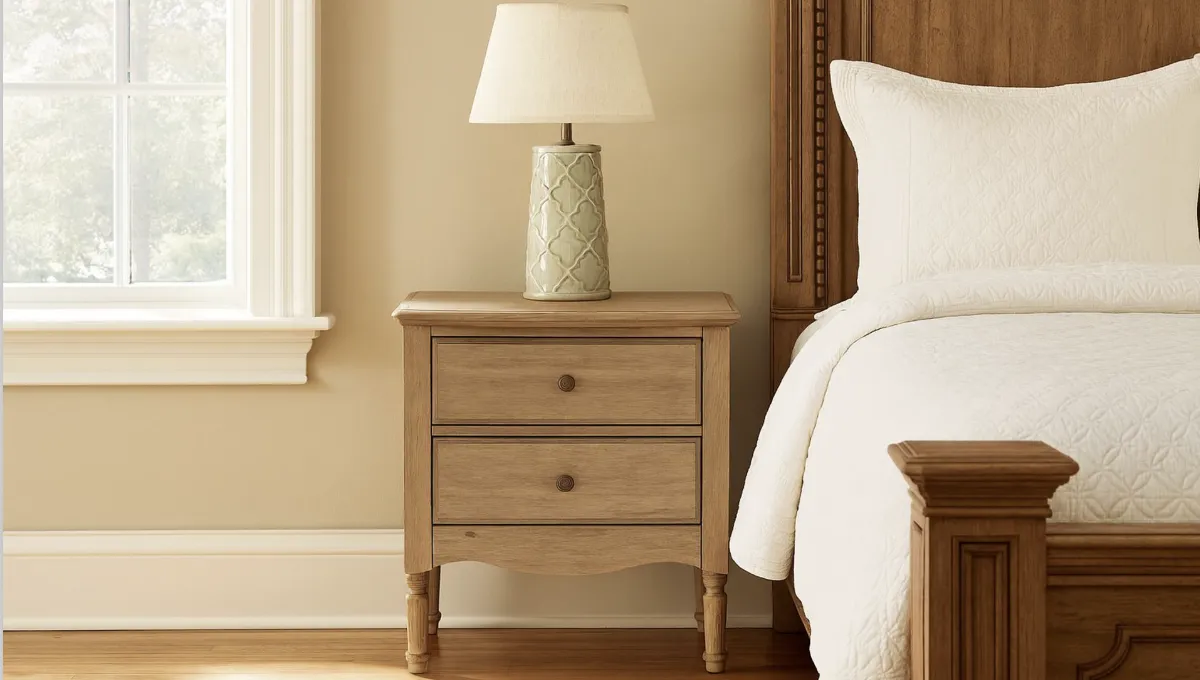
The traditional nightstand is a product of a different era, designed for homes where bedrooms were generous and furniture was expected to fill space rather than respect it. A standard two-drawer nightstand runs anywhere from 18 to 24 inches wide. In a room where you’re working with24 inches of clearance between the bed and the wall, that’s not a piece of furniture it’s a baricade.
But here’s the thing: the functions a nightstand serves are completely separable from its form. You need somewhere to put a glass of water, a phone, a book, maybe a lamp. None of those things actually require a freestanding cabinet with legs. Once you let go of the object itself and focus on what it’s supposed to do, a narrow room stops being a problem and starts being a design challenge worth solving.
Why the Nightstand Became a Problem in the First Place
Most bedroom furniture is sized for rooms that average around 12 by 12 feet or larger. Nightstands, in particular, evolved as matching companions to bed frames part of a set, sold together, designed to look proportional in a showroom where space is never the constraint. The result is furniture that works beautifully in a staged environment and awkwardly in real life, especially in older homes, urban apartments, or converted spaces where rooms were never meant to hold a king bed and two matching side tables.
Narrow rooms typically anything under 10 feet wide demand a completely different logic. The floor plan is the enemy. Every square inch of floor space you surrender to furniture is a square inch you lose to circulation, and in a tight room, losing circulation means losing the feeling of being able to breathe. The solution isn’t to find a smaller nightstand. It’s to get the furniture off the floor entirely, or to rethink what “furniture” even means in that context.
The Wall Is Your Best Friend
Wall-mounted solutions are the most obvious answer, and they work because they’re genuinely good not just as a compromise, but as a design choice that often looks more intentional than a freestanding table ever would.
A floating shelf installed at mattress height gives you a surface without consuming any floor space at all. The visual footprint is essentially zero. You can go as narrow as six inches deep if all you need is a resting spot for a phone and a candle, or push it to ten or twelve inches if you want room for a small lamp and a book lying flat. The key is mounting height too high and it feels like a shelf rather than a bedside surface; too low and you’re reaching down awkwardly every morning. Aim for the top surface to sit roughly level with the top of your mattress, accounting for any mattress topper.
Wall-mounted sconces with a small integrated shelf take this a step further. They solve the lighting problem and the surface problem simultaneously, and they do it without a single cord running to a floor outlet. Some versions include a USB port built into the base, which eliminates the phone charger cable entirely. In a narrow room, that kind of consolidation matters more than it might seem fewer cords, fewer objects, less visual noise.
For renters who can’t put holes in walls, there are tension-rod shelf systems and over-the-headboard organizers that achieve a similar effect without permanent installation. They’re not as clean-looking, but they work, and they move with you.
Think Vertical, Not Horizontal
Narrow rooms have one resource that often goes completely untapped: height. The instinct in a tight space is to keep things low and minimal, which is correct for the floor plane but mises an opportunity above it.
A tall, slim ladder shelf positioned at the head of the bed can function as a nightstand replacement with significantly more storage than a traditional table. The footprint of a ladder shelf is typically six to eight inches deep and twelve to sixteen inches wide far less than a standard nightstand but it gives you multiple tiers. Bottom rung for books, middle for a lamp or small plant, top for things you want visible but out of reach. The vertical orientation actually draws the eye upward, which creates a sense of height in the room rather than crowding.
Pegboards mounted beside the bed are another vertical option that’s underused in bedrooms. They’re more commonly associated with garages or craft rooms, but a pegboard painted to match the wall, fitted with a few hooks and small shelves, becomes a highly customizable bedside system. You can hang a small basket for your phone, a hook for headphones, a tiny shelf for a glass. It sounds utilitarian, but executed with the right materials a painted birch board, brass hooks, a linen basket it reads as considered and modern.
Furniture That Pulls Double Duty
Sometimes the floor is unavoidable, and that’s fine. The goal isn’t to eliminate furniture from the bedside entirely it’s to make sure whatever occupies that space is earning its keep in more than one way.
A small upholstered stool or ottoman at the bedside works as a surface, as extra seating when you need it, and as a footrest when you’re sitting up in bed reading. The visual weight is lower than a nightstand because there are no drawers, no hardware, no vertical mass. A round stool in particular takes up less perceived space than a rectangular table because it has no corners to catch the eye.
Stacked vintage suitcases have become something of a cliché at this point, but the underlying logic is sound: you get a surface, hidden storage inside the cases, and a piece that reads as decorative rather than functional. The trick is keeping the stack to two cases maximum and choosing cases that are genuinely flat on top a rounded lid turns a clever idea into a frustrating one every time you try to set something down.
A small wooden crate, turned on its side and mounted to the wall at the right height, gives you a cuby and a surface in one. It’s a five-minute project with a drill and two screws, and it costs almost nothing. The interior of the crate holds books or a small basket; the top holds whatever you need within arm’s reach at night.
The Lighting Question
Lighting deserves its own consideration because it’s the piece most people try to solve with a table lamp, which requires a surface, which requires a nightstand. Break that chain and the whole problem simplifies.
Clip-on reading lights that attach directly to a headboard or to the book itself are the most minimal option. They’re not glamorous, but they’re functional and they disappear when not in use. For a more designed look, a wall-mounted swing-arm lamp gives you directional light that you can position exactly where you need it, with no surface required at all. Swing-arm lamps have a long history in European bedrooms precisely because European apartments have always tended toward the compact they’re a proven solution, not a workaround.
String lights or LED strip lighting tucked behind a headboard can provide ambient light for winding down without requiring any bedside surface at all. They’re controlled by a remote or a smart plug, which means your phone can stay on the floor or in a wall-mounted holder rather than on a table you don’t have room for.
When the Floor Is the Only Option
There are situations where nothing wall-mounted or vertical will work maybe the wall beside the bed is a window, or the room layout puts the bed in a corner with no accessible wall space. In those cases, the floor is what you have, and the goal becomes minimizing the footprint as much as possible.
A C-shaped side table the kind with a base that slides under the bed frame is one of the most space-efficient floor options available. The base sits under the bed, the arm extends up and over, and the surface hovers at the right height without occupying any of the floor space beside the bed. It’s a strange-looking piece of furniture in isolation, but in a narrow room it’s almost elegant in how little it asks of the space.
A single small tray on the floor, styled intentionally with a candle, a book, and a small plant, can read as a deliberate design choice rather than a lack of options. Japanese interior aesthetics have long embraced the floor as a living surface rather than just a place to put furniture legs. A low tray arrangement beside a platform bed doesn’t look like a compromise it looks like someone who knows what they’re doing.
The narrow room forces a kind of discipline that more spacious rooms never demand. You can’t accumulate. You can’t default to the obvious solution just because it’s what everyone else uses. Every object has to justify its presence, and the ones that can’t justify it have to go. That constraint, frustrating as it is in the moment, tends to produce bedrooms that feel more intentional, more personal, and once you’ve solved the nightstand problem genuinely more restful than rooms where space was never the issue.