
Every backyard has at least one. Maybe it’s the rusting AC unit wedged against the house, the trash cans lined up like sentinels by the gate, or the utility meter that somehow ended up front and center in your otherwise decent outdoor space. These things exist because they have to but that doesn’t mean you have to look at them.
The good news is that hiding backyard eyesores doesn’t require a landscape architect or a renovation budget. It requires a little creativity, some patience with a weekend project, and the willingness to see your yard differently. Some of the most effective solutions cost under $50. A few cost nothing at all.
Start With What You’re Actually Hiding
Not all eyesores are created equal. A dead patch of lawn calls for a different fix than a hulking HVAC unit. Before you start buying lattice panels or bamboo rolls, spend ten minutes walking your yard and making a mental list. What bothers you most? What do guests see first when they step outside? What’s visible from the kitchen window?
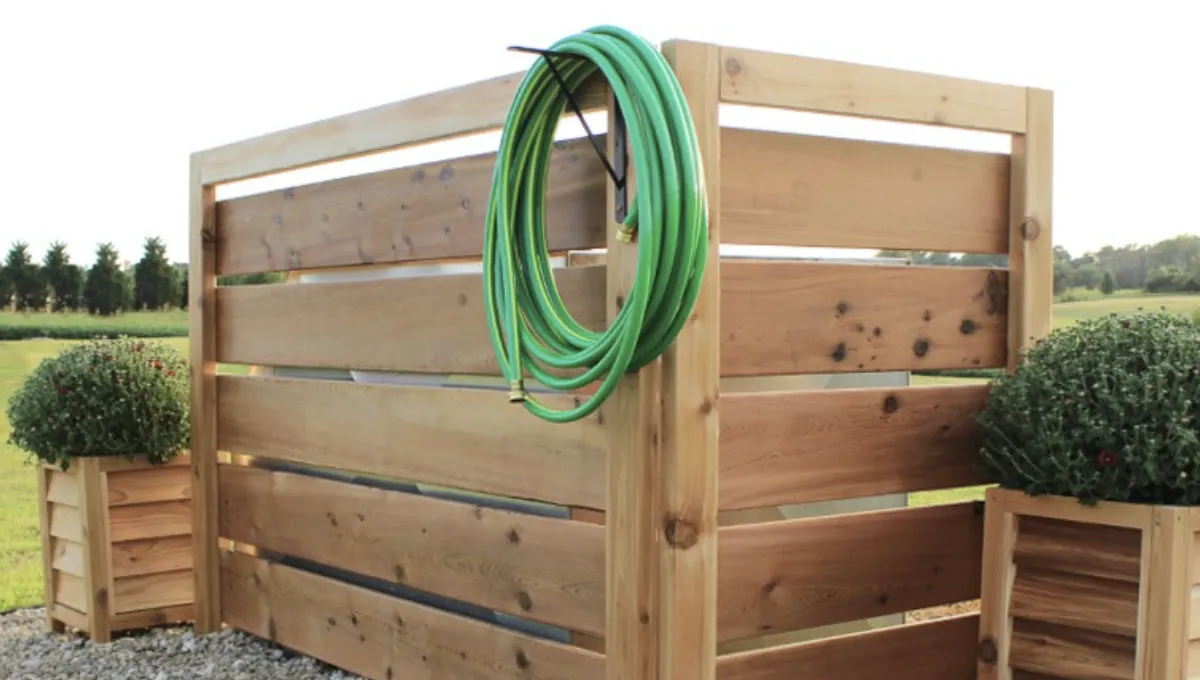
This matters because the wrong solution can make things worse. Throwing a trellis in front of something that needs airflow like an AC condenser can restrict ventilation and cause real mechanical problems down the line. Planting fast-growing shrubs near a utility box might look great for two years and then become a maintenance nightmare when the utility company needs access. The goal is concealment that works with your space, not against it.
The Lattice Panel: Ugly’s Best Enemy
If there’s one material that punches above its weight in the backyard concealment game, it’s lattice. A sheet of cedar or vinyl lattice from a home improvement store runs anywhere from $15 to $40, and with a few 2×4 posts and some basic hardware, you can build a freestanding screen in an afternoon.
The real magic happens when you add plants. Climbing vines like clematis, morning glory, or even fast-growing annual beans will weave through the lattice within a single growing season. By midsummer, what was once a screen in front of your trash cans becomes a living wall. The eyesore disappears. The screen itself disappears. What’s left is just greenery.
For renters or anyone who doesn’t want to dig post holes, there are freestanding lattice panels with weighted bases that require zero installation. They’re not as sturdy in wind, but for a sheltered corner of the yard, they do the job.
Bamboo Rolls and the Art of the Quick Fix
Bamboo fencing rolls are one of those products that feel almost too easy. You unroll them, zip-tie them to an existing fence or frame, and suddenly a chain-link fence that’s been an eyesore for years looks intentional. Rustic, even. A 6-foot by 16-foot roll typically costs between $25 and $45, and the installation takes about twenty minutes.
The catch is longevity. Bamboo weathers. In wet climates, it can start to look tired within a few years. But for the price, you can replace it when it does, and you’ll still have spent less than a single panel of custom fencing. Treating it with an outdoor sealant when you install it buys you extra time.
Bamboo works especially well for hiding the side of a shed, a compost area, or the gap between a fence and a gate where things tend to accumulate. It’s also surprisingly effective at softening the look of a concrete block wall something that’s notoriously hard to deal with cheaply.
Repurposed Pallets: The DIY Workhorse
Wooden pallets have become something of a cliché in the DIY world, but they earned that status for a reason. They’re free or nearly free, they’re structurally sound, and they can be transformed with a coat of exterior paint or stain into something that looks genuinely intentional.
A row of pallets stood upright and secured to each other with screws makes a solid privacy screen. Sand the rough edges, paint them a deep charcoal or a warm cedar tone, and they read as a design choice rather than a budget workaround. Add hooks and hang a few potted plants, and you’ve turned a screen into a vertical garden.
The key is sourcing palets marked “HT” (heat-treated) rather than “MB” (methyl bromide treated). The latter were treated with a pesticide and aren’t safe for use in spaces where you spend time. Most palets at hardware stores, garden centers, or furniture retailers are heat-treated just check the stamp before you take them home.
Redirecting the Eye: The Power of Distraction
Sometimes the best way to hide something isn’t to cover it it’s to give people something better to look at. This is a principle borrowed from interior design, and it works just as well outdoors.
A bold focal point a large ceramic planter, a birdbath, a fire pit, even a striking piece of outdoor art draws the eye away from whatever you’re trying to conceal. Position it so that it’s the first thing someone sees when they step into the yard, and the AC unit in the corner becomes background noise.
This approach works best when the eyesore is on the periphery rather than dead center. If your compost bin is tucked in the back corner, a well-placed seating area or raised garden bed in the middle of the yard will naturally pull attention forward. The bin doesn’t disappear, but it stops being the thing people notice.
Outdoor Curtains and Fabric Screens
Outdoor curtains have had a moment in recent years, and for good reason. Hung from a simple tension wire or a basic curtain rod mounted between two posts, they create an instant sense of enclosure and privacy. They’re also one of the few solutions that can be taken down and stored when you don’t need them.
For hiding eyesores specifically, a panel of outdoor fabric hung in front of a utility area or a messy storage zone works well. Look for fabrics rated for outdoor use they resist mildew and UV fading far better than repurposed indoor curtains. IKEA’s outdoor curtain panels are a popular budget option, often running under $20 per panel.
The limitation is wind. In an exposed yard, fabric screens can become a nuisance on breezy days. Weighting the bottom hem with a length of chain sewn into the fabric helps considerably, and it’s a five-minute modification that makes a real difference.
What to Do With an Ugly Shed
The shed is a special case. It’s too big to hide behind a trellis, too permanent to move, and often too structurally sound to justify replacing. But a shed that’s weathered, stained, or just aesthetically out of place can drag down the entire yard.
Paint is the obvious answer, and it’s worth taking seriously. A coat of exterior paint in a color that complements your house or deliberately contrasts it in an interesting way transforms a shed from an eyesore into an architectural element. Dark colors like forest green, navy, or charcoal tend to recede visually, making the shed feel smaller and less intrusive.
Beyond paint, consider what’s growing around the shed. A few climbing roses or a row of tall ornamental grasses planted along the base soften the transition between structure and ground. They don’t hide the shed, but they integrate it into the landscape in a way that makes it feel like it belongs there.
Window boxes are another underated move. Even simple wooden boxes mounted below a shed window and filled with trailing plants add enough visual interest to shift the shed from “problem” to “charming outbuilding.”
The Gravel and Stone Redirect
Bare dirt patches, exposed tree roots, and the dead zones that form under dense tree canopies are a different kind of eyesore not a structure to hide, but a void to fill. Grass won’t grow there. Mulch looks fine for a season and then turns gray and matted.
Gravel and decorative stone are the underappreciated solution. A layer of pea gravel or river rock over landscape fabric transforms a dead zone into a clean, intentional surface. Add a few large stepping stones and a potted plant or two, and it becomes a feature rather than a problem area.
The cost varies by region, but a cubic yard of pea gravel enough to cover roughly 100 square feet at a 3-inch depth typically runs between $30 and $60 when purchased in bulk from a landscape supply yard. That’s significantly cheaper than buying it by the bag at a garden center, and the difference in coverage is dramatic.
The Honest Truth About Cheap Solutions
There’s a version of this conversation that ends with a tidy list of hacks and a promise that your yard will look like a magazine spread for under $100. That’s not quite honest. Cheap solutions require more maintenance, more creativity, and more willingness to iterate when something doesn’t work.
A bamboo roll that looks great in June might look rough by October. A pallet screen that you painted last spring might need a touch-up by fall. The trade-off for spending less money is spending more attention checking in on what’s working, adjusting what isn’t, and treating the yard as an ongoing project rather than a problem to be solved once and forgotten.
But there’s something genuinely satisfying about that. A yard shaped with your own hands, with materials you sourced and solutions you figured out, has a character that no professionally installed landscape quite replicates. The eyesores don’t disappear forever. They just stop winning.