
There’s a particular kind of disappointment that comes with stepping out your back door and being greeted by a flat, gray concrete slab. It’s not dramatic. It doesn’t demand attention. It just sits there, utilitarian and indifferent, radiating heat in July and collecting pudles in March. Most homeowners either ignore it entirely or spend years vaguely planning to “do something with it” a plan that never quite materializes.
Here’s the thing, though. That slab is actually one of the better starting points you could ask for. It’s level It’s structurally sound. It gives you a defined footprint to work within. The problem isn’t the concrete itself it’s the failure of imagination that tends to suround it.
Transforming a concrete slab into a space you genuinely want to spend time in doesn’t require a contractor, a massive budget, or a complete demolition. It requires layering building up texture, life, shade, and personality until the concrete underneath becomes almost incidental.
Don’t Ignore the Surface Itself
Most people skip straight to furniture and plants, which is understandable. But the slab’s appearance sets the tone for everything placed on top of it, and a little investment here pays off visually in a way that’s hard to replicate with accessories alone.
Concrete stain is one of the most underated tools in outdoor renovation. Acid-based stains react chemically with the concrete to create mottled, variegated color earthy teracotas, warm tans, slate blues that looks nothing like paint and everything like natural stone. Water-based stains offer more predictable, consistent color if you want something cleaner. Either way, the process is manageable as a weekend DIY project, and the result fundamentally changes how the space reads.
If staining feels like too much commitment, concrete paint with a masonry sealer on top is a solid alternative. A warm charcoal or a soft sage can make the samelab feel intentional rather than accidental. Some people go further with stenciled patterns geometric tile designs, heringbone, even faux wood grain using concrete-specific paint and steady hand. Done well, it’s genuinely striking.
For those who want to go further without pouring new concrete, a micro-topping or overlay system can resurface the slab entirely, giving it the look of polished stone or smooth plaster. These products are applied thin, bond directly to existing concrete, and can be tinted to almost any color. The cost is higher than stain, but still a fraction of what new hardscaping would run.
Define Zones Like You Would an Interior Room
One of the reasons concrete slabs feel so dead is that they’re undifferentiated. Everything is the same height, the same texture, the same temperature. The fix is to think about the space the way an interior designer thinks about an open-plan living area: break it into zones, and give each zone a distinct identity.
An outdoorug is the single fastest way to do this. A large, weather-resistant rug under a dining table and chairs immediately creates a “room” it signals that this is a place for gathering, not just a surface for standing on. The rug softens the visual hardness of the concrete, adds color and pattern, and makes the whole arrangement feel considered rather than thrown together.
From there, furniture placement does the rest of the work. A seating area with a low coffee table and a couple of deep chairs reads as a lounge. A dining set with a market umbrella reads as an outdoor kitchen extension. If your slab is large enough, you can have both separated by a few feet of open space or a planter that acts as a visual divider.
The key is to resist the urge to push everything against the walls. Floating furniture in the center of the space, the way you would indoors, makes the area feel larger and more intentional.
Plants Are the Whole Game
No amount of furniture or lighting will make a concrete slab feel like an oasis if there’s no living material in it. Plants are what transform a patio from an outdoor room into an outdoor escape. The challenge on a concrete slab is that you’re working entirely with containers but that’s less of a limitation than it sounds.
Large containers are your best friends here. A single oversized planter something24 inches or wider filled with a small ornamental tree or a tall ornamental grass creates immediate vertical interest and a sense of enclosure. Cluster three or four of them together and you’ve built something that functions like a garden bed, with the added advantage that you can rearrange it whenever you want.
Raised planter boxes placed along the perimeter of the slab serve double duty: they add greenery and they define the edges of the space, creating a sense of boundary that makes the area feel more intimate. Cedar or redwood boxes are classic choices. Corten steel planters have a more contemporary look and develop a beautiful rust patina over time. Even simple galvanized metal troughs from a farm supply store work beautifully and cost almost nothing.
Vertical gardening is worth serious consideration on a concrete slab, especially if the surrounding space is tight. A trellis panel leaned against a fence or wall, planted with climbing jasmine or a fast-growing clematis, adds a wall of green that changes the entire atmosphere of the space. Wall-mounted pocket planters can turn a bare fence into a living surface. The vertical dimension is almost always underused in patio design, and exploiting it is one of the most effective ways to make a small slab feel lush.
Herbs deserve a mention here too. A cluster of teracotta pots with rosemary, basil, mint, and thyme near the dining area does something that purely ornamental plants can’t: it engages multiple senses. The smell of warm rosemary on a summer evening is its own kind of luxury.
Shade Changes Everything
A concrete slab in full sun is genuinely unpleasant for about six months of the year in most of the country. It absorbs heat, reflects glare, and makes the idea of sitting outside feel more like a punishment than a pleasure. Solving the shade problem isn’t optional it’s foundational.
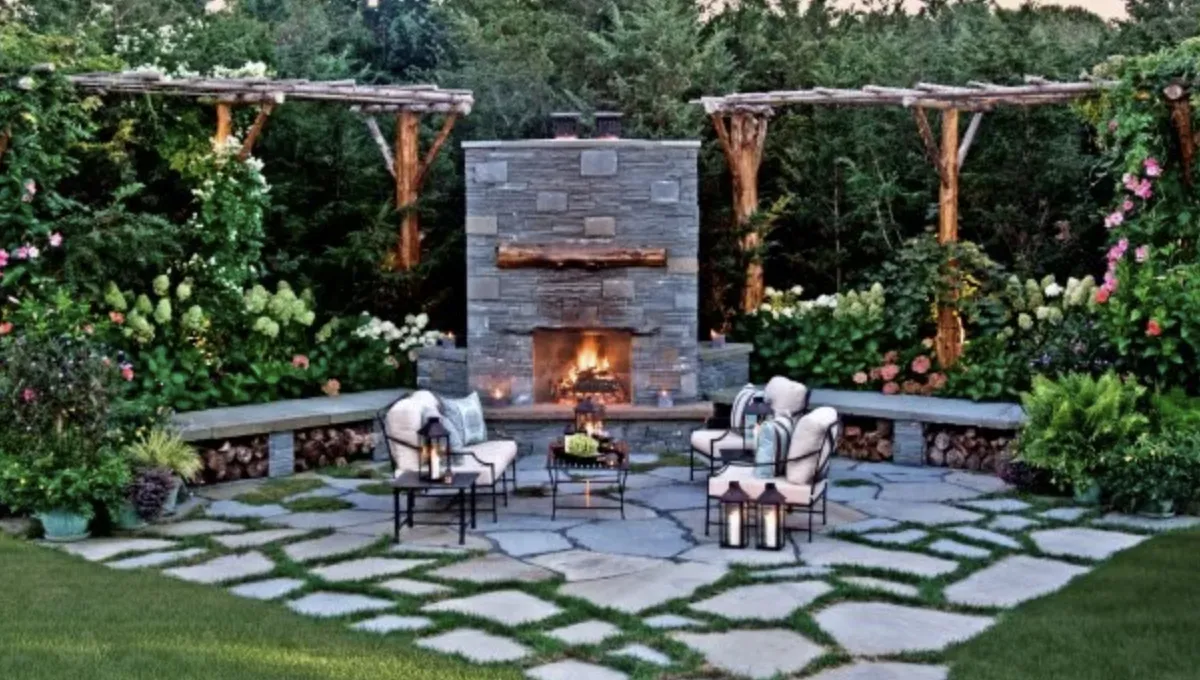
A freestanding pergola is the most architecturally satisfying solution. Even a simple kit pergola, assembled over a weekend, creates a defined overhead plane that makes the space feel like a room. Add a climbing vine wisteria, trumpet vine, or a hardy grape and within a couple of seasons you have a canopy of living material overhead. String lights woven through the rafters turn the whole thing into something magical after dark.
Shade sails are a more affordable and flexible alternative. A single large sail in a neutral linen or warm white can cover a significant area, and the asymetrical angles they create add visual interest rather than just blocking sun. They’re also easy to take down in winter, which matters in climates where the hardware would otherwise take a beating.
Market umbrellas are the most accessible option they require no installation, they’re portable, and a good one in a solid color or a classic stripe can anchor a dining area beautifully. The limitation is coverage: one umbrella covers one zone, and on a larger slab you may need two.
Water, Sound, and the Sensory Layer
This is where a patio stops being a nice outdoor space and starts feeling like an actual retreat. Water features have a way of doing something that’s hard to articulate but immediately felt: they make the outside world recede. The sound of moving water masks traffic noise, neighbor noise, the ambient hum of suburban life. It creates a kind of acoustic privacy that changes how relaxed you feel in the space.
On a concrete slab, a self-contained fountain is the practical choice no digging, no plumbing, just a reservoir, a pump, and whatever vessel you want the water to flow through. A large ceramicurn with water spilling over the rim. A stacked slate column. A simple bowl with a bubling jet. The scale should match the space: a tiny tabletop fountain gets lost on a large patio, while an oversized piece can anchor a corner and become a genuine focal point.
Wind chimes, a small outdoor speaker tucked into a planter, even the rustle of ornamental grasses in a breeze all of these contribute to the sensory texture of the space in ways that photographs can’t capture but that you feel immediately when you sit down.
Lighting as the Final Layer
The way a space looks at7 PM on a Tuesday evening in August is arguably more important than how it looks at noon on a Saturday. That’s when you’re actually out there, glass in hand, deciding whether this is a place you want to be.
String lights remain the most forgiving and effective outdoor lighting tool available. Hung between a pergola and a fence post, or draped in loose catenary curves overhead, they create warmth and enclosure that no other light source quite replicates. The key is to use bulbs with a warm color temperature 2200K to 2700K and to hang them low enough that they feel intimate rather than stadium-bright.
Uplighting plants and trees from below creates drama and depth. A simple solar spike light aimed up into a large container plant transforms it from a daytime feature into a nighttime focal point. Lanterns on a dining table, candles in hurricane glasses, a string of Edison bulbs along a fence rail the goal is layered light at multiple heights, the same principle that makes a well-designed interior feel warm and alive.
The concrete slab you started with is still there, of course. It’s just that by now, you’ve stopped noticing it.