
There’s a moment every host knows well standing in the linen aisle, or scrolling through some home décor rabbit hole at midnight, holding two very different visions of the same table. One feels collected, editorial, like something out of a slow-living magazine. The other feels warm, intentional, grounded. You’re not just picking a piece of fabric. You’re deciding what kind of gathering you want to create.
That’s the real conversation behind table runners and placemats. Not which one is “better” but which one is actually you.
They’re Solving Different Problems
People often treat this as a purely aesthetic choice, but before style enters the picture, it helps to understand what each of these things is actually doing at your table.
A table runner is a long, narrow strip of fabric or sometimes woven material, macramé, linen, even dried botanicals that runs down the center of the table. Its job is to anchor the tablescape. It creates a visual spine, a throughline that pulls the centerpiece, candles, and serving dishes into a cohesive moment. The table runner doesn’t belong to any one seat. It belongs to the table itself.
Placemats, on the other hand, are individual. Each one claims a seat, marks a person’s space, and quietly says: you belong here. They’re practical in a way runners rarely are they catch crumbs, protect the table surface, and give each diner a defined zone. Functionally, they’re closer to a personal stage than a shared backdrop.
That distinction matters more than most people realize. If your dinner parties tend to be communal big bowls in the center, wine poured freely, conversation that bounces across the whole table a runner fits that energy. If you’re someone who sets each place with care, who likes the ritual of laying out forks and folding napkins just so, placemats are doing something emotionally different. They’re an act of individual welcome.
The Aesthetic Argument (And Why It’s Complicated)
Here’s where it gets interesting. Both options have been claimed by almost every design aesthetic imaginable, which means “it depends on your style” is almost useless advice.
Minimalists love runners because they leave the table largely bare clean wood grain visible, negative space preserved. But minimalists also love placemats in neutral linen because they’re functional without being fussy. Maximalists layer both, stacking a runner down the center and placemats at each seat, building a whole composed scene. Cottagecore tables lean toward floral placemats with mismatched charm. Japandi-inspired tables might use a single raw linen runner and nothing else.
So style alone won’t settle this. What actually helps is thinking about the visual weight you want.
Runners are horizontal drama. They draw the eye lengthwise, elongate the table, and work especially well on long rectangular tables where the proportions need something to unify them. On a round table, a runner can look a little lost it doesn’t have the same anchoring effect without a strong linear geometry beneath it.
Placemats are vertical anchors. They create rhythm a repeated shape that moves around the table and gives the eye a pattern to follow. On a round table, placemats feel natural, almost inevitable. On a very long table with eight or ten seats, they can start to feel like a row of identical squares, which can read as institutional rather than intimate.
What Your Table Shape Is Quietly Telling You
If you’ve never thought about your table’s geometry as a design partner, this is the moment. The shape of your table isn’t just a spatial fact it’s an aesthetic instruction.
Long farmhouse table? A runner was practically invented for this. It echoes the table’s own elongated logic, and it gives you a natural home for a centerpiece arrangement without making the table feel cluttered. Add candles at intervals, a few stems of eucalyptus trailing off the edge, and the runner becomes the whole story.
Round pedestal table? Placemats win here, almost every time. They follow the curve of the table’s edge, they define each seat without fighting the shape, and they leave the center open for whatever you want a single vase, a candle cluster, a fruit bowl that doubles as décor.
Square table for four? This is genuinely the most flexible scenario. A small square runner can bisect the table beautifully. Two placemats on opposite sides can create a diner-for-two energy even when four people are seated. Or you go full placemat, four corners, clean and considered.
The Occasion Changes Everything
There’s also a temporal dimension to this that rarely gets discussed. What works for a Tuesday dinner doesn’t necessarily work for Thanksgiving. What sets the right tone for a casual brunch might feel completely wrong for a dinner party where you actually ironed your shirt.
Runners tend to skew formal or at least, intentional. Even a casual linen runner signals that someone thought about the table. That’s not a bad thing, but it does carry a certain expectation. Guests notice. They sit up a little straighter. The meal feels like an occasion.
Placemats are more democratic. They can be casual rattan for a summer lunch, or crisp white cotton for a holiday dinner. They transition between registers more easily because they’re already a familiar object people know what a placemat means, and it doesn’t carry the same weight of ceremony.
This is worth thinking about if you host a wide variety of gatherings. A set of versatile placemats might carry you through more scenarios than a runner that only really works when the table is fully set. But if most of your entertaining tends toward the deliberate and atmospheric, a runner might be the piece that makes every table feel finished.
The Layering Option Nobody Talks About Enough
Let’s address the obvious third path: use both.
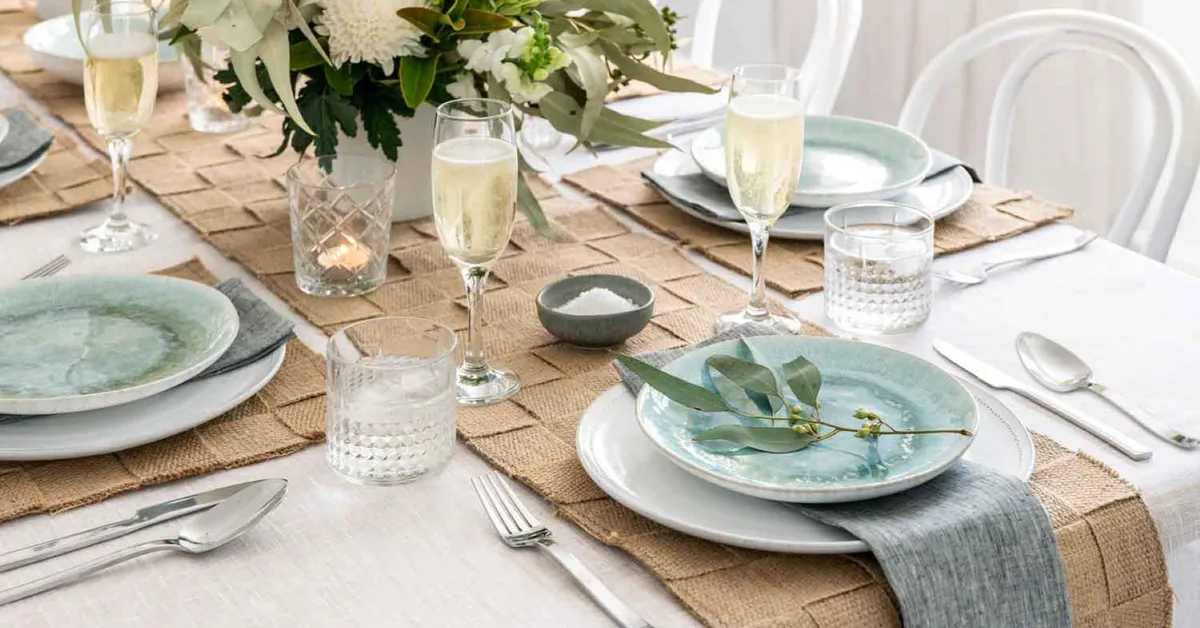
This isn’t a cop-out answer. Layering a runner over placemats is a genuinely beautiful technique when it’s done with intention. The key is contrast not just in color, but in texture and scale. A chunky jute runner over smooth linen placemats. A narrow velvet runner over wide woven placemats. The runner claims the center; the placemats claim the seats. Neither competes because they’re operating in different zones.
Where this goes wrong is when the two elements are too similar same material, same weight, same color family and the table just looks busy without looking layered. The goal is visual conversation, not visual noise.
If you’re going to try this, start with the placemat as your base and let the runner be the accent. Not the other way around. The runner should feel like punctuation, not the whole sentence.
The Part That Actually Matters Most
All of this the geometry, the occasion, the layering logic is useful. But there’s something underneath all of it that’s worth naming.
The table you set is a reflection of how you want people to feel when they sit down. Some hosts want their guests to feel like they’ve walked into a curated experience a table that says, I thought about this, I wanted it to be beautiful for you. A runner does that. It signals intention. It makes the ordinary feel elevated.
Other hosts want their guests to feel claimed, personal, seen. A placemat at your seat says: this spot is yours. I put it here for you specifically. That’s a different kind of care, quieter maybe, but no less real.
Neither impulse is more sophisticated than the other. They’re just different ways of saying the same thing that you wanted the people at your table to feel something when they sat down.
The runner or the placemat is just the language you chose to say it in.