
The Rule Nobody Questions
Walk into almost any home and you’ll find the same thing on the dining room walls: art hung at what designers call “eye level,” which in practice means somewhere between 57 and 60 inches from the floor to the center of the piece. It’s the gallery standard. Museums do it. Interior design blogs repeat it like scripture. And for most rooms in most contexts, it’s perfectly reasonable advice.
But the dining room is not most rooms.
There’s something quietly off about a painting positioned for a standing adult when everyone in the room is seated. You’ve probably felt it without being able to name it that slight disconnect, the way a piece of art seems to float above the experience rather than inside it. The meal is happening at one level, and the art is happening at another, and the two never really meet.
Seated Eye Level Changes Everything
When you sit down at a dining table, your eye level drops to roughly 43 to 48 inches from the floor, depending on your height and the chair. That’s a meaningful difference sometimes more than a foot lower than where your art is currently hanging. What this means, practically, is that you’re spending an entire dinner looking slightly upward at whatever is on the wall, the way you might crane your neck at a presentation screen in a conference room. It’s not uncomfortable enough to complain about. But it’s not right, either.
Lower the art so its center sits around 48 inches from the floor or even a touch below that and something shifts. The piece enters your field of vision naturally. You don’t have to seek it out. It becomes part of the room you’re actually inhabiting, not a decoration installed for some hypothetical standing guest.
This isn’t a radical idea. It’s an acknowledgment of how people actually use a dining room.
What Happens to the Room When You Get It Right
There’s a particular kind of evening that every home has hosted at least once the kind where the conversation flows, the food is good, and nobody wants to leave even after the plates are cleared. In those moments, the room itself is doing something. The lighting, the warmth, the scale of furniture, the way objects are arranged all of it contributes to a feeling that’s hard to articulate but immediately recognizable.
Art hung at the right height in a dining room is part of that equation. When a painting or print sits at seated eye level, it anchors the wall in a way that feels grounded rather than decorative. It creates a visual companion to the meal rather than a backdrop to it. Guests don’t necessarily notice the art consciously, but they feel the room as more cohesive, more considered. The space seems to hold them rather than just contain them.
That might sound like a lot to attribute to a few inches of vertical adjustment. But interior design is largely a discipline of small calibrations that accumulate into atmosphere.
The Furniture Line Argument
One practical concern people raise: if you hang art lower, won’t it look like it’s competing with the furniture? Won’t a painting feel cramped if it’s too close to the top of a sideboard or buffet?
This is a legitimate tension, and it’s worth thinking through. The general guidance is to leave six to eight inches between the top of a piece of furniture and the bottom of whatever is hanging above it. That gap is enough to read as intentional rather than accidental. If your sideboard is tall say, 36 inches and you’re hanging a piece with its center at 48 inches, the math usually works out fine, especially if the artwork itself isn’t enormous.
For dining rooms without furniture against the wall, the calculation is simpler. You’re free to position the art purely based on the seated viewer, without negotiating around a credenza or console. In those cases, going lower is even easier to justify, and the effect is often more immediate.
The real mistake isn’t hanging art too low. It’s hanging art too high and then never questioning it because that’s simply what everyone does.
Scale, Proportion, and the Forgotten Ceiling
Here’s where it gets more nuanced. Lowering your art doesn’t mean ignoring the room’s vertical proportions. A dining room with nine-foot ceilings and modest-sized art hung at 48 inches can start to feel bottom-heavy if you’re not thoughtful about what else is happening in the space. The wall above the art becomes a large expanse of nothing.
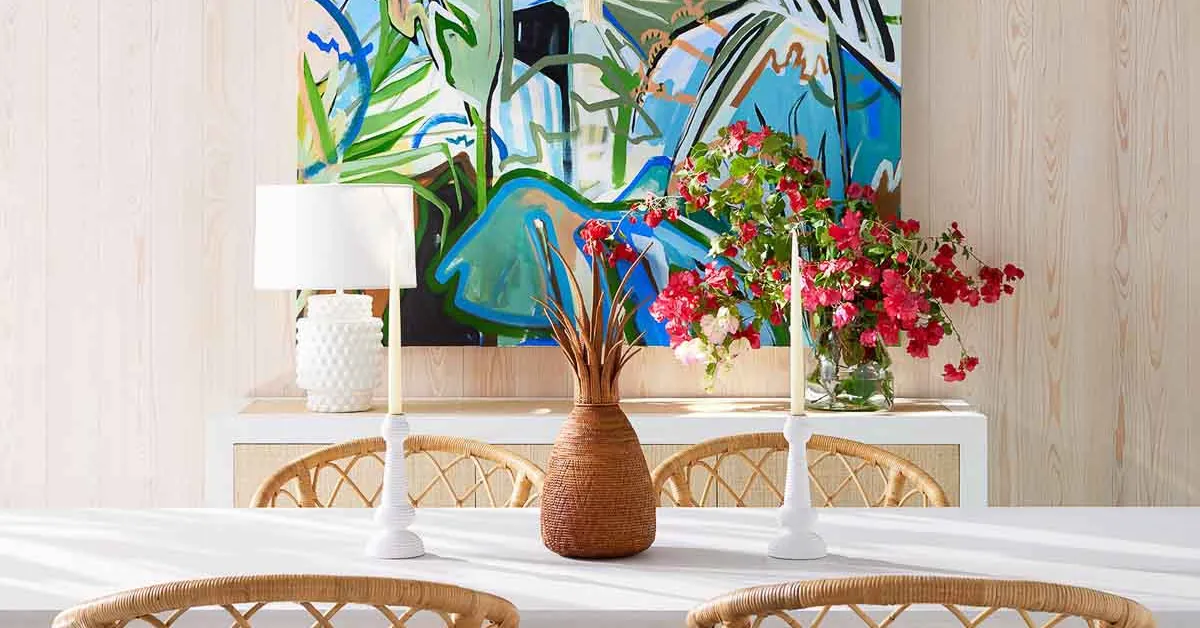
There are a few ways to work with this. One is to choose artwork that has enough visual presence to hold its own something with strong color, a bold composition, or enough scale that it doesn’t disappear. Another is to pair lower-hung pieces with something higher on the same wall: a mirror, a wall sconce, a smaller secondary piece. This creates a vertical dialogue that uses the full height of the room without abandoning the seated viewer.
Some designers solve this by grouping multiple pieces at a lower hang height, creating a gallery-style cluster that collectively commands the wall. Done well, this approach can feel both intimate and intentional like the wall was curated for the people sitting in front of it, which is exactly what it was.
A Different Way of Thinking About Art in Functional Spaces
The deeper issue here isn’t really about inches. It’s about the difference between decorating a room and designing an experience.
When art is hung according to abstract rules gallery standard, eye level for a standing adult, whatever looks right in an empty room it’s being treated as an object to be displayed. When it’s hung in response to how people actually inhabit a space, it becomes something else. It becomes part of the life of the room.
Dining rooms are among the most human spaces in a home. They’re where families negotiate the day, where friends linger over wine, where the ordinary rituals of eating together happen. The art on those walls should be part of that world, not hovering above it like a caption to a photograph.
There’s something almost philosophical about this. The gallery model of art display assumes a viewer who is mobile, upright, moving through space. The dining room inverts that. The viewer is still. The room comes to them. And the art, if it’s placed well, meets them where they are.
Try It Before You Commit
If you’re skeptical, there’s an easy experiment. Cut a piece of paper or cardboard to the size of your artwork and tape it to the wall at the height you’re considering. Sit down at your dining table. Eat something, or at least pretend to. Look at the wall the way you actually look at it during a meal not with focused attention, but with the peripheral, ambient awareness that defines how we experience a room we’re comfortable in.
Then move the paper up to the standard height and do the same thing.
The difference is usually obvious. And once you see it, you can’t unsee it which is true of most things worth noticing.