
The Room That Felt Wrong
You’ve walked into a space and felt it before that vague, unsettling sense that something is off. The furniture is fine. The layout makes sense. But the room feels heavy, closed-in, almost hostile. Nine times out of ten, the culprit isn’t the couch or the paint color. It’s the light. More specifically, it’s the absence of it in the right places.
Most people treat lighting as an afterthought. You move into a home, you flip on the overhead fixture, and you call it done. But a single ceiling light no matter how bright doesn’t illuminate a room. It flattens it. It casts hard shadows into every corner, turns three-dimensional space into something that looks like a stage set with bad production design. The corners go dark. The shelves disappear. The room shrinks.
This is the quiet problem that lamps solve, and it’s a more profound design principle than most people realize.
Light Is Not Uniform, and Neither Are We
Here’s something lighting designers understand that the rest of us tend to overlook: light has layers. There’s ambient light, the general wash of illumination that lets you navigate a space. There’s task light, focused and purposeful, aimed at a desk or a reading chair. And there’s accent light, the kind that grazes a bookshelf or pools softly on a side table, creating warmth and visual interest.
A single overhead fixture gives you ambient light and nothing else. It’s the lighting equivalent of eating plain rice every meal technically sufficient, completely joyless.
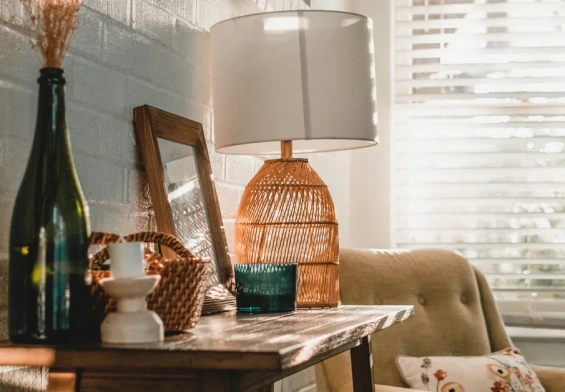
Lamps introduce the other layers. A floor lamp tucked behind an armchair creates a halo of warm light that makes the entire seating area feel intentional, inhabited. A small table lamp on a console in the hallway transforms what could be a dead transitional space into something that feels like it belongs to someone. These aren’t decorative flourishes. They’re functional decisions that change how a space reads, how it feels to be inside it, and more than you might expect how you feel while you’re there.
The Corner Problem Nobody Talks About
Corners are the most neglected real estate in any room. Architecturally, they’re inevitable. Aesthetically, they’re a challenge. Left dark, they create a visual boundary that makes a room feel smaller than its actual square footage. The eye travels to the edge of the light and stops. The room ends there, psychologically, even if the walls continue.
Put a lamp in that corner a tall arc floor lamp, a slim torchiere, even a modest table lamp on a low stool and something remarkable happens. The eye follows the light into the space. The corner becomes part of the room instead of the edge of it. The walls seem to push outward. The whole volume of the space becomes legible in a way it simply wasn’t before.
Interior designers call this “activating the corners,” and it’s one of the lowest-cost, highest-impact changes you can make to a room. You don’t need to repaint. You don’t need new furniture. You need a lamp and an outlet, and suddenly a space that felt cramped starts to breathe.
Warmth Is a Technical Specification
There’s a reason hotel lobbies feel so welcoming and fluorescent-lit offices feel so draining. It isn’t just the decor. It’s the color temperature of the light.
Light is measured in Kelvins. Cool, blue-white light the kind that mimics daylight or a cloudy sky runs above 5000K. It’s stimulating, clinical, and useful for tasks that require precision. Warm light, the amber-toned glow you associate with candlelight or an old incandescent bulb, runs between 2700K and 3000K. It’s the range where human beings instinctively relax.
Most overhead fixtures in residential spaces use bulbs that skew cooler than they should. Lamps, by contrast, are almost always designed for warm-toned bulbs. They sit closer to eye level. They cast light downward and outward rather than straight down. All of this combines to produce something that overhead lighting structurally cannot: the feeling of warmth as a physical, sensory experience.
When you light a room with multiple lamps instead of a single ceiling fixture, you’re not just redistributing lumens. You’re changing the emotional register of the space entirely.
The Psychology of Layered Light
There’s research behind this, though you probably don’t need a study to confirm what your body already knows. Bright, uniform overhead lighting is associated with alertness and productivity which is exactly why it’s used in hospitals, offices, and interrogation rooms. It signals that this is a space for doing, for vigilance, for staying switched on.
Low, layered, warm light signals the opposite. It tells your nervous system that you’re somewhere safe. Somewhere that doesn’t require your full defensive attention. Somewhere you can actually rest.
This is why restaurants that want you to linger use candlelight and table lamps. Why hotel rooms feel more luxurious when they’re lit with bedside lamps rather than overhead fluorescents. Why your grandmother’s living room, with its collection of mismatched table lamps and their amber shades, felt like the most comfortable place in the world when you were eight years old. She wasn’t making an aesthetic choice. She was, whether she knew it or not, engineering a feeling.
Practical Without Being Prescriptive
None of this requires a design degree or a significant budget. A lamp from a thrift store with a fresh shade and the right bulb can transform a corner just as effectively as something from a high-end lighting boutique. The principles are simple enough to apply immediately.
Think about where the dark spots are in your most-used rooms. Not just the corners, but the spaces between furniture, the walls that the ceiling light doesn’t reach, the reading nook that always feels slightly gloomy. Each of those spots is an opportunity. A lamp there isn’t a luxury it’s a correction.
Consider the height variation too. A mix of floor lamps and table lamps at different elevations creates a visual rhythm that makes a room feel considered and alive. One lamp at floor level, one at seated eye level, and one slightly higher creates a layered effect that no single light source can replicate.
And think about control. Lamps on dimmers, or simply on separate switches from your overhead fixture, give you the ability to tune the room’s mood in real time. Bright and clear for a dinner party. Dim and warm for a quiet evening. The same room, entirely different experiences, controlled entirely by which lamps you turn on and how high you set them.
What the Shadows Are Actually Telling You
A dark corner isn’t just an aesthetic problem. It’s information. It’s the room telling you that something hasn’t been attended to, that the space hasn’t been fully claimed or considered. Lighting those corners is, in a small but genuine way, an act of care for the space, and for the people who inhabit it.
There’s something almost philosophical in it, if you’re willing to follow the thought. We spend enormous energy on the lit, central parts of our lives the main events, the focal points, the things that are already visible. The corners get ignored precisely because they’re easy to ignore. They’re peripheral. They’re not demanding attention.
But rooms that feel truly alive, truly comfortable, truly like somewhere a person actually lives rather than merely exists those rooms have no neglected corners. Every edge has been considered. Every shadow has been answered with a small, warm point of light.
That’s not interior design. That’s a philosophy about what it means to fully inhabit a space. And it starts, simply and practically, with plugging in a lamp.