
There’s a particular kind of frustration that comes with a beautiful room that never quite feels right. The light is too harsh by noon, too exposed by evening, and the sheer panels you hung in a hopeful moment do almost nothing when the neighbor’s porch light clicks on at dusk. Windows are the lungs of a home they breathe in daylight and air but left unaddressed, they’re also the most vulnerable points in any room’s sense of sanctuary.
Choosing the right window treatment isn’t just an aesthetic decision. It’s a negotiation between competing needs: the warmth of natural light versus the comfort of privacy, the openess of a view versus the intimacy of a closed-off space. Getting that balance right requires understanding what’s actually available, how different materials behave across different times of day, and which solutions are genuinely worth the investment.
The Spectrum from Sheer to Blackout
Most people think about window treatments in binary terms either you can see in or you can’t. The reality is far more nuanced. Fabric opacity exists on a continuous scale, and where you land on that scale should be driven by the specific function of each room and the direction its windows face.
Sheer fabrics filter light beautifully, softening harsh afternoon sun into something diffused and warm. They offer almost no privacy during daylight hours, but at night, with interior lights on, they become nearly transparent from the outside. Light-filtering shades sit in the middle ground they reduce glare and UV exposure while maintaining a sense of brightness, and they provide reasonable daytime privacy without blocking the view entirely. Room-darkening treatments block most light but allow soft glow around the edges. True blackout options, typically achieved through a combination of dense fabric and side channels or cassette headrails, eliminate virtually all light penetration.
The mistake most homeowners make is applying one category uniformly across the house. A bedroom facing east needs something fundamentally different from a living room facing north. A bathroom window six feet off the ground has different privacy requirements than a ground-floor window facing a busy sidewalk.
Cellular Shades: The Workhorse Nobody Talks About Enough
If there’s one category of window treatment that consistently outperforms its reputation, it’s cellular shades also called honeycomb shades. The name comes from their cross-section: a series of air pockets formed by folded fabric that trap air and create a thermal barrier between the glass and the room.
What makes them genuinely compelling isn’t just the insulation value, though that’s real and measurable. It’s the combination of clean aesthetics, precise light control, and the availability of top-down/bottom-up configurations. That last feature is quietly transformative. A top-down/bottom-up shade can be lowered from the top to let in light from above while keeping the lower portion of the window covered giving you sky and treetops without exposing the interior to street-level sightlines. For urban apartments or homes on busy streets, this is one of the most practical privacy solutions available.
Single-cell shades are lighter and less expensive; double-cell and triple-cell constructions offer progressively better insulation. For rooms where temperature regulation matters a sun-drenched home office, a bedroom above a garage the upgrade to double-cell is usually worth it.
Roman Shades: Where Softness Meets Structure
Roman shades occupy a different aesthetic register entirely. When raised, they stack into neat horizontal folds; when lowered, they present a flat, tailored panel of fabric. That simplicity is deceptive the range of fabrics available means a Roman shade can read as casual linen in a kitchen, as formal silk in a dining room, or as graphic and modern in a home office.
The privacy and light control performance of a Roman shade depends almost entirely on the fabric chosen. A loosely woven linen will filter light gently but offer minimal privacy. A lined Roman shade particularly one with a blackout lining sewn behind the face fabric can achieve near-total darkness while still presenting a beautiful textile to the room.
One consideration worth raising: Roman shades are typically flat against the window when lowered, which means they don’t address light gaps at the sides the way a shade mounted inside a deep window recess might. For maximum light blocking, pairing a Roman shade with side drapery panels or choosing an outside-mount installation that extends well beyond the window frame will close those gaps.
Plantation Shutters: The Long Game
Plantation shutters are the most permanent solution on this list, and that permanence is both their greatest strength and the reason some people hesitate. Installed correctly, they become part of the architecture of a room they don’t date the way fabric treatments can, they require almost no maintenance, and they offer a level of light and privacy control that’s genuinely granular.
The louvers those horizontal slats can be tilted to direct light upward toward the ceiling, downward toward the floor, or closed completely. A room with plantation shutters can go from bright andiry to dim and private in seconds, without touching a cord or remote. The split-tilt feature available on most quality shutters allows the top and bottom sections of each panel to operate independently, which mirrors the functionality of a top-down/bottom-up shade.
The investment is real. Plantation shutters cost significantly more than most fabric alternatives, and they’re not easily moved if you relocate. But for homeowners who plan to stay, they add measurable resale value and eliminate the recurring cost of replacing fabric treatments every several years.
The Case for Layering
Single-treatment solutions work in some rooms. In others, layering is the only way to achieve the full range of functionality a space actually needs.
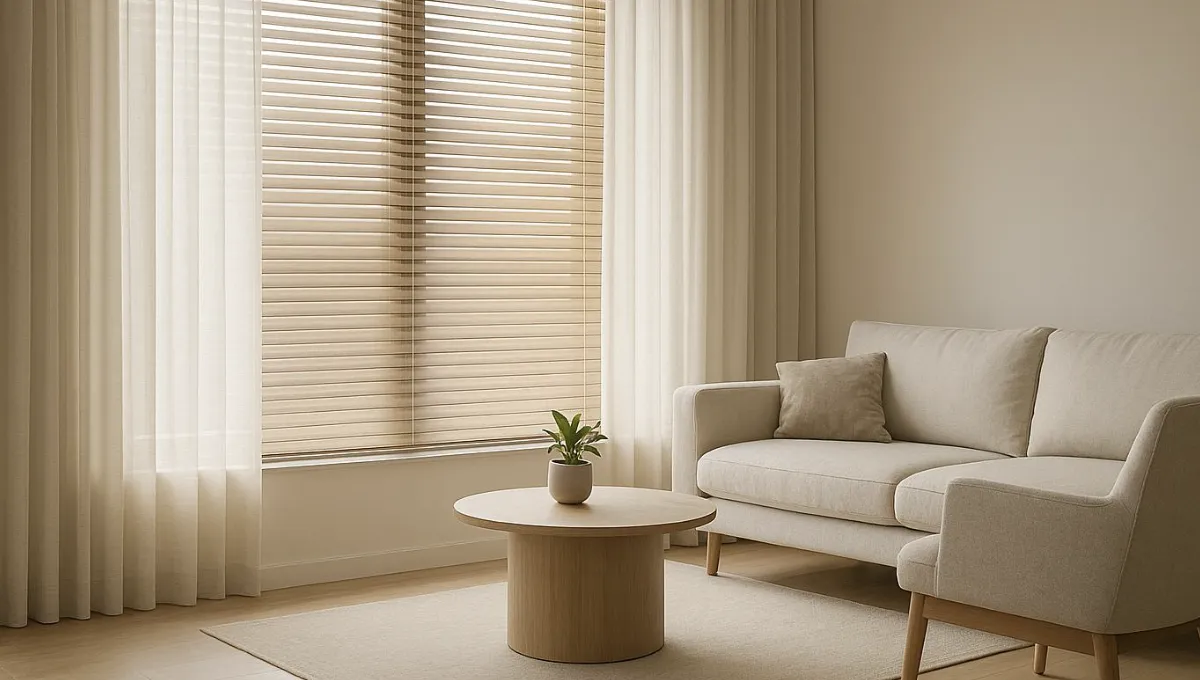
The classic layered approach pairs a functional shade cellular, roller, or Roman with decorative side panels. The shade handles the actual work of light control and privacy; the panels add softness, frame the window, and allow the room to feel finished even when the shade is fully raised. This combination is particularly effective in living rooms and bedrooms, where the aesthetic stakes are higher and the functional demands shift throughout the day.
A more sophisticated version of this approach uses sheer roller shades paired with blackout roller shades on a dual bracket system. During the day, the sheer shade filters light and maintains privacy without darkening the room. At night, the blackout shade rolls down over it, creating complete privacy and darkness. This dual-shade system has become increasingly popular in bedrooms and media rooms precisely because it handles the full spectrum of conditions without requiring any additional hardware or wall space.
Room-by-Room Thinking
Bedrooms are the most demanding environment for window treatments. Sleep quality is directly affected by light exposure, and the circadian disruption caused by early morning light particularly in east-facing rooms is well documented. For bedrooms, blackout performance should be the baseline requirement, not an upgrade. Cellular blackout shades with side channels, or plantation shutters paired with blackout drapery, are the most reliable options.
Bathrooms present a different challenge: privacy is non-negotiable, but ventilation and moisture resistance matter too. Faux wood blinds and composite shutters handle humidity far better than real wood or fabric. Frosted window film is worth considering for fixed windows that don’t need to open it provides permanent privacy without any hardware at all.
Kitchens and dining rooms tend to benefit from lighter treatments that don’t compete visually with the activity of the space. Woven wood shades made from bamboo, jute, or reds filter light warmly and add texture without heaviness. They’re not blackout solutions, but in rooms where privacy is less critical and ambiance matters more, they strike a genuinely appealing balance.
Home offices deserve more attention than they typically get. Glare on screens is a productivity killer, and the direction a monitor faces relative to the windows determines everything. Roller shades in a solar fabric a tightly woven mesh that reduces glare while preserving the outward view are often the most functional choice for a workspace. They cut the harshest light without making the room feel closed off.
Motorization and Smart Integration
Motorized window treatments have moved well past the luxury category. The price gap between manual and motorized has narrowed considerably, and the practical benefits are significant enough that for hard-to-reach windows skylights, high transoms, windows above staircases motorization isn’t a convenience, it’s a necessity.
Beyond accessibility, smart integration allows window treatments to respond to conditions rather than requiring manual adjustment. Shades that lower automatically when direct sun hits a particular window, or that adjust based on time of day, reduce both glare and heat gain without any conscious effort. For homeowners who’ve invested in a smart home ecosystem, most major shade manufacturers now offer compatibility with platforms like Apple HomeKit, Google Home, and Amazon Alexa.
Battery-operated motors have improved dramatically and are now reliable enough for everyday use. Hardwired systems remain the most dependable option for whole-home installations, but the installation complexity is real and typically requires an electrician.
What Actually Matters When You’re Choosing
The window treatment industry is full of beautiful options that perform poorly and functional options that look institutional. The best choices tend to be the ones that don’t force a compromise between the two.
Before committing to anything, spend a few days observing how light actually moves through each room where the sun hits in morning, where glare appears in the afternoon, which windows feel exposed at night. That observation will tell you more than any product specification. A treatment that looks perfect in a showroom can feel completely wrong in a room with a different orientation, a different ceiling height, or a different relationship to neighboring buildings.
The window is the one element in a room that connects interior life to the outside world. How you frame it how much you reveal, how much you hold back shapes the entire character of the space. That’s worth getting right.