
There’s a particular kind of frustration that comes with a dining room that never quite looks right. You’ve cleaned the table. You’ve organized the sideboard. You’ve even lit a candle and stepped back to admire the space and yet something still feels off. Crowded. Unresolved. Like a sentence that trails off without landing anywhere.
Most people blame themselves. They assume they own too much stuff, or that they lack some innate design sensibility that other people were simply born with. But the real reason dining rooms look cluttered has almost nothing to do with how much you own. It has everything to do with how the room has been asked to function and the quiet, creeping identity crisis that most dining rooms are quietly suffering through.
The Dining Room That Forgot What It Was For
Think about what a dining room is supposed to be. At its core, it’s a room built around a single ritual: the shared meal. Everything in that space the table, the chairs, the lighting overhead should serve that one moment of gathering. The problem is that modern life has slowly colonized the dining room with other purposes, and the room has accepted all of them without protest.
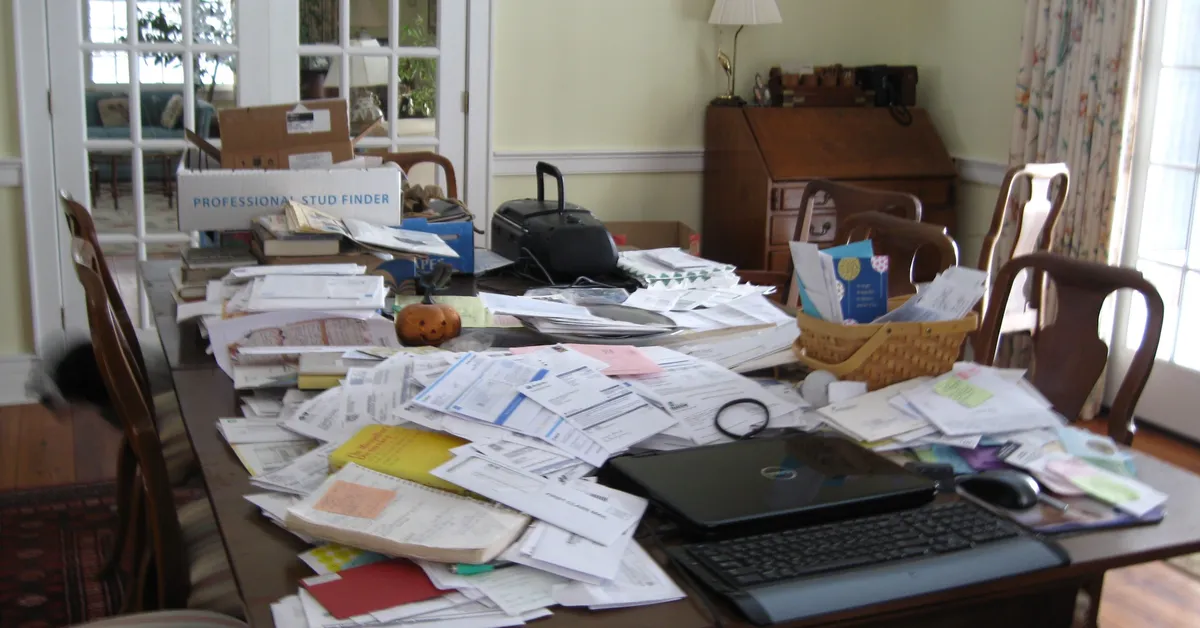
Homework gets done at the dining table. Packages get dropped on the chairs. Mail accumulates at one end of the table like sediment. A laptop lives there semi-permanently. The good china sits in a cabinet that hasn’t been opened since someone’s birthday two years ago. And none of this feels like clutter in the moment, because each individual item has a reason to be there. But collectively, they send the room into a kind of visual chaos a space that’s trying to be a home office, a storage unit, a library, and a dining room all at once.
When a room loses its singular identity, the eye has nowhere to rest. That’s the real source of the clutter feeling. Not the objects themselves, but the fact that they represent competing stories about what the room is supposed to be.
The Table Is Not a Surface. It’s a Signal.
Here’s something that interior designers understand intuitively but rarely explain plainly: the dining table is the most psychologically loaded piece of furniture in the home. It’s not just a flat surface. It’s a signal to everyone who enters the room about how that space is meant to be used.
When a table is clear, or styled with intention a simple centerpiece, a set of candles, a bowl of fruit it communicates that this is a room for gathering. It invites people to sit down, to stay, to be present. When a table is covered in random objects, it sends the opposite message. It says: this is a dumping ground. And once a room starts reading as a dumping ground, every new object that enters it looks like clutter, even things that would look perfectly fine somewhere else.
This is why tidying the table alone doesn’t always solve the problem. If the underlying signal of the room hasn’t changed if it still reads as a multi-purpose catch-all the clutter feeling persists even after you’ve cleared the surface. You’re treating the symptom without addressing the cause.
What Clutter Actually Is (And What It Isn’t)
There’s a useful distinction that gets lost in most decluttering conversations. Clutter isn’t the same as fullness. A dining room can be full of objects and still feel calm, intentional, even beautiful. A dining room can have very few objects and still feel cluttered. The difference isn’t quantity. It’s coherence.
Clutter is what happens when objects don’t have a clear relationship to each other or to the room they’re in. A stack of books on the dining table looks cluttered not because books are inherently messy, but because books belong to a different story than the one the dining room is trying to tell. Move those same books to a reading nook or a shelf in the living room, and they stop reading as clutter entirely. They become part of the narrative of that space.
This is why the advice to “just get rid of stuff” is so often unsatisfying. The problem isn’t always the stuff. It’s the placement and the lack of a clear, enforced identity for the room that would make the right placement obvious.
The Lighting Problem Nobody Talks About
There’s another layer to this that most people never consider: lighting. Dining rooms are almost universally under-lit in ways that make clutter worse, not better.
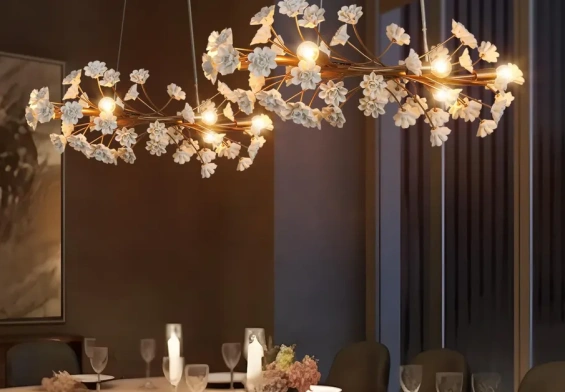
The typical dining room has a single overhead fixture a chandelier or pendant centered over the table. That fixture is usually too bright or too dim, and it casts a kind of flat, indiscriminate light that illuminates everything equally. Clutter thrives under flat light. When everything is equally visible, the eye has to process all of it at once, and the brain reads that as visual noise.
Good dining room lighting is layered. The overhead fixture should be on a dimmer, set low enough to create atmosphere rather than interrogation. A sideboard with a lamp or two adds warmth and depth. Candles, when used, don’t just add ambiance they actually direct the eye, pulling focus toward the table and away from the peripheral chaos that might be lurking at the edges of the room.
Lighting, in other words, is an editing tool. It decides what you see and what you don’t. Most dining rooms have never been given that editorial control, and they suffer for it.
The Sideboard Situation
If the table is the heart of the dining room, the sideboard is where most of the room’s clutter problems actually live. Sideboards are designed for storage and display, which sounds helpful but in practice, they become the room’s junk drawer at eye level.
The issue is that sideboards invite accumulation. They’re flat, they’re accessible, and they have just enough surface area to become a landing zone for everything that doesn’t have a better home. A vase here, a stack of placemats there, a random candle, a pile of napkins still in their packaging, a decorative object someone gave you that you’re not sure you like but feel guilty about hiding.
The sideboard becomes cluttered not because you have too many things, but because you haven’t made a decision about what the sideboard is for. Is it for display? Then treat it like a shelf in a gallery curated, intentional, with breathing room between objects. Is it for storage? Then store things inside it, not on top of it. The surface should either be styled or clear. The in-between state where it’s neither a display nor a clean surface is where clutter is born.
Why We Keep Recreating the Same Problem
There’s a psychological dimension to all of this that’s worth sitting with. Dining rooms get cluttered not because people are lazy or careless, but because the dining room is the room in the house that’s most often treated as temporary. The living room gets decorated. The bedroom gets personalized. But the dining room? It’s often the last room to receive real attention, the space that gets furnished and then largely forgotten.
We treat it as a backdrop to meals rather than a room with its own character. And when a room doesn’t have a strong identity, it becomes a magnet for everything that doesn’t fit anywhere else. It absorbs the overflow of the house. It becomes the room of last resort.
The clutter you see in your dining room isn’t really about the dining room at all. It’s a map of every decision that got deferred, every object that didn’t have a clear home, every moment when the path of least resistance was to set something down on the table and deal with it later.
Later, of course, never quite comes. And so the room waits full of other people’s stories, other rooms’ overflow, other moments’ unfinished business quietly wondering when someone will finally decide what it’s actually for.