
Why Your Room Feels Off (And Why You Keep Blaming the Paint)
You’ve rearranged the furniture three times. You’ve tried two different throw pillow combinations. You even repainted the accent wall, which your partner warned against, and you did it anyway, and it didn’t help. The room still feels wrong slightly off in a way you can’t name, like a sentence with a word missing. Most people in this situation blame the color palette or the furniture style. Very few think to look down.
The rug is doing more structural work than almost any other element in a room, and most of us are sizing it wrong. Not a little wrong. Dramatically, fundamentally wrong in ways that quietly undermine everything else we’ve tried to get right. And at the center of that mistake is one specific relationship that decorators have quietly been obsessing over for decades: the ratio between the rug and the dining table sitting on top of it.
This isn’t esoteric design theory. It’s closer to basic geometry, except the consequences of ignoring it aren’t a failed exam they’re a dining room that makes guests feel vaguely uncomfortable without knowing why.
The Rule Nobody Taught You in IKEA
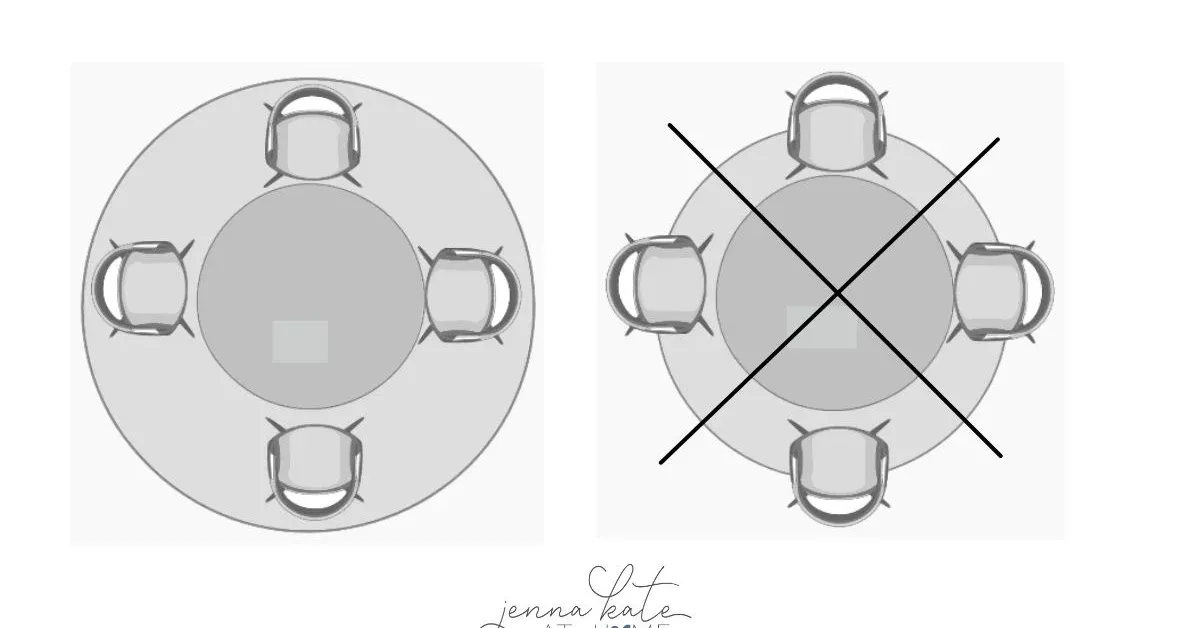
Here’s the core principle: when a rug sits beneath a dining table, every chair at that table should remain fully on the rug even when pulled out to a seated position. Not hovering at the edge. Not with the back legs dangling off into hardwood territory. Fully on.
The standard guidance puts that at roughly 24 to 30 inches of rug extending beyond each side of the table. Pull a chair back to sit down that’s about 18 inches of travel. Add the depth of the chair leg itself, and you need that buffer. The math isn’t complicated, but it requires you to measure before you buy, which is where most people skip a step.
A six-person rectangular dining table typically runs around 36 by 72 inches. Add 24 inches on each end and each side, and you’re looking at a rug that should be at least 8 by 10 feet and honestly, 9 by 12 feels more generous and usually looks better. Yet walk into any furniture showroom and you’ll find 5 by 8 rugs marketed with dining sets, positioned right underneath them, looking like a place mat that got ideas above its station.
The visual result of undersizing is something designers call “floating” and not in the good, airy, Scandinavian-minimalism sense. The furniture looks unanchored. The rug looks like an afterthought. The room reads as a collection of objects rather than a composed space.
When the Chair Scrapes Off the Edge
There’s a functional dimension here that goes beyond aesthetics, and it’s the part that genuinely irritates people once they notice it. When a chair’s back legs slide off the rug as someone sits down, you get that familiar lurch the slight drop in height, the scrape of wood against the rug’s edge, the wobble as the chair sits half-on and half-off two different surfaces. It happens at every meal. Guests politely ignore it. You notice it every single time.
A rug that’s properly sized eliminates this entirely. Chairs move smoothly. The dining experience becomes, almost imperceptibly, more comfortable not because anything dramatic changed, but because a source of low-grade friction was quietly removed. Good design often works this way. You don’t notice it when it’s right. You only feel it when it’s wrong.
There’s also the question of what happens to the rug itself. A chair repeatedly catching on the edge of a rug will curl that edge up over time, fray it, and eventually destroy it. People buy cheap rugs partly because they expect them not to last but sometimes they’re not lasting because the sizing is wrong and the wear pattern is brutal. A correctly sized rug, even a moderately priced one, will hold up significantly longer simply because it’s not being abused at its perimeter every time someone sits down to eat.
Shape Follows Function (and Table)
Round tables introduce their own logic. A round rug beneath a round table has an obvious visual elegance the concentric geometry feels intentional and calm. The sizing principle stays the same: 24 inches of clearance around the table’s edge, which means a 48-inch round table needs a rug that’s at least 8 feet in diameter. Round rugs in that size are harder to find and more expensive, which is probably why people so often pair round tables with rectangular rugs instead.
That combination isn’t wrong, exactly, but it requires more care. A rectangular rug under a round table works best when the rug is large enough that the mismatch reads as deliberate contrast rather than a sizing error. If the corners of the rug barely clear the table’s edge, it looks like you meant to buy a round rug and settled. If the rug is generously oversized and the round table sits confidently within it, the contrast can actually be striking.
Oval tables are the trickiest. They resist both round and rectangular rugs equally, and the temptation to just “eyeball it” is strong. Don’t. Measure the longest and widest points of the oval and treat it like a rectangle for sizing purposes. The rug won’t be oval-shaped, and that’s fine the table’s silhouette provides the softness, and the rug provides the grounding.
The Room-to-Rug Ratio Nobody Mentions
Here’s where it gets more interesting, because the table-to-rug ratio doesn’t exist in isolation. The rug also has a relationship with the room itself, and getting one right while ignoring the other is still a losing game.
The general principle for room-scale rugs is that they should leave a border of bare floor visible around the room’s perimeter typically 12 to 18 inches in smaller rooms, up to 24 inches in larger ones. This border acts as a visual frame. Too little border and the rug fights the walls; too much and the rug looks like it shrank in the wash.
In a dining room, these two constraints the table clearance and the room border need to be solved simultaneously. That’s the actual math lesson. You’re not just picking a rug size that works with the table. You’re finding the size that works with the table and the room at the same time, which sometimes means the “correct” rug is a size you wouldn’t have intuitively chosen.
This is why designers measure rooms before they do anything else. And it’s why the advice “just get an 8 by 10” is both commonly given and frequently wrong. An 8 by 10 might be perfect in one dining room and look like a bath mat in another.
The Confidence Problem
Part of why people consistently undersize rugs is psychological. A large rug on the showroom floor looks enormous. It feels like a commitment, a statement, something that will dominate the room. Then it goes home and the room swallows it, and you’re back to wondering what’s wrong with the space.
Rugs almost always look smaller in a room than they do in a store. The store is staging them against nothing; your room has furniture, walls, windows, and competing visual weight. What felt bold in the showroom becomes invisible at home. This is why experienced decorators consistently push clients to go one size larger than their instinct suggests not to be extravagant, but to counteract a perceptual bias that’s nearly universal.
There’s also a cost hesitation that’s worth naming directly. Larger rugs cost more. A 9 by 12 can run significantly more than an 8 by 10, and the jump from a 5 by 8 to something appropriately sized for a dining room can feel steep. But consider the math from the other direction: a rug that’s wrong for the space doesn’t actually save you money, because you’ll either live with a room that never quite works, or you’ll eventually replace it anyway. The cheaper rug, bought twice, isn’t cheaper.
What Proportion Actually Does to a Room
Proportion is the underlying concept that ties all of this together, and it’s worth sitting with for a moment. When the ratio between the rug and the table is right, something settles in a room. The dining area feels like a defined zone within the larger space a destination, not just a place where furniture happens to be clustered. The rug creates a boundary that the eye reads as intentional, and that sense of intention is what separates a room that feels designed from one that just feels furnished.
It’s the difference between a room that makes you want to linger and one that makes you vaguely ready to leave. And the strange thing is, most people who feel that difference can’t articulate what’s causing it. They’ll compliment the light, or the color, or the art on the wall. They won’t look down.
But you will now.