
The Promise That Rarely Delivers
Walk into almost any new apartment building, open a real estate listing from the last fifteen years, or flip through an architectural digest, and you’ll encounter the same breathless language: “open-concept living,” “seamless flow,” “light-filled spaces.” The open-plan layout where the kitchen bleeds into the dining area, which melts into the living room has been sold to us as the pinnacle of modern domesticity. Airy. Social. Effortless.
And yet, sit down to eat in one of these spaces and something feels off. The meal is fine. The food is good. But the experience of eating there carries a subtle unease, a faint emotional flatness that’s hard to name but impossible to ignore. You’re not quite relaxed. The conversation doesn’t quite settle. Something about the room resists the intimacy that a shared meal is supposed to create.
This isn’t a matter of taste or personal quirk. It’s architecture doing something to your nervous system that you weren’t warned about.
Boundaries Are Not Barriers They’re Belonging
Human beings have a deeply wired relationship with enclosure. Evolutionary psychologists point to what’s called the “prospect and refuge” theory the idea that we feel safest, and most at ease, when we can see outward (prospect) while also having our backs protected (refuge). A cave mouth. A corner booth. A dining room with walls on three sides and a window facing the yard.
Open-plan eating areas, by definition, dissolve the refuge. You’re exposed on multiple sides. There’s no clear boundary that says: this is the eating place, and everything outside it is somewhere else. The spatial ambiguity isn’t liberating it’s quietly destabilizing. Your brain never fully receives the signal that it’s okay to settle in.
This is why restaurants that want you to linger invest heavily in booth seating, low ceilings, warm lighting, and defined alcoves. They understand something that residential open-plan design often ignores: containment is comfort. The sense of being held by a space not trapped, but held is what allows people to exhale and actually be present with each other.
Acoustics and the Invisible Architecture of Mood
Sound does more to shape the emotional character of a space than most people consciously realize. In a traditional dining room four walls, a door that closes, maybe curtains and a rug sound behaves. Conversation stays at the table. The room absorbs and softens noise. There’s an acoustic intimacy that encourages people to speak at a natural register, to lean in, to listen.
Open-plan spaces are acoustic disasters dressed up as design triumphs. Without walls to contain sound, voices scatter. The ambient noise from the kitchen the hum of the refrigerator, the exhaust fan, the clatter of dishes being set aside bleeds directly into the eating area with nothing to interrupt it. People unconsciously raise their voices to compensate, which raises the overall noise floor, which makes everyone raise their voices further. It’s a cycle that creates the same sensory fatigue you feel after a long afternoon in a busy café.
There’s also the matter of echo. Hard floors, high ceilings, and minimal soft furnishings all hallmarks of the open-plan aesthetic bounce sound rather than absorb it. The result is a room that feels louder and more chaotic than its occupant count would suggest. Meals become slightly effortful. Listening becomes work. And when listening becomes work, connection suffers.
The Kitchen Is Watching You
Here’s something nobody puts in the real estate brochure: in an open-plan layout, the cook is never really off duty. In a traditional arrangement, the person preparing the meal disappears into the kitchen, does the work, and emerges. There’s a theatrical quality to it a reveal. The table is set, the food arrives, and the meal has a beginning.
In an open kitchen that faces the dining area, the sightlines never close. Dirty prep surfaces, used cutting boards, the pile of dishes accumulating in the sink all of it remains visible throughout the meal. For the person who cooked, there’s a particular psychological weight to eating while looking directly at the mess you still have to clean. The meal doesn’t feel finished. The work hasn’t receded. You’re eating in the middle of your labor, not at the end of it.
And for guests, the open kitchen subtly shifts the social dynamic. The host’s effort is continuously visible, which can create a low-level guilt or self-consciousness that interrupts the ease of being a guest. There’s something to be said for the magic of not knowing exactly how much work went into what you’re eating it lets you receive the hospitality more fully.
Scale and the Problem of Borrowed Space
Open-plan living areas tend to be large. That’s the point. The removal of interior walls creates a single expansive room that reads as generous and impressive particularly in photographs. But a dining table placed inside a large, undivided space doesn’t feel like it belongs to a dining room. It feels like furniture that has been placed in a warehouse.
Scale matters enormously to how we experience eating together. A table that fills most of a small room creates a sense of occasion, of intention. The same table floating in the middle of a vast open floor plan looks provisional, like it could be moved at any moment. That visual impermanence communicates itself emotionally. You’re eating in a space that doesn’t quite claim you as its purpose.
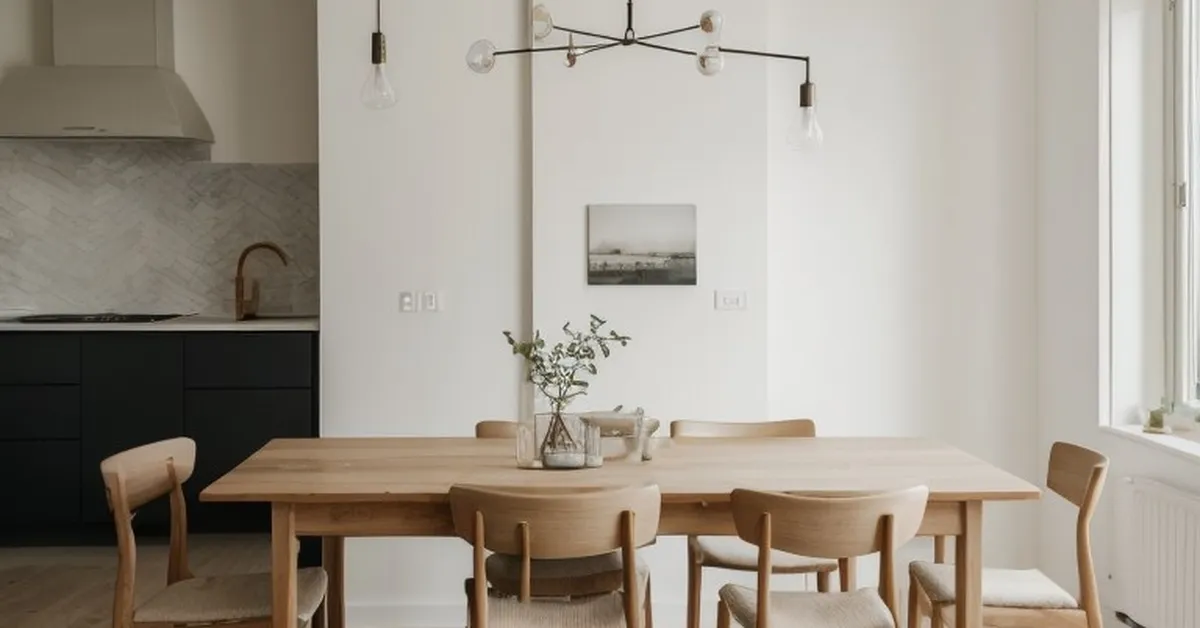
This is why so many people who live in open-plan apartments unconsciously try to create zones a rug under the dining table, pendant lights hung low over it, a shelving unit positioned nearby. They’re attempting to rebuild the walls that were taken away, to give the eating area the sense of enclosure and definition that the architecture refused to provide. Sometimes it works, partially. But it’s always a workaround for a design that started from the wrong premise.
What We Actually Want When We Sit Down to Eat
A meal is one of the few daily rituals that still asks us to stop. To sit. To be in one place with other people and do nothing else for a while. That’s increasingly rare, and increasingly precious. The spaces where we eat should support that should make stopping feel natural, should signal to the body that this moment is different from the rest of the day.
Open-plan design, for all its visual appeal, tends to work against this. The space doesn’t change register when you move from the kitchen to the table. The visual field remains the same. The acoustic environment remains the same. There’s no threshold to cross, no sense of arrival. You’re just in a different part of the same undifferentiated room.
The coldness people feel in these spaces isn’t imaginary, and it isn’t simply a matter of décor. It comes from the absence of the quiet architectural cues that tell us we’ve entered somewhere worth being somewhere that expects us to slow down, to pay attention to each other, to stay a little longer than we planned. Those cues used to be built into the walls themselves. When the walls came down, something went with them that no amount of pendant lighting or Scandinavian furniture has quite managed to replace.