
There’s a particular kind of dinner party that stays with you not because of the food, not because of the conversation, but because something felt subtly off the entire evening. You couldn’t name it at the time. The wine was good. The host was warm. But by nine o’clock, people were shifting in their seats, checking their phones, finding reasons to migrate toward the kitchen. Nobody said anything. Nobody had to.
Chances are, the culprit was overhead.
Lighting is one of those design elements that operates almost entirely below the level of conscious awareness. We don’t walk into a room and think “this illumination is psychologically destabilizing.” We just feel vaguely tense, or strangely exposed, or oddly flat and we attribute it to something else. A bad mood. Too much work this week. The awkward seating arrangement. But researchers who study environmental psychology have documented for decades what interior designers have known intuitively: the quality of light in a space fundamentally shapes how safe, how seen, and how socially connected we feel inside it.
The dining room is where this plays out most consequentially, because it’s the room designed around a single, loaded human ritual. Eating together is vulnerable. It involves proximity, eye contact, the lowering of a certain kind of guard. The lighting either supports that vulnerability or it punishes it.
The Overhead Light Problem Nobody Talks About
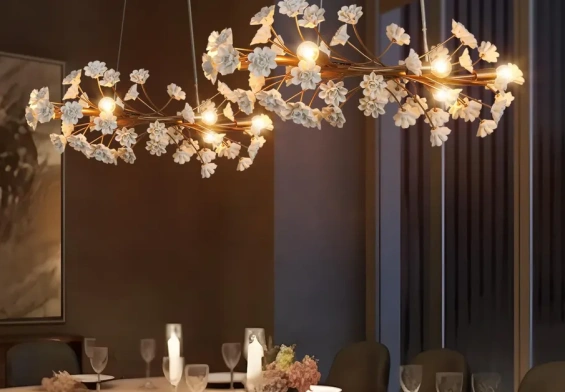
Most dining rooms in American homes rely on a single ceiling fixture usually a chandelier or flush mount positioned directly above the table. This seems logical. The table is where the action is. Light it from above. Done.
Except that’s not how flattering, comfortable light works for human faces, and it’s not how we’ve historically lit the spaces where we gather to eat.
Downward-facing overhead light creates what photographers call “top-down shadows.” The forehead catches the light. The eyes fall into shadow. The area under the nose and chin darkens. It’s the same principle behind why holding a flashlight under your face looks sinister you’re reversing the direction of natural light, which almost always comes from the side or at an angle, not from directly above. When every face at your dinner table is subtly shadowed in this way, something registers as wrong, even if nobody can articulate it. Faces look harder. Expressions become harder to read. The warmth you’re trying to create with good food and good company gets quietly undermined by the physics of your fixture placement.
There’s also the matter of intensity. Many homeowners keep their dining room lights at full brightness because it feels hospitable bright equals welcoming, right? In retail environments, yes. In spaces designed to move product and signal cleanliness, high-lumen overhead light does exactly that. But a dining room isn’t a grocery store. High, flat, undimmed overhead light signals exposure rather than intimacy. It’s the light of interrogation rooms and hospital waiting areas. It removes shadow, and shadow counterintuitively is part of what makes a space feel safe and enveloping.
Color Temperature Is Doing More Than You Think
Walk into a hardware store and you’ll find light bulbs labeled with numbers like 2700K, 4000K, and 5000K. Most people ignore these entirely and buy whatever fits the socket. This is a significant mistake in a dining context.
Color temperature is measured in Kelvin and describes the warmth or coolness of the light a bulb emits. Lower numbers 2700K to 3000K produce warm, amber-toned light, the kind associated with candlelight and incandescent bulbs. Higher numbers 4000K and above produce cooler, bluish-white light, the kind associated with office environments and daylight.
Cool light is activating. It promotes alertness and focus, which is exactly why it works well in kitchens and home offices. In a dining room, it does something less useful: it makes food look less appetizing, makes skin tones appear slightly washed out or greenish, and creates an ambient energy that reads as “productive” rather than “relaxed.” Guests feel subtly like they should be doing something rather than simply being somewhere.
Warm light, by contrast, is physiologically calming. It triggers associations with fire, with dusk, with the end of the day all of the environmental cues that signal to the human nervous system that it’s time to slow down, lower defenses, and connect. This is not an accident of aesthetics. It’s a deeply embedded biological response. Restaurants figured this out long ago, which is why the places we associate with romantic dinners or long, unhurried meals are almost universally bathed in warm, low light.
If your dining room bulbs are anywhere above 3000K, you are actively working against the atmosphere you’re trying to create.
The Dimmer Switch Is Not Optional
Lighting needs to be dynamic because dinners are dynamic. The energy at the table when guests arrive slightly performative, slightly electric, everyone getting their bearings is different from the energy two hours later when the second bottle is open and someone is telling a story that keeps getting interrupted by laughter.
A fixed light level serves neither moment particularly well.
Dimmer switches allow you to modulate the room’s energy in real time, and the effect is more dramatic than most people expect. Dropping from 100% to 60% brightness doesn’t just make the room darker it changes the psychological register of the entire space. Shadows deepen. The table feels more contained, more like its own world separate from the rest of the house. Faces soften. The conversation, almost without anyone noticing, tends to drop in volume and slow in pace which usually means it gets better.
The technical installation of a dimmer is straightforward and inexpensive. The reluctance to do it is mostly psychological: it feels like a small thing, too small to matter. It matters.
What Candlelight Actually Does to a Room
Candles are not merely decorative. They are, in lighting terms, doing something structurally important that your overhead fixture cannot do: they introduce light sources at table level, which means they’re illuminating faces from below and from the side simultaneously.
This is the most flattering angle for human features. It fills in the shadows created by overhead light. It introduces a gentle flicker that the eye finds naturally engaging there’s research suggesting that the slight unpredictability of flame movement keeps us in a state of soft, pleasant attention rather than the glazed passivity that steady artificial light can produce over time. And because candlelight is warm by definition typically around 1800K to 2000K it layers beautifully with warm-toned overhead lighting to create a depth that a single source can never achieve.
The mistake people make with candles is treating them as decoration first and light source second. Three small tea lights scattered around a centerpiece aren’t doing much. Two or three substantial candles, properly placed, change the room.
Layering: The Principle Most Dining Rooms Are Missing
Professional lighting designers talk constantly about layering the idea that good lighting in any space comes from multiple sources at different heights and intensities, working together. A dining room with only one overhead fixture has no layers. It’s a single, flat plane of light, and flat light is the enemy of atmosphere.
The solution doesn’t require a renovation. A sideboard lamp adds a secondary light source at a lower height, creating visual depth and warming the periphery of the room. Wall sconces, if you have them, should be on during dinner not just for decoration, but to soften the edges of the space and prevent the table from feeling like it’s floating in darkness. Even a lit candle on the sideboard contributes to the layering effect.
The goal is to make the light feel like it’s coming from everywhere and nowhere in particular ambient, enveloping, sourceless in the best sense. When you walk into a restaurant and think “this place feels amazing,” that feeling almost always traces back to layered, warm, low-intensity light working across multiple heights.
Your dining room can do the same thing. It doesn’t require expensive fixtures or a design degree. It requires understanding that light is not just visibility it’s the invisible architecture of how your guests feel in your home, and how willing they are to stay a little longer than they planned.